By Prof. Nassir Hussein Kahin
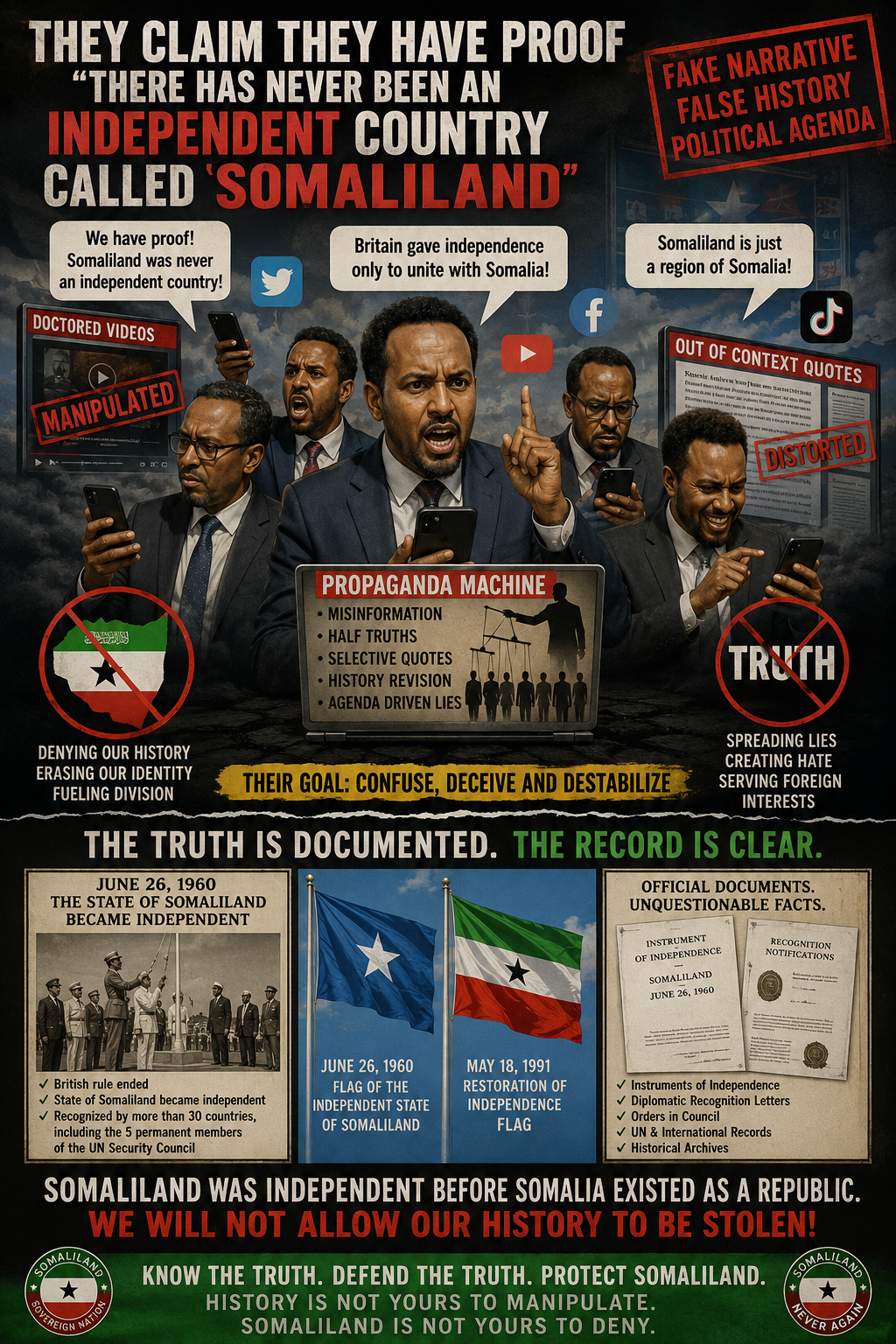
Every few months, another video, article, or social media thread appears claiming that “Somaliland was never an independent country” and that Britain granted independence only as a temporary arrangement to facilitate union with the former Italian-administered Trust Territory of Somalia.
The conclusion is always the same: because Somaliland intended to unite with Somalia, Somaliland never actually became an independent state.
This argument is historically inaccurate and legally flawed.
It also contradicts the very evidence its proponents claim to rely upon.
No serious student of Somaliland’s history denies that many Somaliland political leaders in 1960 supported the idea of Greater Somali unity. Somalilanders themselves have never denied that fact. They openly acknowledge that their leaders voluntarily pursued union with the south in the hope of creating a democratic republic founded on equality, justice, and shared nationhood.
But that is an entirely different question from whether Somaliland became independent.
The desire for union did not erase independence.
A sovereign state can decide to unite with another sovereign state. Those are two separate legal and historical events.
Indeed, the argument advanced by Somaliland’s sovereignty deniers defeats itself.
If Britain granted Somaliland Independence “so it could unite with Somalia,” then Britain first had to grant Somaliland independence.
There is simply no legal mechanism by which a territory still under British sovereignty could voluntarily unite with another territory administered separately under a United Nations Trusteeship. Britain could not legally transfer British Somaliland into another jurisdiction without first ending British sovereignty and recognizing Somaliland as an independent political entity.
That is exactly what happened.
On June 26, 1960, British rule ended. The State of Somaliland became independent. Diplomatic recognition followed from more than thirty countries, including permanent members of the United Nations Security Council. Foreign governments exchanged diplomatic messages and treated Somaliland as an independent state.
Only five days later, on July 1, 1960, the former Italian-administered UN Trust Territory also became independent. Only then did the two newly independent states voluntarily unite.
The chronology is not controversial.
The legal record is not controversial.
Only the political interpretation is.
Many sovereignty deniers attempt to confuse political intention with constitutional reality.
Yes, Somaliland’s elected leaders wanted eventual union.
No, that does not mean Somaliland never became independent.
The distinction is obvious.
A person who intends to marry next week is still legally single today.
Likewise, an independent state intending to enter a political union remains an independent state until that union actually takes effect.
Political intention is not the same as constitutional status.
Yet Somaliland’s critics repeatedly blur that distinction because acknowledging June 26, 1960 weakens the claim that Somaliland has always been merely “a region of Somalia.”
History says otherwise.
Before July 1, there was no Somali Republic.
There was the independent State of Somaliland.
There was the UN Trust Territory of Somalia.
The Somali Republic came into existence only after those two separate political entities voluntarily united.
That sequence cannot be erased by speeches, edited videos, or selective quotations.
Nor does Britain’s support for eventual union prove that Somaliland lacked independence.
Many colonial powers favored regional political arrangements during decolonization. Their political preferences did not eliminate the constitutional acts through which independence was granted.
Supporting union is not the same as denying sovereignty.
Perhaps the greatest irony is that Somalilanders themselves have never denied the voluntary union of 1960.
They accept it.
They acknowledge it.
They commemorate it as one of the most significant decisions in their modern history.
What they reject is the attempt to erase the independent State of Somaliland that entered that union.
That is not history.
It is historical revisionism.
Today, some governments and political activists continue to describe Somaliland as a “breakaway region” or portray Somalilanders as “secessionists.”
Such descriptions ignore the central historical fact.
Somaliland did not emerge from nowhere in 1991.
It restored the sovereignty it had voluntarily surrendered in 1960 after the political union collapsed under dictatorship, repression, mass atrocities, and the complete disintegration of the Somali state.
Whether one supports Somaliland’s international recognition today is a legitimate political debate.
Whether Somaliland became independent on June 26, 1960 is not.
That question was answered sixty-six years ago by constitutional instruments, diplomatic recognition, government archives, and international records.
History cannot be rewritten simply because its conclusions are politically inconvenient.
The documents remain.
The chronology remains.
The legal record remains.
And so does the truth.
June 26, 1960: The State of Somaliland became independent.
July 1, 1960: Two independent entities voluntarily united to form the Somali Republic.
Those two historical facts do not contradict one another.
They complete one another.
To every Somaliland independence and sovereignty denier, the challenge is simple:
If you wish to dispute Somaliland’s current political aspirations, make your political argument openly.
But do not attempt to erase documented history.
No amount of propaganda, selective editing, or historical revisionism can change what happened on June 26, 1960.
Some facts belong not to politics, but to history.
And history, unlike propaganda, leaves a documentary record.
Prof. Nassir Hussein Kahin is a researcher, educator, journalist, and geopolitical analyst specializing in the Horn of Africa, the Red Sea, international law, diplomacy, and strategic affairs. To read Full Bio click on this link: ABOUT THE AUTHORProf. Nassir Hussein Kahin