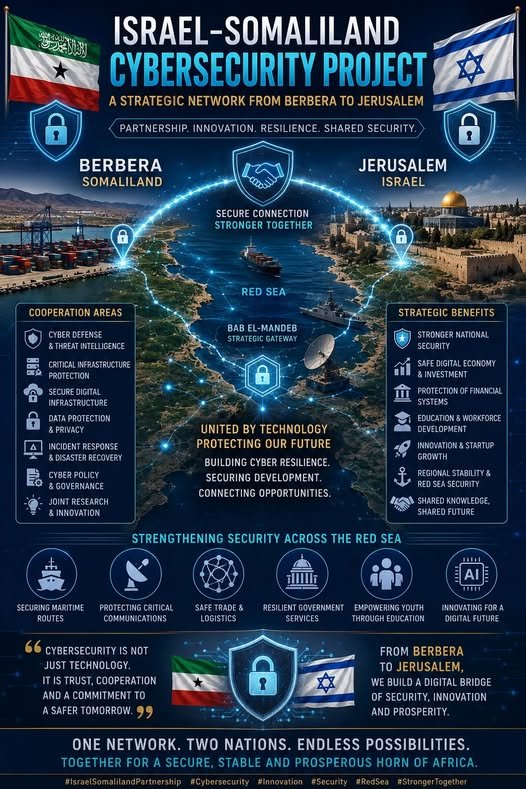
Israel-Somaliland Cybersecurity Partnership
By Prof. Nassir Hussein Kahin
As the world becomes increasingly digital, national security is no longer defined solely by military strength, air defense systems, or naval power. The security of data networks, financial systems, communications infrastructure, energy grids, and government institutions has become equally critical. In the twenty-first century, cyberspace has emerged as a new strategic domain where states compete, cooperate, and defend their national interests.
For Somaliland and Israel, this reality presents an opportunity to build one of the most valuable dimensions of their emerging bilateral relationship.
While recent discussions have understandably focused on diplomacy, Red Sea security, trade, and investment, cyber-security may ultimately become one of the most enduring pillars of cooperation between the two countries.
Israel is internationally recognized as one of the world’s leading cyber-security and innovation hubs. Its ecosystem of universities, research institutions, government agencies, military experience, and private technology companies has produced globally respected expertise in cyber defense, artificial intelligence, encryption, digital infrastructure protection, and cyber resilience.
Somaliland, meanwhile, is at an important stage in its digital development. Government services are becoming more computerized, financial transactions increasingly rely on mobile technologies, businesses are expanding their online presence, and educational institutions are embracing digital learning. As this transformation accelerates, protecting critical digital infrastructure will become a national priority.
This creates a natural area for partnership.
One of the first opportunities lies in protecting government networks. Modern public administration depends on secure digital systems for taxation, immigration, customs, healthcare, education, land registration, and public records. Cyber-attacks targeting these systems can disrupt public services, expose sensitive information, and undermine public confidence. Sharing expertise in cyber-security governance, risk management, and incident response could help strengthen institutional resilience.
A second area is financial security.
Somaliland’s widely used mobile payment systems have become an important part of everyday economic life. Around the world, financial institutions increasingly face phishing campaigns, ransomware attacks, payment fraud, and other cyber threats. Cooperation on secure payment technologies, fraud detection, cyber awareness, and financial-sector resilience could help protect consumers and businesses while supporting investor confidence.
Education represents another strategic opportunity.
Rather than viewing cyber-security solely as a government responsibility, Somaliland can invest in developing a new generation of cyber-security professionals. Partnerships between Somaliland universities and Israeli academic institutions could include faculty exchanges, online certification programs, joint research, scholarships, and specialized training in ethical hacking, digital forensics, network security, cloud computing, and artificial intelligence.
Such cooperation would not only strengthen national capabilities but also create employment opportunities for young Somalilanders in a rapidly growing global industry.
Innovation should also be part of the conversation.
Israel’s internationally recognized start-up ecosystem demonstrates how universities, investors, entrepreneurs, and government support can work together to build high-value technology industries. Somaliland’s youthful population, expanding telecommunications sector, and entrepreneurial culture provide a foundation for developing its own digital economy.
Technology incubators, coding academies, innovation hubs, and start-up accelerators could become practical areas of bilateral collaboration.
Cyber-security also has an important regional dimension.
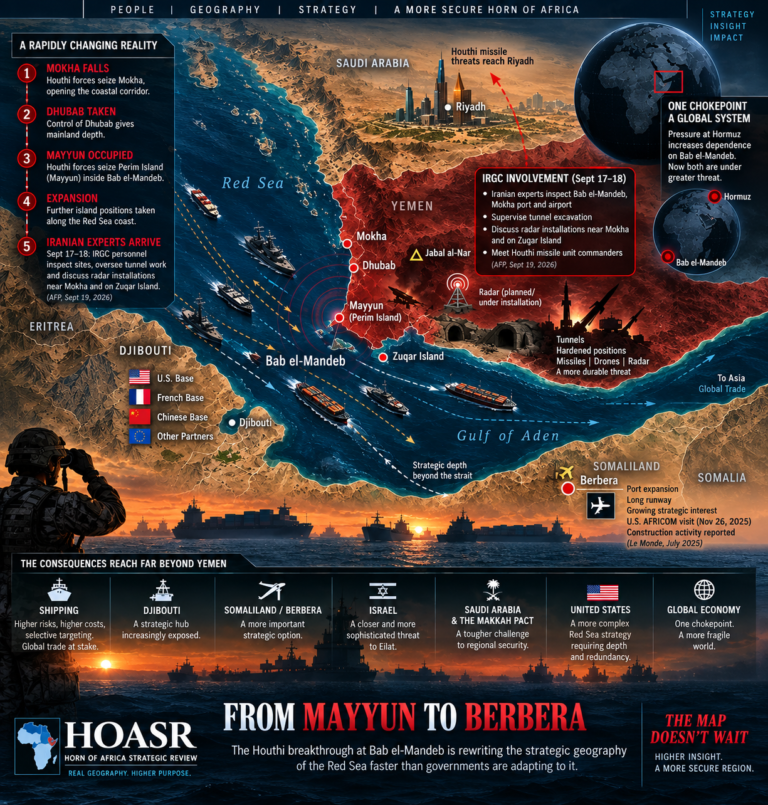
The Horn of Africa occupies one of the world’s most strategically significant locations. Ports, airports, telecommunications infrastructure, undersea fiber-optic cables, logistics corridors, and maritime navigation systems increasingly depend on secure digital networks. Disruptions to these systems can affect trade, communications, and essential services across borders.
Strengthening cyber resilience contributes not only to national security but also to the reliability of regional commerce and connectivity.
Importantly, cooperation in cyber-security should remain firmly grounded in international law, respect for privacy, and the protection of civilian infrastructure. The objective is to enhance resilience against cyber-crime, improve emergency preparedness, safeguard digital services, and build technical capacity—not to encourage offensive cyber operations or escalate regional tensions.
A practical road-map for cooperation could include:
- Establishing a Somaliland–Israel Cyber-security Working Group.
- Creating scholarship and exchange programs for students and IT professionals.
- Developing joint training on cyber incident response and digital resilience.
- Supporting university partnerships in computer science, artificial intelligence, and information security.
- Encouraging collaboration between technology startups and private-sector innovators.
- Sharing best practices on protecting critical digital infrastructure.
- Hosting annual cyber-security and technology conferences in Hargeisa and Jerusalem.
Beyond technical cooperation, such initiatives would help cultivate trust between institutions, expand educational opportunities, and support economic modernization.
The emerging relationship between Somaliland and Israel is often discussed through the lens of diplomacy, Maritime Security, and geopolitics. Those dimensions are undeniably important. Yet some of the partnership’s most lasting achievements may occur in laboratories, classrooms, innovation centers, and technology parks rather than in conference halls.
In an increasingly interconnected world, resilience is measured not only by the strength of borders but also by the security of digital networks and the knowledge of those who protect them.
If Somaliland seeks to build a diversified, knowledge-based economy, cyber-security is not merely a technical necessity—it is a strategic investment in the country’s future.
For Israel, partnering with a stable and increasingly connected country on the western shore of the Red Sea offers an opportunity to support digital development while contributing to broader regional resilience.
For Somaliland, learning from one of the world’s leading innovation ecosystems could help prepare its institutions, businesses, and young professionals for the challenges and opportunities of the digital age.
The next frontier of the Somaliland–Israel partnership may therefore not lie only across the Red Sea—but also in cyberspace.

Prof. Nassir Hussein Kahin is a researcher, educator, journalist, and geopolitical analyst specializing in the Horn of Africa, the Red Sea, international law, diplomacy, and strategic affairs. To read Full Bio click on this link: ABOUT THE AUTHORProf. Nassir Hussein Kahin