
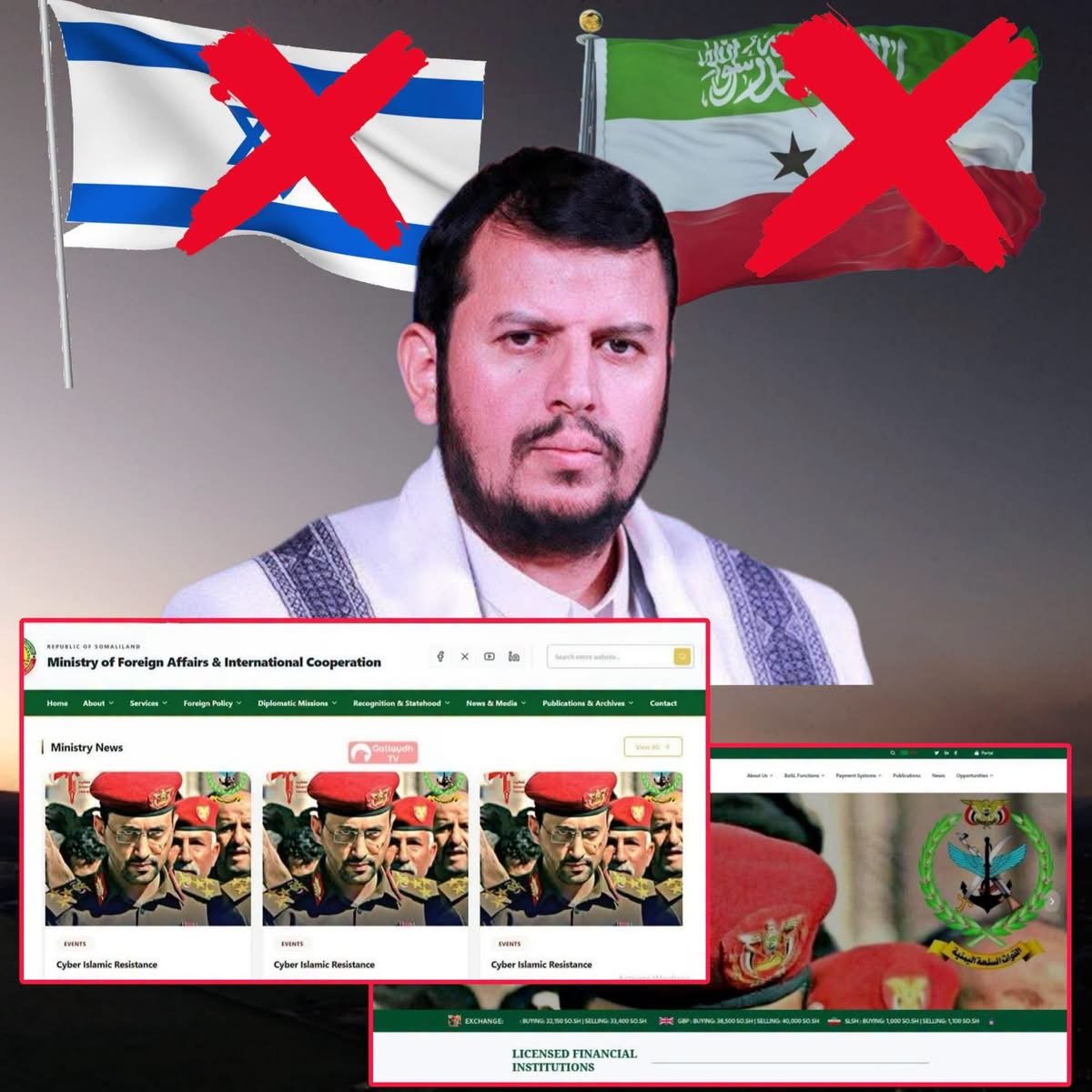
The Cyberattack Images That Appeared on Somaliland Government Websites
By Prof. Nassir Hussein Kahin
A National Security Wake-Up Call for the Digital Age!
Yesterday’s cyber-attack targeting Somaliland government websites and the Somaliland Central Bank should be viewed as far more than an isolated act of digital vandalism. If confirmed by ongoing technical investigations, it represents an unmistakable warning that Somaliland has entered a new strategic environment in which cyber warfare is becoming an increasingly important component of geopolitical competition.
Only a day after the Horn of Africa Strategic Review examined the strategic importance of an Israel-Somaliland cybersecurity partnership, Somaliland appears to have become the latest target of an ideologically motivated cyber campaign.
Whether the reported attackers ultimately prove to be the Iran-aligned “Cyber Islamic Resistance” collective or another threat actor, the broader lesson remains unchanged: Somaliland’s growing international profile is also increasing its exposure to sophisticated cyber threats.
This development should accelerate—not postpone—the government’s efforts to build a modern national cybersecurity architecture.
Cybersecurity Is National Security
For decades, national security focused primarily on protecting borders, military installations, airports, ports, and government institutions. Today, a country’s digital infrastructure has become equally vital.
Government databases, banking systems, customs operations, airports, telecommunications, electricity networks, hospitals, and financial institutions all depend on secure digital systems.
A successful cyberattack against any one of these sectors can undermine public confidence, interrupt essential services, damage the economy, and create strategic vulnerabilities without a single shot being fired.
This is precisely the type of asymmetric warfare increasingly employed by state-sponsored and ideologically aligned cyber groups across the Middle East and beyond.
Somaliland’s Strategic Importance Has Changed
Somaliland is no longer viewed solely through a local or regional lens.
Its position overlooking the Bab al-Mandeb Strait, expanding international partnerships, growing diplomatic engagement with Israel, Berbera Port, and increasing relevance to Red Sea security have elevated its strategic profile.
With greater visibility inevitably comes greater risk. Countries that occupy strategically important locations increasingly face cyber campaigns designed to influence political decisions, damage reputations, or weaken critical institutions. The digital domain has become another battlefield.
Why Israel Is a Logical Cybersecurity Partner
Israel has developed one of the world’s most advanced cybersecurity ecosystems. Over the past two decades, it has invested heavily in cyber defense, digital resilience, artificial intelligence, critical infrastructure protection, financial security, and incident response capabilities. Its experience defending against continuous cyber threats makes it a valuable partner for countries seeking to strengthen national resilience.
A comprehensive Somaliland-Israel cybersecurity partnership could include:
- Establishment of a National Cyber Security Center.
- Creation of a Somaliland Computer Emergency Response Team (CERT).
- Protection of government digital infrastructure.
- Cyber defense for the Somaliland National Bank and financial sector.
- Security assessments of Berbera Port and airport systems.
- Training programs for government IT professionals.
- University partnerships in cybersecurity education.
- Joint cyber exercises and incident-response simulations.
- Intelligence sharing on emerging cyber threats.
Such cooperation would strengthen Somaliland’s institutions while helping build long-term technical capacity rather than dependence.
Beyond Technology: Building Human Capacity
Cybersecurity is not simply about purchasing software or installing firewalls. It requires trained professionals, legal frameworks, institutional coordination, and continuous investment in education. Somaliland should consider introducing specialized cybersecurity programs at its universities while encouraging partnerships with Israeli academic institutions, technology companies, and innovation centers. Developing a new generation of cybersecurity professionals would represent one of the country’s most valuable long-term investments.
A Moment for Strategic Leadership
Every major cyber incident offers two choices.
One is to restore affected systems and return to business as usual.The other is to recognize that the threat environment has fundamentally changed and respond with structural reforms.
The second path is the wiser one.
If today’s reported cyberattack serves as the catalyst for establishing a comprehensive national cybersecurity strategy supported by trusted international partners, Somaliland may ultimately emerge stronger than before. Rather than allowing hostile cyber actors to dictate the country’s digital future, Somaliland has an opportunity to transform this challenge into a strategic advantage.
As diplomacy increasingly extends into cyberspace, resilience will depend not only on political alliances but also on secure digital infrastructure and highly trained cyber professionals.
The reported attack should therefore be remembered not merely as a security incident, but as the moment Somaliland recognized that cybersecurity is no longer an optional technical function—it is an essential pillar of national security, sovereignty, economic stability, and modern statecraft.Cyber Frontiers: How Somaliland and Israel Can Build a Strategic Partnership in Cybersecurity.

Prof. Nassir Hussein Kahin is a researcher, educator, journalist, and geopolitical analyst specializing in the Horn of Africa, the Red Sea, international law, diplomacy, and strategic affairs. To read Full Bio click on this link: ABOUT THE AUTHORProf. Nassir Hussein Kahin