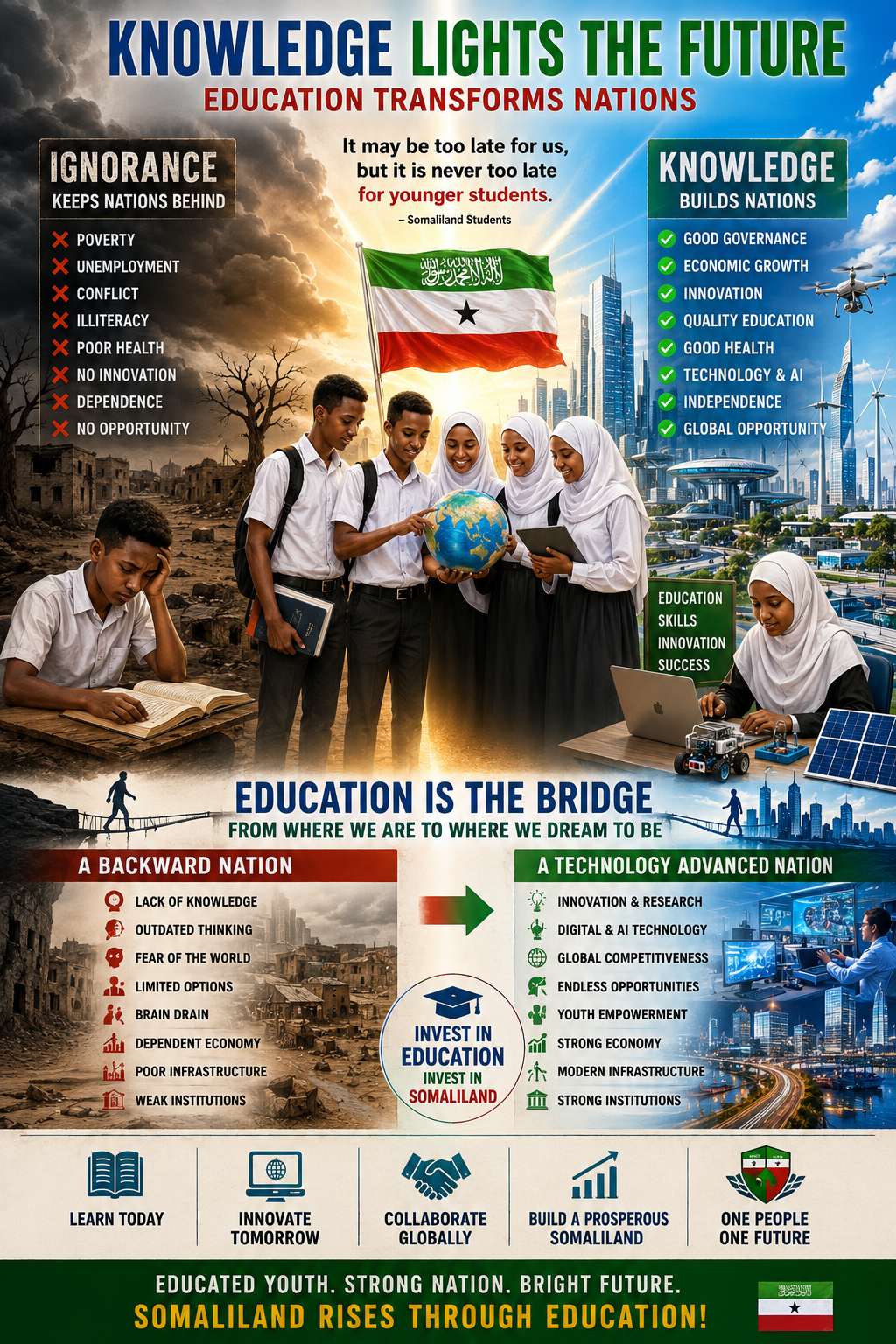
"It may be too late for us, but never too late for younger students"
By Prof. Nassir Hussein Kahin
The conclusion of Somaliland’s national secondary school examinations this year produced an unexpected but thought-provoking public debate.
In interviews with local television stations, several graduating students openly appealed to the government to consider introducing the geography and history of Israel into Somaliland’s school curriculum. Their reasoning was simple and remarkably mature.
If Somaliland’s education system already teaches the geography and history of numerous countries—including many that have never recognized Somaliland’s sovereignty—why should students not also learn about a country that has formally recognized the Republic of Somaliland?
One young woman summarized the sentiment with striking clarity:
“It may be too late for us, but it is never too late for younger students.”
Whether policymakers ultimately embrace or reject the proposal is a matter for Somaliland’s educational authorities, curriculum specialists, teachers, parents, and scholars.
What should not happen, however, is for an honest educational discussion to be transformed into an international conspiracy theory.
Education Expands Minds—It Does Not Replace Identities
One of the defining characteristics of successful education systems is intellectual openness.
Students study ancient civilizations without becoming Romans.
They study the French Revolution without becoming French.
They study the Industrial Revolution without becoming British.
Likewise, studying Israel’s geography, history, political institutions, scientific achievements, and regional challenges would not diminish Somaliland’s national identity.
Knowledge does not erase patriotism.
It strengthens it.
Modern education prepares students to understand the wider world, evaluate competing ideas critically, and engage internationally with confidence rather than fear.
A nation seeking greater diplomatic recognition cannot afford an education system that avoids learning about the very countries shaping global affairs.
Why Israel Matters Educationally
Regardless of political opinions, Israel occupies an important place in contemporary international affairs.
It has become internationally recognized for innovation in agriculture, water conservation, desert farming, medical research, cybersecurity, artificial intelligence, renewable energy, entrepreneurship, emergency medicine, and technological development.
Its experience transforming scarce natural resources into economic opportunity has been studied by universities, development agencies, and policymakers around the world.
For Somaliland—a country facing challenges related to water, food security, climate resilience, technology, and economic diversification—there are practical lessons worth studying.
Learning about those achievements is education.
It is not political endorsement.
Just as Somaliland’s students study countries with different political systems, cultures, religions, and diplomatic relationships, studying Israel should be viewed through the same educational lens.
Diplomatic Reality Should Inform Educational Awareness
As Somaliland expands its international engagement, students deserve an education that reflects contemporary diplomatic realities.
Countries with which Somaliland develops meaningful diplomatic, economic, technological, or cultural relations naturally become subjects of academic interest.
Understanding those relationships helps prepare future diplomats, teachers, engineers, entrepreneurs, journalists, researchers, and public servants.
An informed generation strengthens national capacity.
Responsible Journalism Matters
The debate also highlights the importance of responsible reporting.
Public discussion about curriculum reform should be based on verified facts rather than speculation.
There is an important distinction between comments made by individual students, proposals debated in public, and official government policy.
Conflating those categories risks misleading audiences and unnecessarily polarizing public discourse.
Media organizations like Aljazeera, carry significant influence. With that influence comes a responsibility to distinguish clearly between confirmed developments, commentary, analysis, and opinion. Sensitive issues involving diplomacy, education, and national identity deserve careful reporting supported by evidence rather than assumptions or sensational framing.
This principle applies equally to domestic media, regional broadcasters, and international news organizations. Healthy public debate depends on rigorous journalism that prioritizes verification over conjecture and context over sensationalism.
Somaliland’s Young Generation Speaks for Itself
Perhaps the most overlooked aspect of this discussion is the students themselves.
The young Somalilanders interviewed were born after the restoration of Somaliland’s sovereignty in 1991.
They have grown up under the Somaliland flag.
Their understanding of nationhood has been shaped by the institutions, schools, elections, and civic life of Somaliland.
Their proposal reflected curiosity, gratitude toward a country that has recognized Somaliland, and a desire for future students to better understand the world.
Agreeing or disagreeing with their suggestion is entirely legitimate.
Misrepresenting it as something it was not is not.
Young people deserve to have their views debated honestly—not exaggerated into narratives they neither expressed nor intended.
Knowledge Is a Strategic National Asset
The world’s most successful nations invest heavily in education because knowledge produces resilience.
It strengthens diplomacy.
It improves innovation.
It expands economic opportunity.
It builds stronger institutions.
It prepares future leaders.
Somaliland’s long-term success will depend not only on diplomatic recognition but also on educating citizens capable of engaging confidently with partners across Africa, the Middle East, Europe, Asia, and the Americas.
Learning about Israel should therefore be viewed not through the narrow lens of political controversy but through the broader vision of educational excellence.
A confident nation does not fear knowledge.
It welcomes it.
A strong education system teaches students how to think—not what to think.
That principle remains one of the strongest foundations upon which Somaliland can continue building its future for posterity.
Prof. Nassir Hussein Kahin is a researcher, educator, journalist, and geopolitical analyst specializing in the Horn of Africa, the Red Sea, international law, diplomacy, and strategic affairs. To read Full Bio click on this link: ABOUT THE AUTHORProf. Nassir Hussein Kahin