By Prof. Nassir Hussein Kahin
For decades, Somaliland’s quest for international recognition was largely framed as a legal and historical argument.
Today, it has become a geopolitical reality.
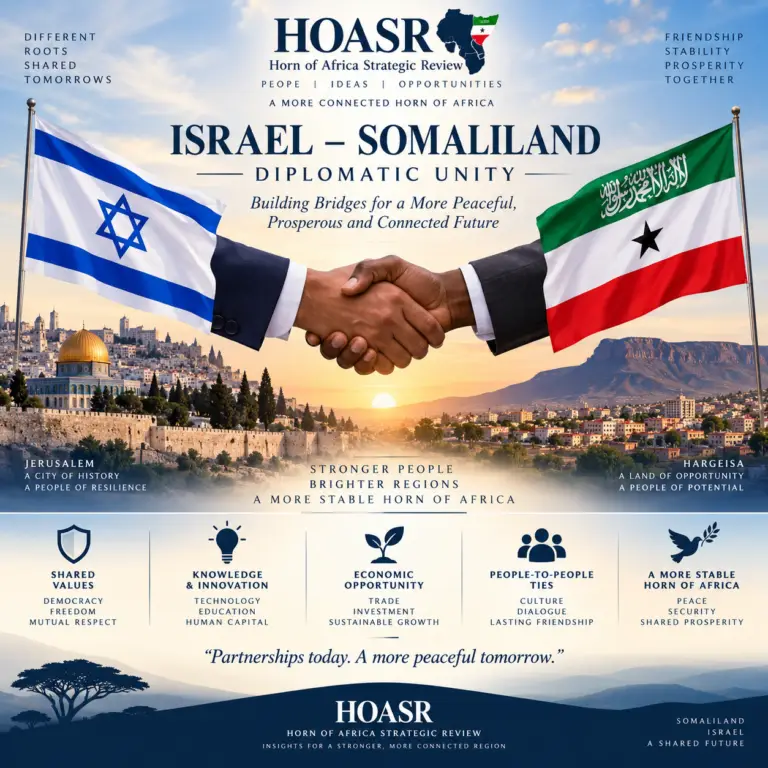
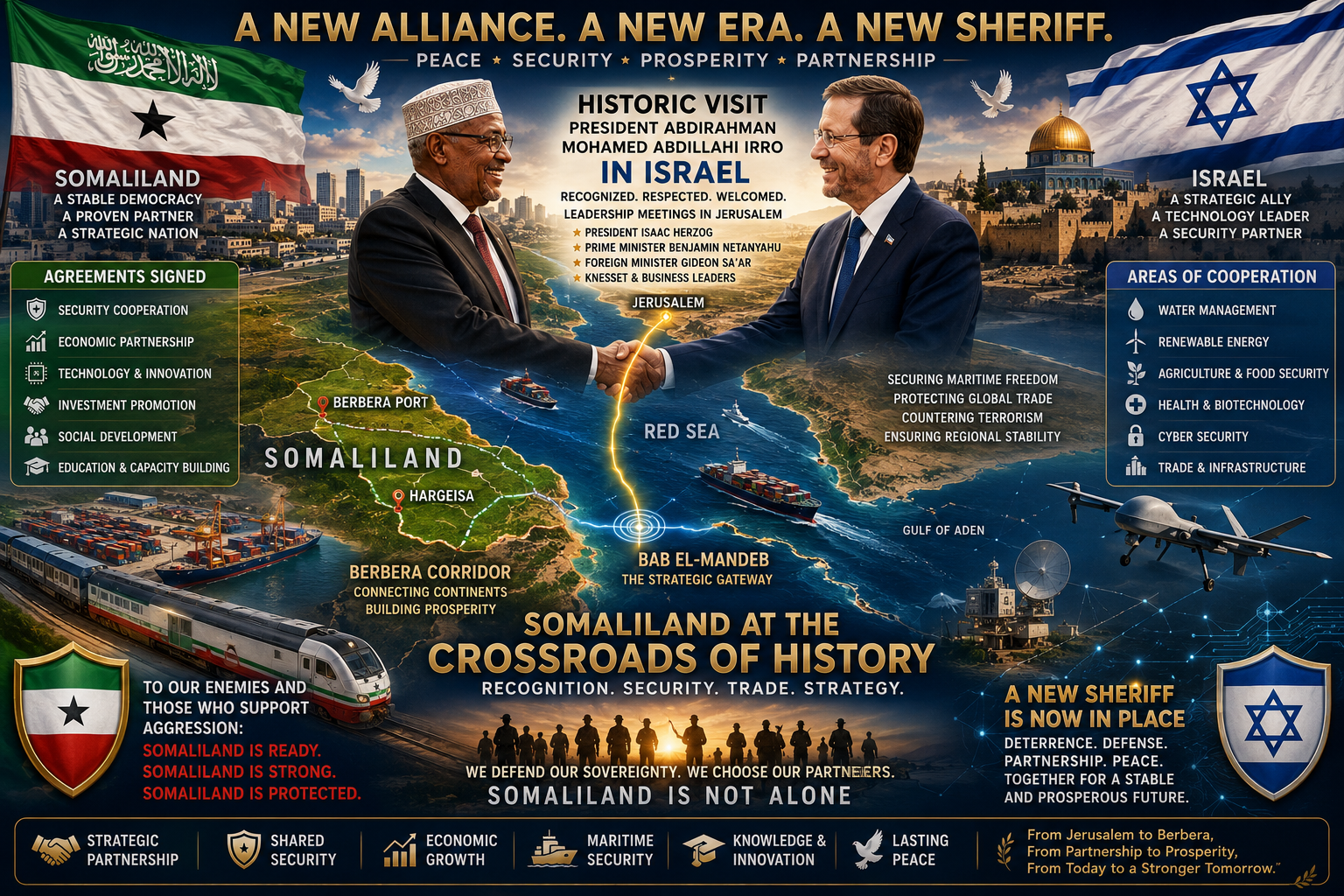
Three days into President Abdirahman Mohamed Abdillahi Irro’s historic state visit to Israel, it is becoming increasingly clear that this is far more than a diplomatic courtesy call between two governments. The visit represents the formal institutionalization of a new strategic partnership that has the potential to reshape political calculations across the Horn of Africa, the Red Sea Basin, and the wider Middle East.
The symbolism alone is extraordinary.
Only six months ago, Israel became the first United Nations member state to formally recognize Somaliland as an independent sovereign nation. Many observers initially dismissed the recognition as largely symbolic. Yet the events unfolding in Jerusalem demonstrate that recognition was merely the beginning.
President Irro has now been received by Israeli President Isaac Herzog, Prime Minister Benjamin Netanyahu, Foreign Minister Gideon Sa’ar, senior security officials, parliamentarians, investors, and business leaders. Somaliland has officially opened its embassy in Jerusalem, placing itself among a very small group of nations that maintain diplomatic missions in Israel’s capital.
This is no longer about recognition.
It is about alliance.
The timing could not be more significant.
The Middle East is experiencing one of its most volatile periods in decades. The ongoing confrontation between Israel and Iran, instability across the Red Sea, Houthi attacks on maritime shipping, and growing competition among global powers have transformed the strategic value of the Horn of Africa.
At the center of this transformation lies Somaliland.
For years, analysts focused on Somaliland’s democratic achievements and internal stability. Today, international think tanks and strategic planners are increasingly focused on its geography.
Located along the Gulf of Aden and overlooking the Bab El-Mandeb Strait, Somaliland occupies one of the most important positions in global maritime commerce. Nearly 15 percent of global trade passes through the Red Sea corridor. Any disruption affects energy markets, shipping costs, and international supply chains.
Recent Houthi attacks on commercial vessels have exposed the vulnerability of these routes and elevated the importance of reliable partners along the African coastline.
This is where Somaliland enters the equation.
The Berbera Port and Berbera Corridor are no longer viewed solely as economic assets. They are increasingly becoming components of a broader strategic architecture connecting the Mediterranean, Red Sea, Arabian Peninsula, and Indian Ocean.
Think tanks in Washington have taken notice.
Several policy analysts argue that Israel’s recognition of Somaliland represents a return to the Red Sea after years of diminishing influence in Sudan and Eritrea. Others view the relationship as part of a larger effort to build a network of strategic partnerships capable of countering Iranian influence and protecting maritime freedom.
The implications extend well beyond Israel.
The United States has intensified its focus on Red Sea security, China’s growing military presence in Djibouti, and instability in Somalia. Washington increasingly views the Horn of Africa through the lens of great-power competition rather than humanitarian intervention alone.
Similarly, Gulf states have invested heavily in ports, logistics infrastructure, and transportation corridors throughout the region.
The emergence of a recognized and strategically aligned Somaliland introduces a new variable into this already complex equation.
For Somalia, the consequences are particularly profound.
For thirty-five years, Mogadishu’s diplomatic strategy rested on the assumption that no country would cross the recognition threshold. That assumption no longer holds.
The reception accorded to President Irro by Israel’s highest officials sends a message to the international community that Somaliland can no longer be treated merely as a regional administration.
It is increasingly being treated as a state actor.
That development is likely to alarm not only Somalia but also countries that have consistently opposed Somaliland’s recognition, including those concerned about territorial integrity, regional separatism, or shifting balances of power in the Horn.
China is also watching closely.
Somaliland already maintains close relations with Taiwan, one of Beijing’s principal geopolitical rivals. With Israel now becoming another major partner, Somaliland finds itself connected to two states that occupy central positions in contemporary global strategic competition.
This will inevitably increase pressure from Beijing and its regional partners.
Yet perhaps the most important lesson from President Irro’s visit is that Somaliland appears increasingly willing to accept those risks.
Risk has never been absent from Somaliland’s national journey.
The decision to restore sovereignty in 1991 carried enormous uncertainty.
The decision to build democratic institutions without recognition carried risks.
Partnerships with Ethiopia, the United Arab Emirates, and Taiwan carried risks.
The relationship with Israel is simply the latest chapter in that history.
What distinguishes this moment is that Somaliland is no longer merely reacting to regional events.
It is helping shape them.
The agreements signed in Jerusalem covering security cooperation, technology, economic development, investment, innovation, and diplomatic engagement suggest that both governments envision a long-term partnership rather than a symbolic relationship.
For supporters, this represents a strategic breakthrough.
For critics, it represents a dangerous escalation.
For geopolitical analysts, it represents something else entirely.
It represents the arrival of Somaliland as an increasingly consequential actor in one of the world’s most strategically important regions.
Whether one views that development positively or negatively, one conclusion is becoming difficult to dispute.
Thirty-five years after restoring its sovereignty, Somaliland is no longer waiting for history to recognize it.
It is positioning itself to become part of the forces shaping history itself.

Prof. Nassir Hussein Kahin is a researcher, educator, journalist, and geopolitical analyst specializing in the Horn of Africa, the Red Sea, international law, diplomacy, and strategic affairs. To read Full Bio click on this link: ABOUT THE AUTHORProf. Nassir Hussein Kahin