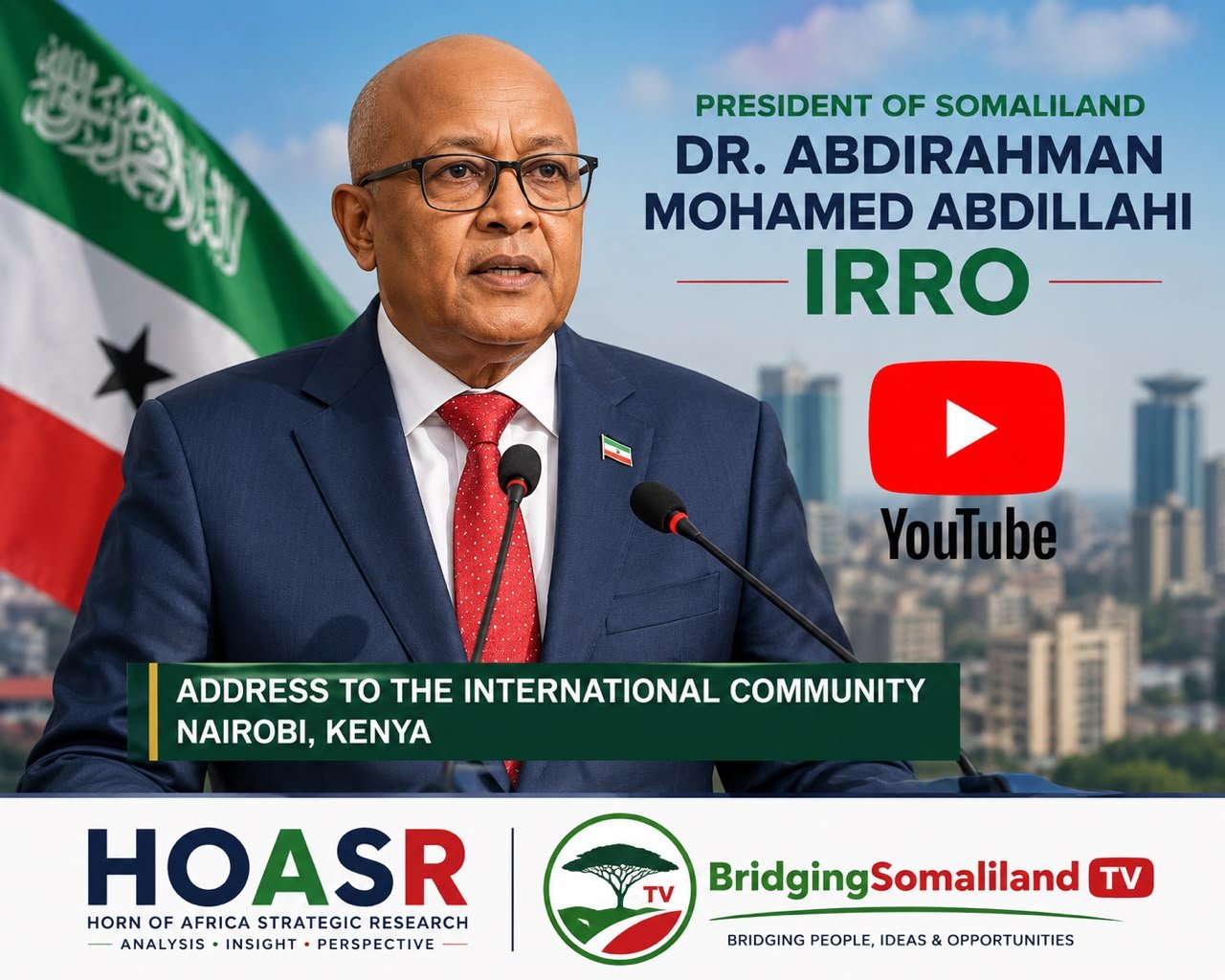
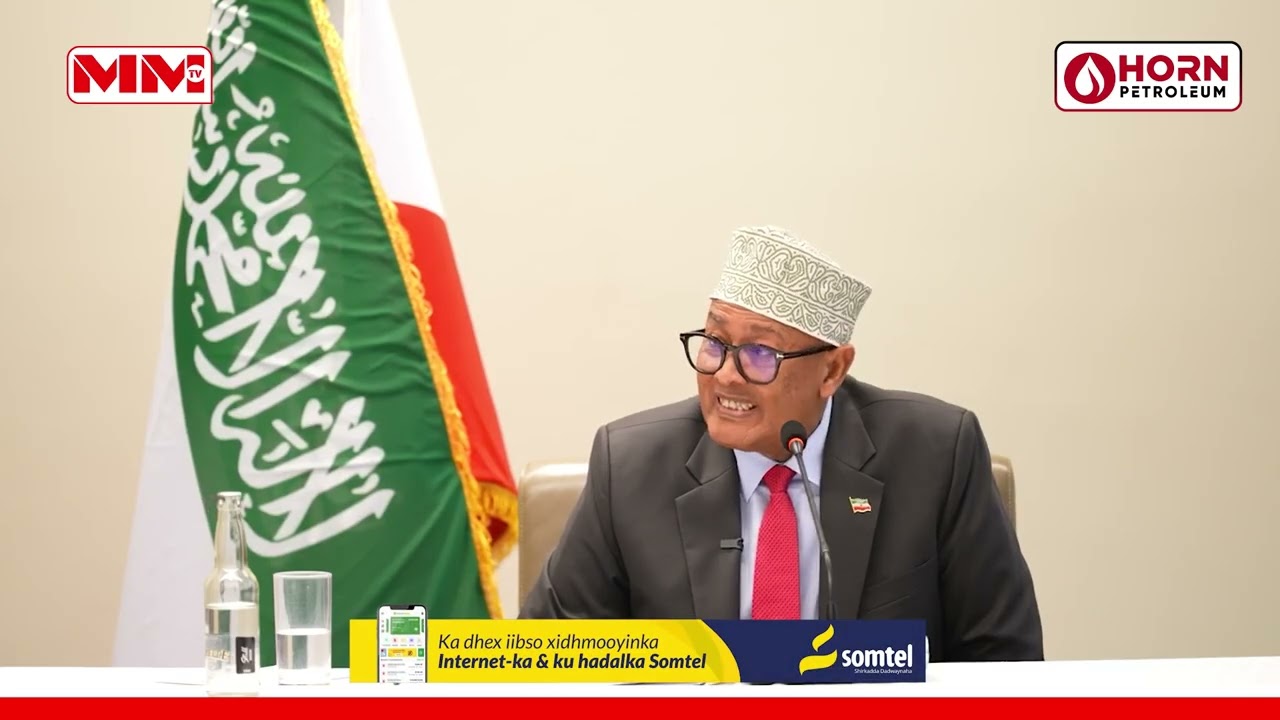
President Abdirahman Mohamed Abdillahi “Irro” used his address in Nairobi not merely as a progress report on his administration, but as a carefully crafted diplomatic appeal to governments, international organizations, investors, and development partners. Speaking before representatives of the international community based in Kenya, the President framed Somaliland as a stable, responsible, and increasingly influential actor in the Horn of Africa, capable of contributing to regional security, economic development, and international partnerships.
Rather than focusing exclusively on Somaliland’s long-standing quest for recognition, President Irro sought to demonstrate that his government has concentrated on governance, security, reconciliation, and economic reforms. The underlying message was clear: Somaliland wishes to be judged by its performance rather than its unresolved diplomatic status.
The speech was structured around four strategic pillars.
First, the President highlighted peace, reconciliation, and national security as the foundation of state-building. He described the successful demobilization of approximately 6,000 militia members and their integration into Somaliland’s national armed forces. He also emphasized dialogue and traditional reconciliation mechanisms in restoring stability in eastern Somaliland. By stressing internal peace, President Irro sought to reinforce Somaliland’s longstanding narrative that it remains one of the most stable political entities in the Horn of Africa despite operating without widespread international recognition.
Second, the President presented economic and infrastructure development as evidence of effective governance. He outlined investments in road construction, water security, renewable energy, and healthcare modernization. Particular emphasis was placed on reducing electricity costs in major urban centers through renewable energy initiatives and upgrading Hargeisa Group Hospital. These projects were portrayed not simply as development achievements but as indicators of institutional capacity and responsible public administration.
Third, the speech focused on Somaliland’s foreign policy. President Irro described Israel’s recognition of Somaliland on 26 December 2025 as a historic diplomatic breakthrough. While acknowledging the significance of this milestone, he avoided presenting it as an end in itself. Instead, he portrayed recognition as part of a broader strategy of building mutually beneficial international partnerships. His repeated assertion that Somaliland seeks “investment and partnership, not charity or dependency” reflected an effort to reposition Somaliland from being viewed primarily as a recipient of humanitarian assistance to becoming a strategic political and economic partner.
Fourth, President Irro directly addressed relations with Somalia. He accused the Federal Government of Somalia of continuing destabilizing activities and urged international partners to encourage Mogadishu to honour previously agreed commitments. Rather than using inflammatory language, he appealed to external actors to promote constructive engagement and accountability, framing Somaliland as the party committed to dialogue and regional stability.
One of the most significant aspects of the speech was its intended audience. Nairobi hosts regional offices of the United Nations, numerous international organizations, diplomatic missions, financial institutions, and development agencies. Delivering this message in Kenya’s diplomatic capital provided President Irro with an opportunity to engage decision-makers whose policies influence the Horn of Africa. It also coincided with high-level discussions with President William Ruto and senior Kenyan officials, adding broader diplomatic significance to the visit.
The speech also reflected an evolution in Somaliland’s diplomatic messaging. Earlier administrations frequently concentrated on historical arguments surrounding Somaliland’s brief independence in 1960, the voluntary union with Somalia, and the restoration of sovereignty in 1991. While these remain central to Somaliland’s legal and political position, President Irro devoted greater attention to contemporary governance, economic reforms, and practical cooperation. This represents a transition from arguing why Somaliland deserves recognition to demonstrating why engagement with Somaliland serves international interests.
For international organizations, the President’s message was equally strategic. He encouraged development partners to view Somaliland as a capable implementing partner with functioning institutions rather than as a peripheral region of Somalia. His emphasis on mutual respect, investment, and institutional cooperation sought to reshape how Somaliland is perceived within international policymaking circles.
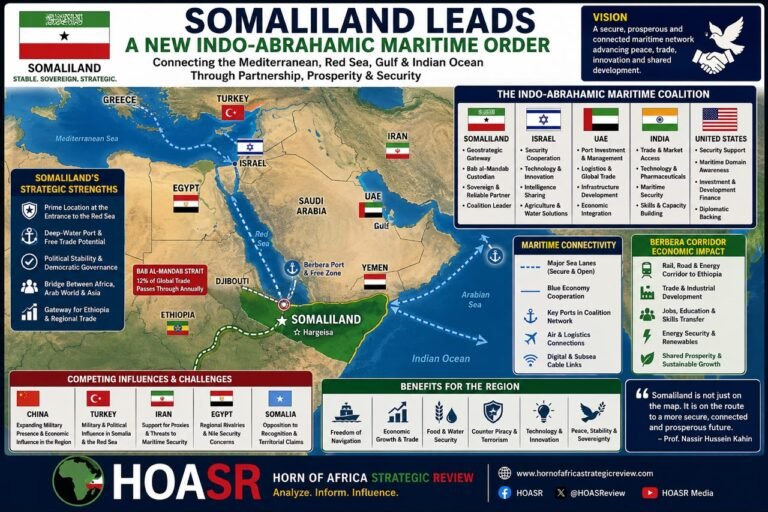
The broader geopolitical context also strengthens the significance of the speech. Growing competition in the Red Sea and Gulf of Aden, concerns over maritime security, expanding regional infrastructure initiatives, and shifting alliances have increased international interest in the Horn of Africa. By presenting Somaliland as peaceful, institutionally stable, and open to strategic partnerships, President Irro positioned his government as a reliable stakeholder in this evolving regional environment.
The address ultimately conveyed a simple but powerful diplomatic proposition: Somaliland believes it has moved beyond demonstrating its ability to govern itself. It now seeks international engagement based on its demonstrated record of peace, democratic governance, economic reform, and regional cooperation.Exclusive i24NEWS Interview with President of Somaliland, Abdirahman Mohamed Abdillahi IRRO
For observers of Horn of Africa geopolitics, the Nairobi speech may be remembered less for announcing new policies than for illustrating the maturation of Somaliland’s diplomacy—from a campaign centered primarily on historical legitimacy to one increasingly grounded in performance, partnerships, and strategic relevance.
Prof. Nassir Hussein Kahin is a researcher, educator, journalist, and geopolitical analyst specializing in the Horn of Africa, the Red Sea, international law, diplomacy, and strategic affairs. To read Full Bio click on this link: ABOUT THE AUTHORProf. Nassir Hussein Kahin