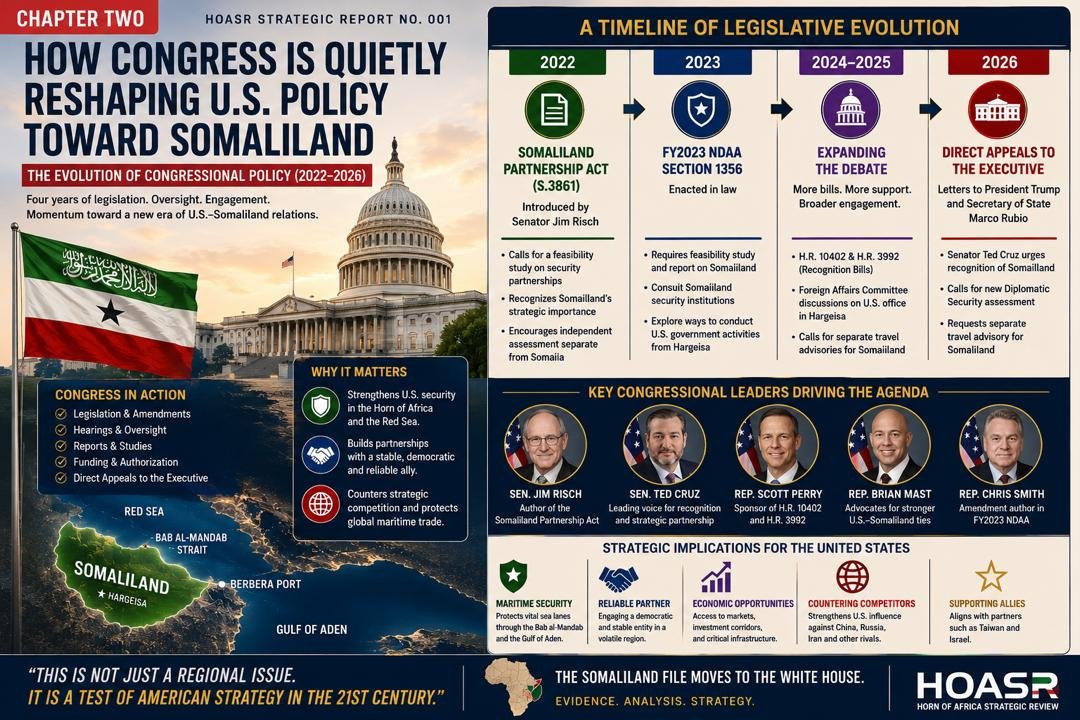
How Congress is quitely Reshaping U.S. Policy Toward Somaliland (2022-2026)
By Prof. Nassir Hussein Kahin
HOASR Strategic Report No. 001
July 2026
THE SOMALILAND FILE MOVES TO THE WHITE HOUSE
How Four Years of Congressional Action Are Quietly Reshaping American Policy Toward Somaliland
⸻
Chapter Two
The Evolution of Congressional Policy Toward Somaliland (2022–2026): Bills, Strategy and Recognition
From Strategic Curiosity to Strategic Consideration
Introduction
Major shifts in United States foreign policy rarely occur suddenly. They are typically preceded by years of legislative inquiry, committee hearings, feasibility studies, appropriations language, and sustained congressional engagement before culminating in executive action. Recognition of new states, expansion of military partnerships, or significant diplomatic realignments generally emerge from an incremental process in which Congress explores strategic options, tests policy assumptions, and gradually reshapes the national debate.
The evolution of congressional engagement with Somaliland between 2022 and 2026 reflects this pattern.
Rather than beginning with proposals for diplomatic recognition, Congress initially focused on practical questions: whether Somaliland’s security conditions justified a different U.S. approach; whether existing policy adequately reflected realities on the ground; and whether deeper cooperation would advance American interests in the Horn of Africa and the Red Sea. Over time, these questions broadened into debates over security partnerships, diplomatic representation, travel advisories, and, ultimately, recognition itself.
Viewed individually, each legislative initiative represents a discrete policy proposal. Viewed collectively, however, they reveal a sustained and increasingly sophisticated congressional effort to reassess Somaliland’s place within U.S. strategy.
This chapter traces that evolution chronologically and explains why each stage represented a meaningful development in American policy thinking.
⸻
2022: The Beginning of a New Congressional Conversation
The year 2022 marked the first comprehensive attempt by Congress to establish a structured framework for direct engagement with Somaliland.
On 17 March 2022, Senator Jim Risch, then the Ranking Member of the Senate Foreign Relations Committee, introduced the Somaliland Partnership Act (S.3861). The bill was cosponsored by Senators Chris Van Hollen, Mike Rounds, and later Roger Wicker, reflecting bipartisan interest in examining Somaliland through the lens of U.S. strategic interests rather than exclusively within the broader Somalia portfolio.
Although the legislation explicitly stated that it would not constitute U.S. recognition of Somaliland as an independent state, its significance lay elsewhere. For the first time, Congress proposed that Somaliland should receive dedicated reporting requirements, separate policy analysis, and an independent assessment of whether closer bilateral security cooperation would advance American interests.
The bill’s findings were particularly notable. It identified Somaliland’s geographic position on the Gulf of Aden, its democratic institutions, and its relative internal stability as strategic assets. It also observed that Somaliland’s security environment differed substantially from conditions prevailing in Mogadishu and much of southern Somalia, arguing against a uniform policy toward all parts of Somalia.
Perhaps even more significant was the legislation’s requirement that the Department of State, in coordination with the Department of Defense, conduct a feasibility study examining opportunities for a security partnership with Somaliland. Among the issues identified for study were maritime security, counterterrorism cooperation, protection of the Bab al-Mandab Strait, intelligence sharing, regional trade, and the potential strategic implications of Somaliland’s relationship with Taiwan and its proximity to China’s military presence in Djibouti.
The bill therefore represented a conceptual shift. Congress was no longer asking whether Somaliland existed as a political reality; instead, it was asking whether closer engagement with Somaliland could advance American national security objectives.
Although S.3861 did not become law before the end of the 117th Congress, it established an intellectual and legislative foundation that would influence subsequent congressional initiatives. It also demonstrated that bipartisan interest in Somaliland could extend beyond humanitarian assistance into questions of strategy, defense, and diplomacy.
⸻
The Strategic Logic Behind the Somaliland Partnership Act
The Somaliland Partnership Act reflected broader changes in the international environment.
China had expanded its military presence in Djibouti, the first overseas base of the People’s Liberation Army. Competition among global powers in the Red Sea region was intensifying. Piracy, illicit trafficking, and violent extremist organizations continued to threaten regional stability, while the strategic importance of maritime supply chains became increasingly apparent.
Against this backdrop, several members of Congress argued that Somaliland possessed characteristics uncommon within the region: functioning democratic institutions, comparatively stable governance, and an interest in closer relations with Western partners.
Importantly, the legislation did not seek to overturn long-standing U.S. recognition of Somalia. Instead, it proposed that the United States should develop policies reflecting conditions on the ground rather than relying exclusively upon formal diplomatic doctrine.
This distinction would become a recurring theme throughout subsequent congressional initiatives.
⸻
Congressional Oversight Expands
The Somaliland Partnership Act also introduced an important oversight function.
It required annual reporting on U.S. assistance directed to Somaliland, detailed accounting of diplomatic and development activities, analysis of travel policies affecting U.S. officials, and justification for maintaining travel advisories that treated Somaliland identically to areas experiencing substantially higher levels of insecurity.
Although technical in appearance, these reporting requirements reflected a broader policy objective: encouraging executive agencies to evaluate Somaliland independently rather than simply as one component of Somalia.
Such reporting obligations often shape future policy debates by creating a sustained evidentiary record. In this sense, the Somaliland Partnership Act served not only as proposed legislation but also as a mechanism for institutional learning within the U.S. government.
⸻
The Significance of 2022
Measured solely by legislative outcome, 2022 might appear modest. No recognition was extended, no embassy was established, and no bilateral defense agreement was concluded.
Measured strategically, however, 2022 represented a turning point.
For the first time, Congress formally articulated that:
* Somaliland’s strategic circumstances differed materially from those of southern Somalia.
* U.S. engagement should be informed by those differences.
* Security cooperation with Somaliland could advance American interests in the Red Sea, the Horn of Africa, and the wider Indo-Pacific.
* Existing policy frameworks warranted reconsideration in light of changing geopolitical realities.
These principles would underpin virtually every subsequent congressional initiative examined in this report.
⸻
Looking Ahead
If 2022 introduced the idea of differentiated engagement, the following year 2023 would begin translating that concept into statutory requirements through the National Defense Authorization Act, moving congressional interest from exploratory legislation toward enacted policy with direct implications for executive branch planning.
That progression marked the next stage in the gradual transformation of the Somaliland question from a regional issue into an element of broader U.S. strategic thinking.
From Legislative Inquiry to Statutory Policy: 2023
The National Defense Authorization Act Changes the Conversation
If the Somaliland Partnership Act of 2022 introduced the idea of differentiated engagement with Somaliland, the enactment of the James M. Inhofe National Defense Authorization Act for Fiscal Year 2023 (Public Law 117–263) transformed that discussion from proposed legislation into statutory policy.
This distinction is significant. Bills introduced by members of Congress may shape public debate, but unless enacted they do not bind the Executive Branch. The National Defense Authorization Act (NDAA), by contrast, is annual legislation that establishes defense policy, authorizes military programs, and frequently includes foreign policy provisions with direct implications for the Departments of Defense and State. For more than six decades, Congress has enacted an NDAA every fiscal year, making it one of the most consequential legislative vehicles affecting U.S. national security policy.
Within that framework, Somaliland moved beyond theoretical discussion and entered the formal planning processes of the United States Government.
⸻
The Chris Smith Amendment
The congressional catalyst for this development was an amendment introduced during House consideration of the FY2023 NDAA by Representative Chris Smith (Republican–New Jersey).
Smith’s amendment directed the Secretary of State, in consultation with the Secretary of Defense, to undertake a feasibility study examining opportunities for expanded U.S. engagement with Somaliland. The study was instructed to consult Somaliland’s security institutions, evaluate prospects for cooperation in support of U.S. national security interests in the Horn of Africa, Gulf of Aden, and Indo-Pacific, assess opportunities to strengthen Somaliland’s security sector, and determine the most effective means for conducting U.S. government activities directly from Hargeisa.
Although the amendment appeared procedural, its implications were substantial.
Rather than asking whether Somaliland should receive humanitarian assistance, Congress directed the Executive Branch to evaluate Somaliland as a potential operational security partner.
That represented a notable evolution in congressional thinking.
⸻
From Proposal to Enacted Law
During negotiations between the House and Senate, the Somaliland feasibility study survived the legislative process and was incorporated into the final NDAA as Section 1356: “Feasibility Study and Report Relating to Somaliland.” President Joe Biden signed the legislation into law on 23 December 2022 as Public Law 117–263.
Section 1356 required the Secretary of State, in consultation with the Secretary of Defense, to conduct a comprehensive feasibility study and submit a report to the appropriate congressional committees. Among the issues to be examined were:
* Consultation with Somaliland security institutions.
* Opportunities for collaboration in pursuit of U.S. national security interests.
* Methods for improving the professionalism and capacity of Somaliland’s security sector.
* Practical options for conducting U.S. government programs and official activities directly from Hargeisa rather than exclusively through Mogadishu.
The language stopped well short of recognizing Somaliland as a sovereign state. Yet it required federal agencies to treat Somaliland as a distinct subject of policy analysis.
That distinction would become increasingly important over the following years.
⸻
Institutionalizing a Different Way of Thinking
The practical significance of Section 1356 extended beyond the report itself.
Historically, most American diplomatic and security planning concerning Somaliland had been conducted through broader Somalia policy frameworks. The NDAA required officials to examine Somaliland on its own merits—its institutions, geography, security forces, infrastructure, and strategic utility.
This may appear to be an administrative change. In practice, however, it represented an institutional shift.
Government policy is shaped not only by presidential directives but also by how agencies gather information, evaluate risks, allocate resources, and prepare recommendations. By mandating a separate feasibility study, Congress created an official process through which Somaliland could be assessed independently within the U.S. national security bureaucracy.
Such studies often become the evidentiary foundation for future policy decisions.
⸻
Why Congress Focused on Security
The emphasis on security cooperation reflected broader geopolitical realities.
By 2023, the strategic environment surrounding the Red Sea had become increasingly complex.
China maintained its military base in Djibouti.
Iran continued supporting regional proxy networks.
Violent extremist organizations remained active across parts of East Africa.
International shipping faced renewed security concerns.
The Horn of Africa was no longer viewed simply as a humanitarian theater; it had become a central arena of strategic competition among global and regional powers.
Within that environment, congressional interest in Somaliland stemmed less from its unresolved political status than from its perceived operational value.
Members of Congress increasingly viewed Somaliland through questions such as:
* Could Berbera support regional logistics?
* Could Somaliland contribute to maritime domain awareness?
* Could its security institutions become reliable partners in counterterrorism?
* Could closer engagement strengthen U.S. influence in a region where strategic competition was intensifying?
These questions did not presuppose recognition. Rather, they reflected a pragmatic assessment of strategic interests.
⸻
Oversight as an Instrument of Policy
The NDAA also demonstrated how Congress exercises influence without directly determining foreign recognition.
Under the U.S. Constitution, recognition of foreign states remains an executive prerogative. Congress cannot compel a President to recognize another country.
Congress can, however:
* Require studies.
* Mandate reports.
* Hold oversight hearings.
* Authorize security cooperation.
* Appropriate funding.
* Encourage diplomatic engagement.
* Shape the information available to executive decision-makers.
Section 1356 illustrates this broader legislative strategy.
Instead of directing recognition, Congress required the Executive Branch to generate detailed assessments capable of informing future policy choices.
⸻
Somaliland Becomes Part of America’s Strategic Vocabulary
Perhaps the most enduring consequence of the 2023 NDAA was symbolic as well as practical.
For decades, Somaliland had appeared in American policy discussions primarily in connection with humanitarian assistance, democratization, or Somalia’s internal political process.
Following enactment of Section 1356, Somaliland increasingly entered congressional discourse as part of a wider conversation concerning:
* Red Sea security.
* Maritime trade.
* Great-power competition.
* Counterterrorism.
* Indo-Pacific strategy.
* Military logistics.
* Regional resilience.
This conceptual shift would become even more apparent in subsequent congressional initiatives.
⸻
Looking Beyond 2023
Although no immediate transformation of U.S. policy followed enactment of the feasibility study requirement, Congress had established an important precedent.
The Executive Branch had now been instructed by law to evaluate Somaliland independently in relation to American strategic interests.
Future proposals would build upon that foundation.
By 2024 and 2025, congressional attention would evolve beyond studies and reporting requirements toward legislation explicitly addressing diplomatic recognition, a permanent U.S. presence in Hargeisa, and broader efforts to distinguish Somaliland administratively and diplomatically from Somalia.
These developments marked the beginning of a more ambitious phase in congressional engagement—one that moved beyond examining Somaliland as a potential partner toward debating what form that partnership should ultimately take. Please continue on to the conclusion of Chapter Two 2026 at this link:HOASR Strategic Report No. 001- Congressional Advocacy Reaches the White House

Prof. Nassir Hussein Kahin is a researcher, educator, journalist, and geopolitical analyst specializing in the Horn of Africa, the Red Sea, international law, diplomacy, and strategic affairs. To read Full Bio click on this link: ABOUT THE AUTHORProf. Nassir Hussein Kahin