Recognition & Resilience
By Prof. Nassir Hussein Kahin
HOASR Strategic Report No. 001
July 2026
THE SOMALILAND FILE MOVES TO THE WHITE HOUSE
How Four Years of Congressional Action Are Quietly Reshaping American Policy Toward Somaliland
⸻
Chapter Two (Conclusion)
2026: From Capitol Hill to the Executive Branch
Congressional Advocacy Reaches the White House
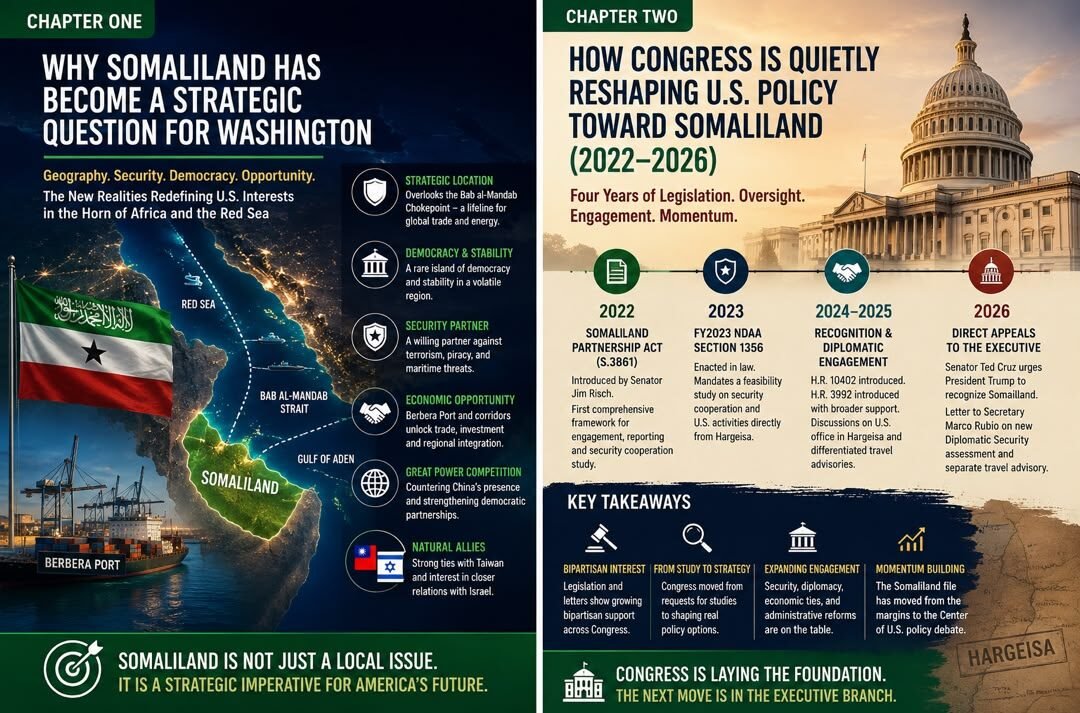
If the preceding four years established a gradual evolution in congressional thinking, 2026 marked the point at which that evolution became a direct effort to influence executive decision-making.
Unlike earlier initiatives, which primarily sought studies, reporting requirements, security cooperation, or legislative debate, senior members of Congress began communicating directly with the President of the United States and the Secretary of State on questions central to Somaliland’s future. These communications did not alter U.S. policy by themselves. They did, however, elevate Somaliland from a subject of committee deliberation to one receiving direct attention from the nation’s highest foreign policy officials.
This transition illustrates an important feature of the American constitutional system. While Congress cannot recognize a foreign state, individual legislators and congressional leaders can shape the policy agenda by presenting strategic arguments, requesting administrative action, and encouraging executive review. In practice, such engagement often precedes major shifts in foreign policy.
⸻
Senator Ted Cruz and the Recognition Question
One of the most consequential developments of 2026 was Senator Ted Cruz’s public appeal urging President Donald Trump to recognize the Republic of Somaliland.
The letter did not present recognition primarily as a historical or humanitarian issue. Instead, it framed the question within the context of American national interests.
The arguments advanced emphasized several interconnected themes:
* Somaliland’s strategic position overlooking the Gulf of Aden and the Bab al-Mandab Strait.
* Its record of internal stability relative to much of the surrounding region.
* Its democratic political institutions.
* Opportunities for expanded security and intelligence cooperation.
* Its relationship with Taiwan.
* Its interest in strengthening ties with Israel.
* The implications of recognition for strategic competition with China.
* The value of reliable regional partners in protecting maritime commerce.
Taken together, these arguments reflected an increasingly common feature of congressional discussion: Somaliland was being evaluated less as an unresolved territorial dispute and more as a potential strategic partner whose characteristics aligned with broader U.S. foreign policy objectives.
Whether one agrees with the recommendation or not, the significance of the letter lies in its framing. Recognition was presented not simply as a moral or historical question but as a policy option linked to contemporary security, diplomacy, and great-power competition.
⸻
Administrative Reform Before Diplomatic Recognition
A second congressional initiative demonstrated that recognition was not the only issue under consideration.
In correspondence addressed to Secretary of State Marco Rubio, Senator Cruz urged the Department of State to undertake a new Diplomatic Security assessment of Somaliland and to consider issuing a travel advisory distinct from that applied to Somalia.
This request was narrower than formal recognition but carried potentially important practical implications.
Supporters of differentiated travel guidance argued that U.S. advisories should accurately reflect security conditions rather than rely upon broad geographic classifications. They contended that treating Somaliland identically to areas experiencing sustained armed conflict could discourage commercial investment, complicate official travel, increase operational costs, and reduce opportunities for diplomatic engagement.
Importantly, such proposals did not require recognition of Somaliland as an independent state. Governments frequently distinguish territories for administrative, consular, or security purposes without making determinations concerning sovereignty.
Accordingly, the request illustrated a broader congressional strategy: where recognition remained politically or diplomatically difficult, practical administrative reforms could nevertheless improve bilateral engagement.
⸻
An Incremental Strategy
Viewed together, congressional initiatives between 2022 and 2026 reveal a deliberate sequence rather than a collection of isolated proposals.
The progression can be summarized as follows:
Phase One: Establish congressional interest through hearings, legislation, and feasibility studies.
Phase Two: Incorporate Somaliland into enacted national security legislation.
Phase Three: Expand discussion to include diplomatic engagement and congressional recognition bills.
Phase Four: Encourage administrative reforms, including differentiated travel guidance and consideration of a U.S. representative presence in Hargeisa.
Phase Five: Present the case for formal recognition directly to the President.
Whether this progression was consciously coordinated or simply reflected converging judgments among different legislators cannot be established from the public record alone. What is clear is that each successive initiative built upon the policy foundations created by earlier congressional actions.
⸻
A Changing Strategic Context
Congressional interest also evolved alongside major geopolitical developments affecting the Horn of Africa and the wider Red Sea region.
Maritime security challenges continued to draw international attention to the Bab al-Mandab Strait. Competition among global and regional powers expanded across East Africa. Infrastructure investment, port development, undersea communications, and military access became increasingly important elements of international strategy.
Within this environment, Somaliland’s geographic position assumed renewed importance.
The Port of Berbera attracted growing commercial and strategic interest. Its proximity to one of the world’s busiest maritime corridors made it relevant to discussions concerning logistics, trade resilience, humanitarian response, and regional security. While different governments assessed these opportunities through different strategic lenses, Congress increasingly viewed Berbera as an asset whose significance extended beyond Somaliland itself.
This broader geopolitical context helps explain why legislative discussions concerning Somaliland increasingly referenced maritime security, supply chains, Indo-Pacific strategy, and strategic competition rather than focusing exclusively on Somalia’s domestic political process.
⸻
Congress and the Executive: Different Constitutional Roles
The developments of 2026 also illustrate the distinction between congressional influence and executive authority.
Under U.S. constitutional practice, the recognition of foreign states is exercised by the President. Congress cannot compel recognition through ordinary legislation alone.
Nevertheless, Congress possesses substantial influence over foreign policy through appropriations, oversight, committee investigations, authorization legislation, public hearings, and sustained political advocacy.
Letters addressed to the President or the Secretary of State therefore serve an important constitutional function. They communicate congressional priorities, articulate strategic reasoning, and encourage executive review, even though they do not themselves change diplomatic recognition.
Understanding this distinction is essential to evaluating congressional initiatives concerning Somaliland. Legislative advocacy should neither be dismissed as merely symbolic nor mistaken for binding executive policy. Its significance lies in shaping the policy environment within which executive decisions are made.
⸻
The Emerging Policy Question
By the middle of 2026, the central question confronting Washington had evolved.
Earlier debates asked whether Somaliland warranted greater attention.
That question had largely given way to a more complex inquiry:
What form should a deeper U.S.–Somaliland relationship take?
Possible answers ranged across a broad spectrum:
* Expanded security cooperation under existing policy.
* Increased economic and development engagement.
* Separate administrative treatment for travel and diplomatic operations.
* Establishment of a representative office in Hargeisa.
* Enhanced intelligence and maritime cooperation.
* Formal diplomatic recognition.
Each option carried different legal, diplomatic, and strategic consequences. The congressional record increasingly reflected discussion across this entire range rather than focusing on a single preferred outcome.
⸻
Conclusion: Four Years That Changed the Debate
Between 2022 and 2026, Congress did not transform U.S. policy toward Somaliland overnight.
What it did accomplish was arguably more enduring.
It created a documented legislative record demonstrating sustained bipartisan interest in Somaliland’s strategic importance. It required executive agencies to evaluate Somaliland independently through statutory reporting. It introduced formal recognition legislation into congressional debate. It examined practical mechanisms for expanding diplomatic engagement. Finally, it presented the case for administrative reform and recognition directly to the President and the Secretary of State.
Whether these developments ultimately lead to changes in executive policy remains uncertain and will depend on future strategic assessments, diplomatic considerations, regional dynamics, and presidential decision-making.
What is beyond dispute, however, is that Somaliland occupies a markedly different place in congressional discourse today than it did only a few years ago. The cumulative record shows a clear progression: from a largely overlooked regional entity to a subject of sustained legislative attention at the intersection of maritime security, great-power competition, diplomacy, and international law.
That transformation provides the foundation for the next chapter, which examines the substance of each major legislative proposal and assesses how individual bills, amendments, and committee initiatives collectively formed the legislative architecture of Congress’s evolving approach to Somaliland.
⸻
End of Chapter Two

Prof. Nassir Hussein Kahin is a researcher, educator, journalist, and geopolitical analyst specializing in the Horn of Africa, the Red Sea, international law, diplomacy, and strategic affairs. To read Full Bio click on this link: ABOUT THE AUTHORProf. Nassir Hussein Kahin