
By Prof. Nassir Hussein Kahin
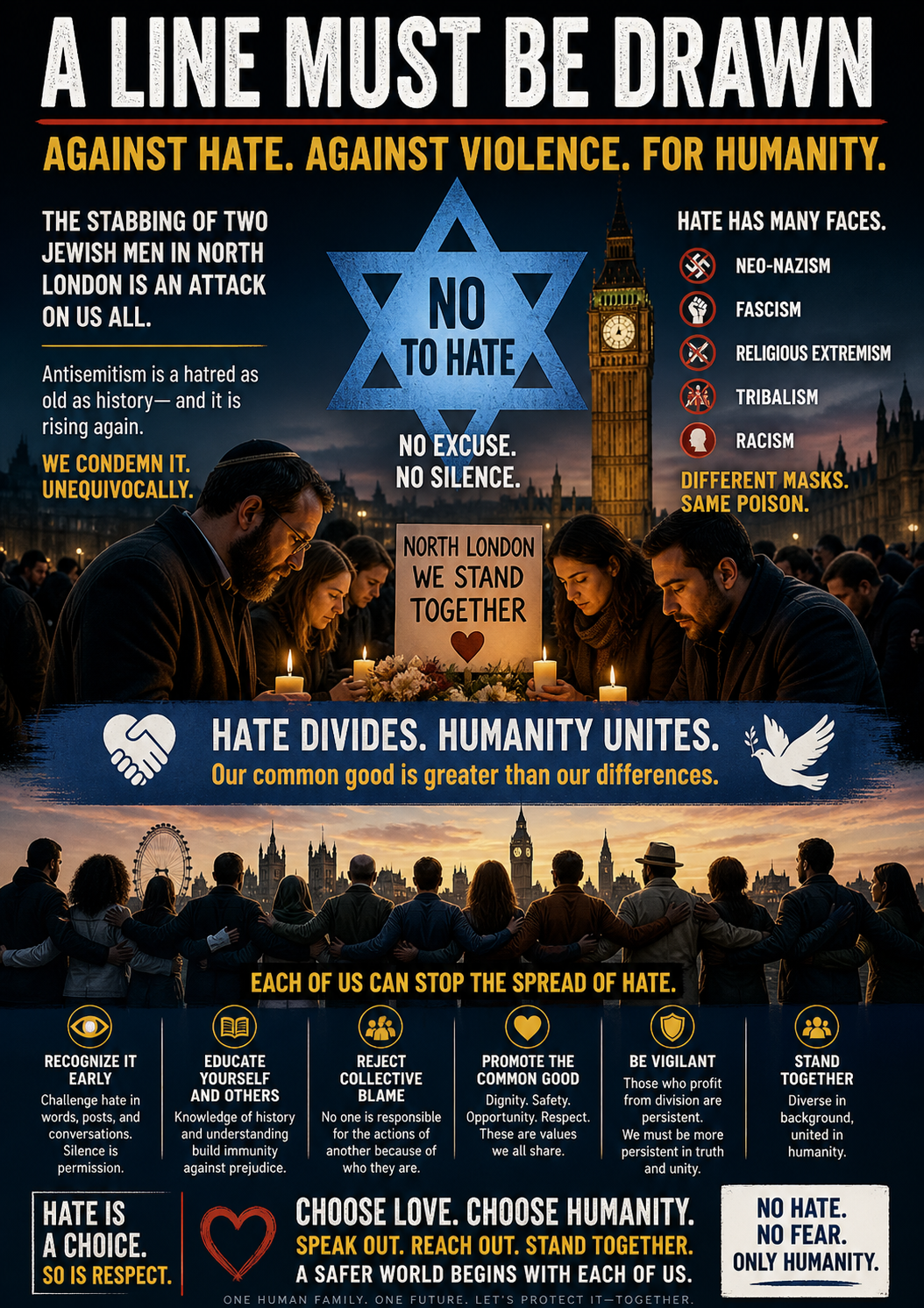
The recent stabbing of two Jewish men in North London is not an isolated crime to be filed away and forgotten. It is a warning. A signal that something corrosive is spreading again—something history has already taught us, at great cost, never to ignore.
This attack must be condemned without hesitation or qualification. Targeting people because of who they are—because of their religion, identity, or perceived affiliation—is an assault not just on the victims, but on the very idea of a civilized society. Antisemitism, in particular, is one of the oldest and most persistent hatreds in human history. When it resurfaces, it rarely travels alone. It comes hand in hand with a wider decay—of truth, of empathy, and of moral courage.
What we are witnessing today is not limited to one city or one country. Across continents, there is a troubling rise in hatred: antisemitism, racism, xenophobia, sectarianism. Old poisons are being repackaged for a new generation. They are spread by extremists of every stripe—whether draped in the symbols of neo-Nazism, cloaked in fascist rhetoric, or justified through distorted interpretations of religion. Different banners, same objective: divide, inflame, and control.
Hate is not spontaneous. It is cultivated.
It begins with language—careless words, dehumanizing labels, insinuations. It grows through repetition, amplified by social media algorithms that reward outrage over truth. It is weaponized by those who seek power through fear, who understand that a divided society is easier to manipulate. And it ultimately manifests in violence—on the streets, in places of worship, in homes.
The most dangerous element in this cycle is the radicalization of the young. A generation raised in a hyper-connected world is increasingly exposed to unfiltered propaganda, conspiracy theories, and ideological extremism. Without guidance, without critical thinking, and without moral grounding, some are drawn into narratives that turn difference into threat, and disagreement into hatred.
This is not someone else’s problem. It is ours.
Each of us has a role to play in stopping this tide before it becomes something far worse.
We must begin by recognizing hate early—challenging it not only when it erupts into violence, but when it first appears in speech, in posts, in casual conversations. Silence is not neutrality; it is permission.
We must educate ourselves and others. Ignorance is the breeding ground of prejudice. Understanding history—especially the catastrophic consequences of antisemitism and other forms of hatred—builds the awareness needed to resist its return.
We must reject collective blame. No individual should ever be held responsible for the actions of another based on shared identity. This principle is fundamental to justice and essential to peace.
We must promote the common good. Beneath the differences of language, religion, or skin color lies a shared humanity—one that values dignity, safety, opportunity, and respect. These are not competing ideals. They are universal.
And finally, we must be vigilant. The forces that profit from division are persistent. They adapt. They exploit moments of uncertainty and fear. But they can be confronted—through truth, through unity, and through a refusal to be manipulated.
The attack in North London should not only shock us. It should awaken us.
Because the line between words and violence is thinner than we often admit. And once crossed, it becomes harder to return.
The choice before us is clear: confront hate now—or pay a far greater price later.
About the Author
