By Professor Nassir Hussein Kahin
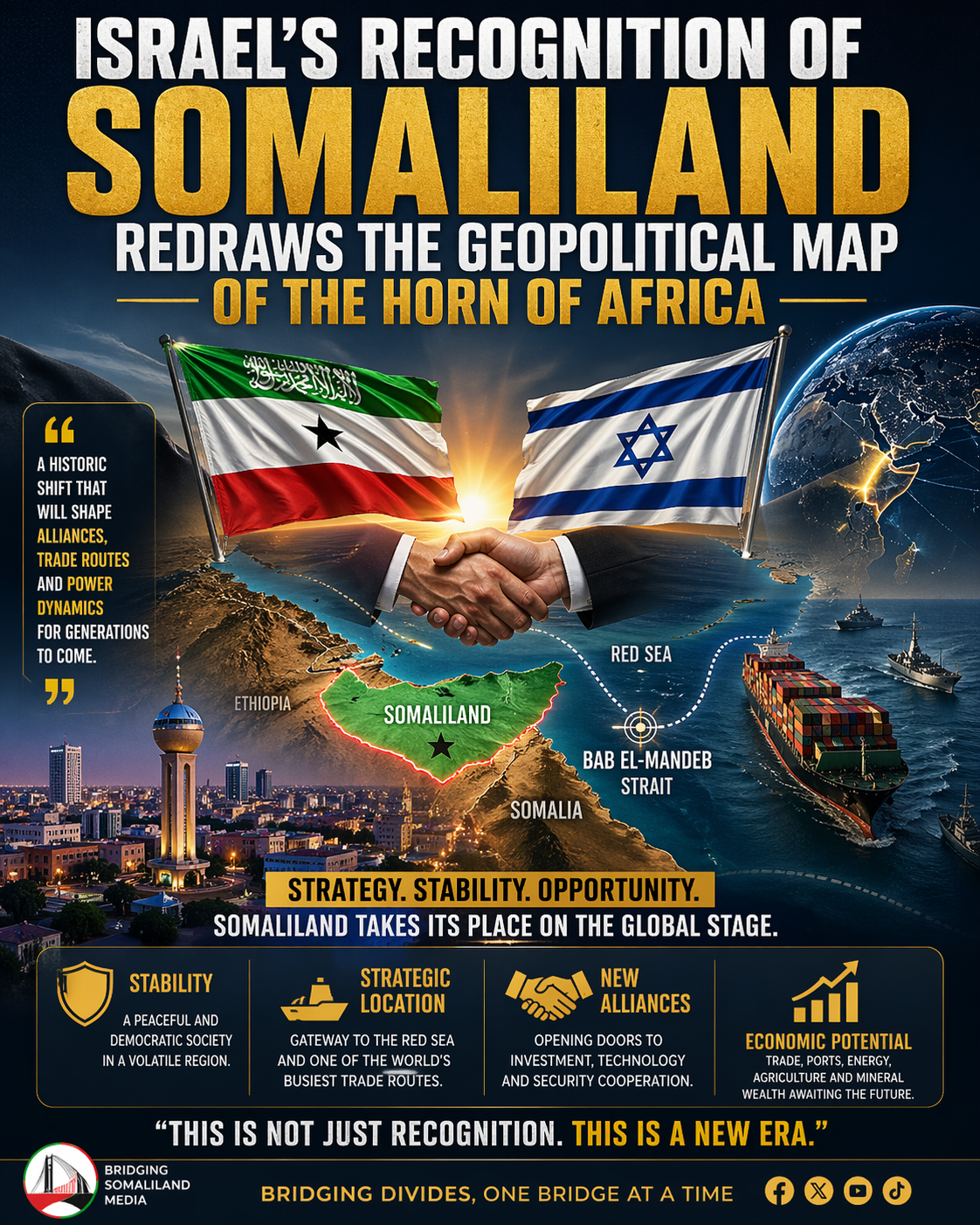
In a move that is already sending shockwaves across the Horn of Africa and beyond, Israel’s decision to formally recognize the Republic of Somaliland—and appoint Michael Lotem as its first ambassador to Hargeisa—may well mark the beginning of a new geopolitical era in one of the world’s most strategically contested regions.
This is not merely a diplomatic gesture. It is a calculated geopolitical statement.
For decades, Somaliland has existed in a paradox—a functioning state without formal recognition. It has built democratic institutions, held elections, maintained internal stability, and secured its territory, all while remaining outside the formal structures of international diplomacy. Now, with Israel’s recognition, that paradox is being challenged in real time.
But this development is not happening in isolation. It is unfolding at the intersection of maritime security, great power rivalry, and shifting alliances stretching from the Middle East to Africa.
At the heart of this shift lies geography. Somaliland sits along the Gulf of Aden, overlooking the Bab el-Mandeb Strait, a narrow maritime corridor through which a significant portion of global trade flows. In an era where supply chains, energy routes, and naval dominance define global power, geography is destiny—and Somaliland has it in abundance.
Israel understands this.
Its expanding diplomatic footprint—shaped in part by the logic of the Abraham Accords—is no longer confined to the Middle East. It is extending outward, seeking reliable partners along critical global trade routes. Somaliland, stable and strategically located, fits perfectly into that vision.
Yet, as expected, the reaction has been swift and sharp.
Iran has condemned the move, framing it as a violation of Somalia’s territorial sovereignty. But beneath the language of international law lies a deeper concern: the expansion of Israeli influence near one of the world’s most sensitive maritime theaters. For Iran, which already exerts influence through allied actors in Yemen, the idea of Israel gaining a foothold across the Red Sea is not just political—it is strategic.
That concern is echoed, more bluntly, by the Houthi movement, which has described the development as a “red line.” Their warning signals a dangerous possibility—that Somaliland, long a symbol of stability, could be pulled into the orbit of broader regional confrontations.
Meanwhile, Somalia maintains its longstanding position, rejecting any recognition of Somaliland as a violation of its sovereignty. Yet this moment exposes a growing divide between legal claims and political realities. Somalia’s argument rests on territorial integrity. Somaliland’s case rests on governance, history, and functionality.
And increasingly, the world appears to be paying attention to the latter.
The truth is that Somaliland’s case has always been unique. Unlike many secessionist movements, it is rooted in a distinct colonial history and a voluntary union that ultimately failed. Even discussions within the African Union have acknowledged that Somaliland cannot be easily compared to other territorial disputes on the continent.
Israel’s recognition may therefore set a precedent—not necessarily a legal one, but a political and strategic one.
It raises an uncomfortable question for the international community:
At what point does a functioning, peaceful, and self-governing entity earn its place among nations?
Beyond the legal debates, a larger transformation is underway. The Horn of Africa is no longer a peripheral region. It is becoming a central arena of global competition, where the interests of the United States, China, Turkey, and Gulf states such as the United Arab Emirates increasingly intersect.
Ports, military access, trade routes, and political alliances are being recalibrated. In this evolving landscape, Somaliland is no longer an overlooked territory—it is an emerging strategic actor.
Israel’s move accelerates that transformation.
For Somaliland, the opportunity is historic. Recognition from a technologically advanced and diplomatically influential state opens doors to investment, security cooperation, and broader international engagement. It strengthens its argument that recognition is not only justified—but overdue.
But the risks are equally real.
With visibility comes vulnerability. As Somaliland steps onto the global stage, it must navigate a complex web of rivalries, ensuring that new partnerships do not entangle it in conflicts beyond its borders. The challenge will be to remain what it has always strived to be: a bridge, not a battleground.
History will likely remember this moment as a turning point—not just for Somaliland, but for the Horn of Africa itself.
Because when one nation is recognized, it does not simply join the map.
It redraws it.
About the Author
