By Nassir Kahin
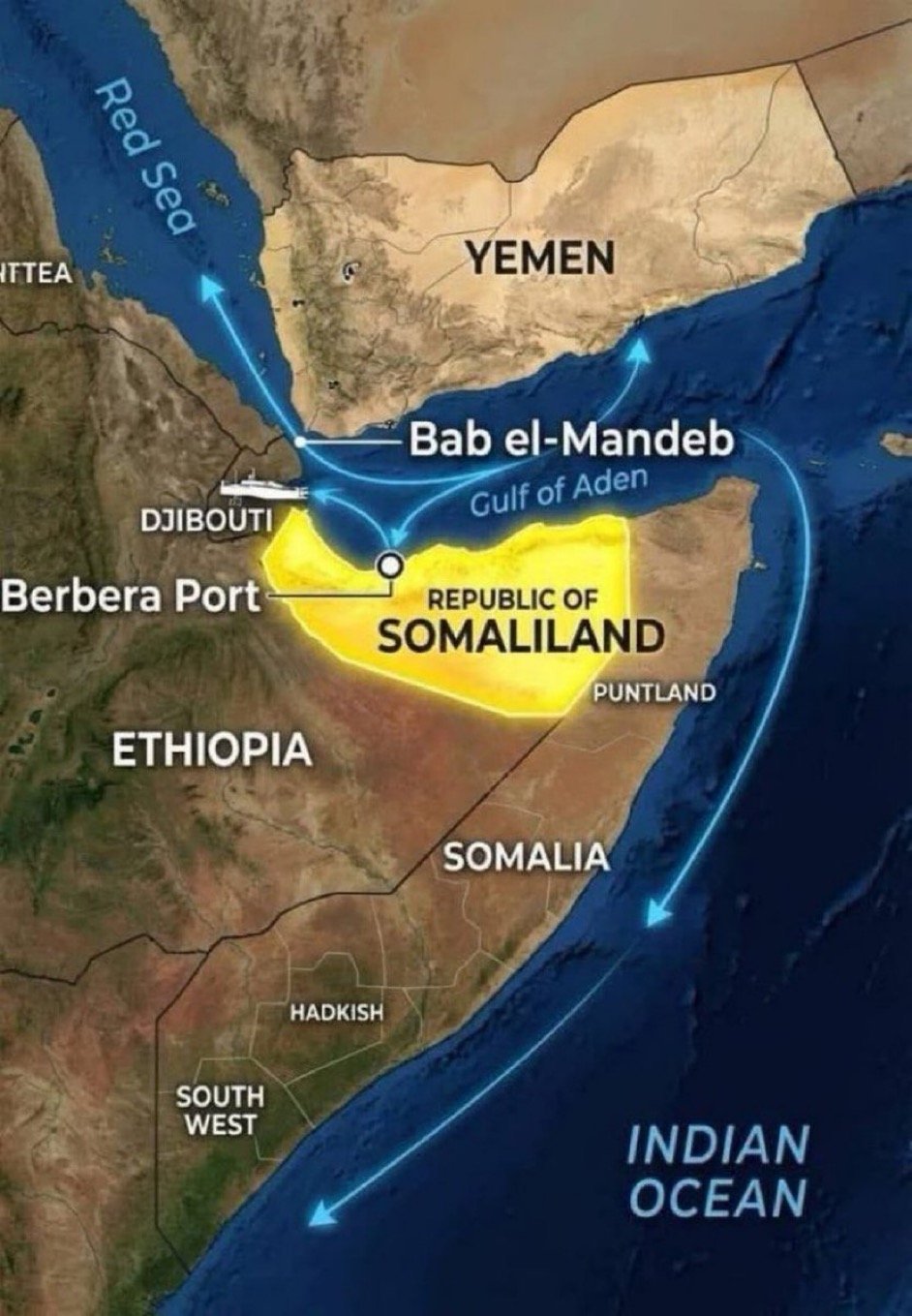
The map of global power is being quietly redrawn along one of the world’s most critical maritime chokepoints: the Bab al-Mandeb Strait. Connecting the Red Sea to the Gulf of Aden, this narrow passage has become a focal point of military positioning, trade security, and geopolitical competition. Yet, in most international discussions, one actor remains underexamined despite its growing importance—Somaliland.
As instability deepens across the Red Sea region—driven by conflict in Yemen, Houthi disruptions to shipping lanes, and renewed tensions involving Iran and Western powers—the need for reliable, stable coastal partners has never been greater. Somaliland’s strategic location along the Gulf of Aden, adjacent to the Bab al-Mandeb corridor, positions it as a potential anchor of maritime stability in an increasingly volatile environment.
Unlike much of the surrounding region, Somaliland has maintained internal peace, functioning governance, and security for over three decades. While Somalia continues to grapple with insurgency and fragile state institutions, Somaliland has built a hybrid political system grounded in local reconciliation, elections, and institutional continuity. This contrast is not merely political—it is strategic.
The development of Berbera Port has significantly elevated Somaliland’s relevance. Backed by international investment, including major infrastructure expansion, Berbera is emerging as a logistics hub capable of supporting regional trade, humanitarian operations, and potentially even maritime security cooperation. In a world where supply chains are being restructured and diversified, such ports are no longer peripheral—they are essential.
For global powers, the Horn of Africa is no longer a secondary theater. The United States, China, the United Arab Emirates, and Turkey have all increased their presence across the region, establishing military bases, port agreements, and diplomatic footholds. Djibouti has long dominated this space, but strategic overreliance on a single node presents risks. Somaliland offers an alternative—one grounded in stability rather than contingency.
The implications extend beyond commerce. The militarization of the Red Sea has accelerated, with naval patrols, drone surveillance, and regional defense alignments becoming more prominent. Securing maritime routes is now inseparable from broader geopolitical strategy. In this context, Somaliland’s coastline—over 800 kilometers along the Gulf of Aden—represents untapped strategic depth.
Yet the paradox remains: despite its functional statehood and strategic relevance, Somaliland remains unrecognized internationally. This disconnect between reality and policy creates limitations—not only for Somaliland but for global actors seeking reliable partnerships. Recognition is no longer simply a diplomatic question; it is increasingly a matter of strategic necessity.
As the international system adjusts to new realities—from disrupted trade routes to intensifying great-power competition—the Horn of Africa is emerging as a central arena. Within this arena, Somaliland is not a peripheral player. It is a missing piece in the architecture of regional stability.
The question is no longer whether Somaliland matters. It is whether the world is prepared to recognize the role it is already playing.
About the Author
