Skip to content
HOASR

Horn of Africa Strategic Review

Strategy| Analysis| Insight| Geopolitics

Primary Menu
  • Home
  • Somaliland Israel Relations
  • Somaliland Recognition & Geopolitics
  • Global Powers: Strategy & Analysis
  • Energy & Strategic Minerals
  • Politics & Government
  • Security and Military Affairs
  • From the Editorial Desk
  • Horn of Africa & Red Sea: Strategy and Analysis
  • Media Hub
  • Opinion & Analysis
Home

Home - Horn of Africa & Red Sea: Strategy and Analysis - Somaliland Is the Red Sea’s Missing Ally

  • Horn of Africa & Red Sea: Strategy and Analysis

Somaliland Is the Red Sea’s Missing Ally

As the Red Sea becomes a theater of confrontation, the absence of Somaliland from the international system is no longer sustainable. It is a strategic blind spot.
hornofafricastrategicreview.com April 2, 2026

By Prof. Nassir Hussein Kahin, International Affairs Writer, Geopolitics Analyst and Managing Editor at Horn of Africa Strategic Review.

In a world increasingly defined by strategic chokepoints and proxy conflicts, the question of Somaliland’s recognition is no longer a matter of diplomatic caution—it is a test of geopolitical clarity.

The recent call by  U.S.  Republican Congressman of Tennessee for the recognition of Somaliland, following the precedent set by Israel, comes at a decisive moment. The entry of the  Houthi Movement into a widening Middle Eastern war—paired with threats to shut down the  Bab -el- Mandab Strait transformed the Red Sea into one of the most dangerous corridors in global trade.

This is no longer a regional issue. It is a global one.

Nearly 12 percent of the world’s seaborne oil and a significant share of global commerce pass through the Bab El-Mandeb, linking the Suez Canal to the Indian Ocean. If this artery is severed, the consequences will ripple across Europe, Asia, and beyond—fueling inflation, disrupting supply chains, and destabilizing markets.

Yet directly across from this volatile chokepoint lies Somaliland: a functioning Democracy, a stable partner, and an unrecognized state.

For over three decades, Somaliland has maintained peace, conducted elections, and built institutions in stark contrast to the instability of southern Somalia. It has done so without international recognition, without access to global financial systems, and without the security guarantees afforded to recognized states.

This is precisely why recognition now matters.

For Israel, Somaliland represents a forward line of defense against Iranian expansion via Yemen. Its recognition aligns naturally with the logic of the Abraham Accords -expanding a network of pragmatic, security-oriented partnerships.

For the United States and its allies, the stakes are even higher.

Iran is no longer confined to the Persian Gulf. Through its proxies, it now threatens both the Straits of Hormuz and the Bab el-Mandeb—effectively positioning itself to choke global trade from two directions.

At the same time, China’s expanding footprint in Djibouti underscores a parallel strategic competition. With its only overseas military base located just miles from Somaliland’s coast, Beijing has already recognized the importance of this geography.

Unfortunately, the West so far has not.

Recognition of Somaliland would immediately unlock a series of strategic advantages: a reliable partner for Maritime Security, a potential host for military and intelligence infrastructure, and a democratic counterweight in a region increasingly shaped by authoritarian influence.

It would also send a powerful message—that democratic resilience, even in the absence of recognition, is not ignored but rewarded.

The argument against recognition has long rested on fears of setting precedents. But Somaliland is not a typical secessionist case. It is a former sovereign entity that voluntarily united with Somalia and later withdrew following state collapse and mass atrocities. Its case aligns closely with the principle of remedial secession under international law.

The greater risk now lies not in recognition, but in continued hesitation.

As the Red Sea becomes a theater of confrontation, the absence of Somaliland from the international system is no longer sustainable. It is a strategic blind spot.

Recognition is not merely an act of diplomacy. It is an act of necessity.

About the Author

20922de5d529790ff230c2bc96afeb05

hornofafricastrategicreview.com

Administrator

Prof. Nassir Hussein Kahin is a researcher, educator, and political analyst specializing in self-determination, international law, and the geopolitics of the Horn of Africa and the Red Sea region. He is the founder of Horn of Africa Strategic Review, an independent platform for geopolitical analysis, where he writes on regional diplomacy, security, global power competition, and emerging global alignments affecting Somaliland with particular focus on Somaliland’s path to international recognition.

Visit Website View All Posts
Tweet
Share
Pin
Share
0 Shares

Post navigation

Previous: From Clan to Citizen: Can Somaliland Reconcile Culture and Statehood?
Next: Bab al-Mandeb, Berbera, and the New Strategic Map of the Horn of Africa

Related Posts

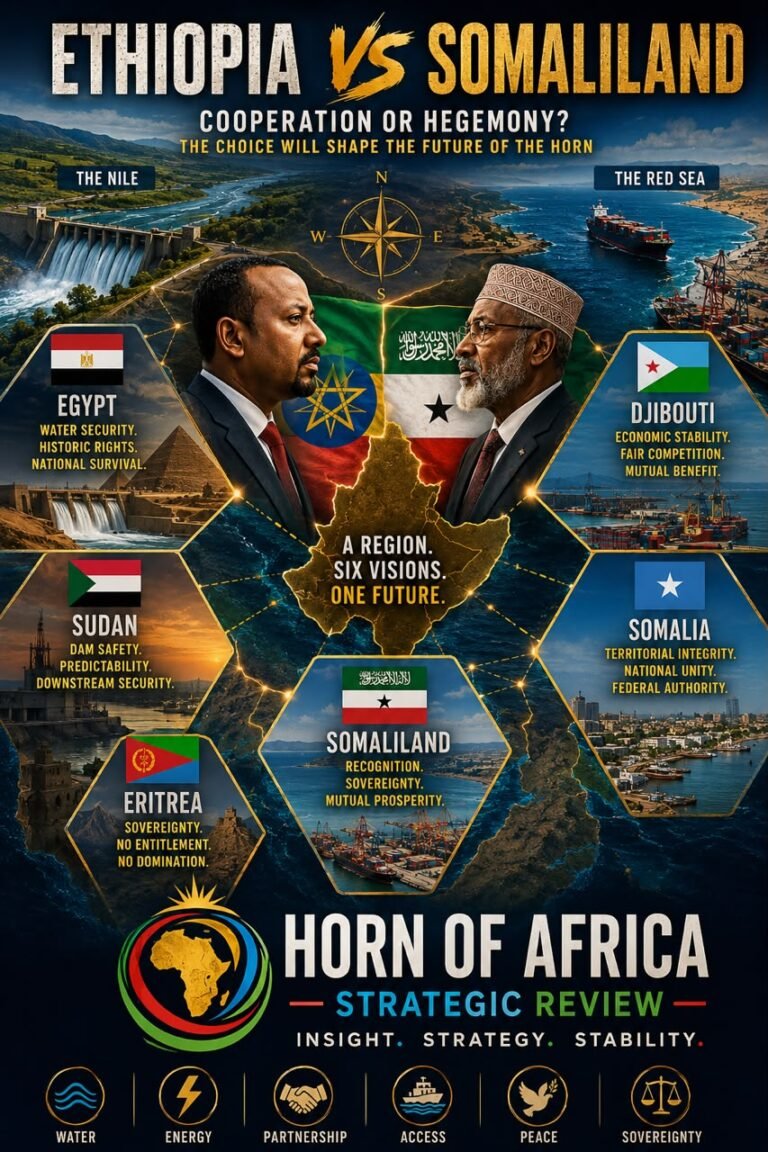
Illustration depicting Ethiopia and Somaliland at the center of competing geopolitical visions in the Horn of Africa, surrounded by Egypt, Sudan, Eritrea, Djibouti and Somalia, with the Nile and Red Sea highlighting regional strategic interests.
  • Horn of Africa & Red Sea: Strategy and Analysis

Ethiopia’s Maritime Doctrine and the Somaliland Test: Cooperation, Recognition or Regional Hegemony?

hornofafricastrategicreview.com July 22, 2026 0
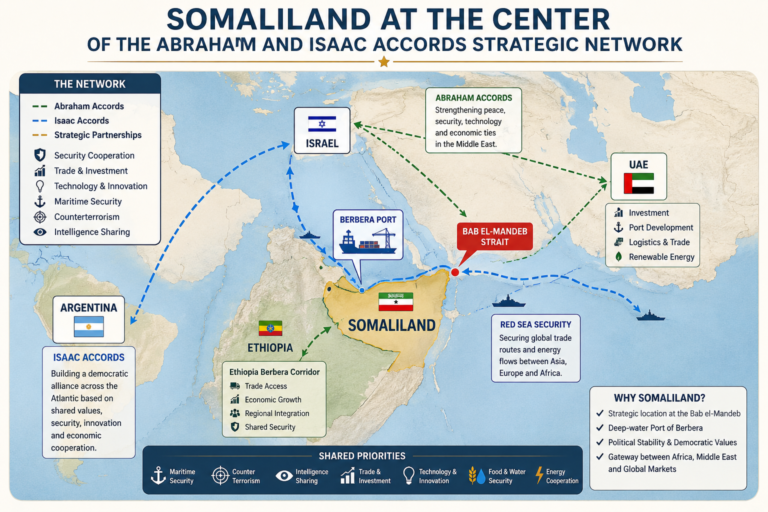
Map showing Isral, Argentina,U.A.E, Ethiopia and Somaliland connected through the Abraham Accords, Isaac Accords, Berbera Port and the Bab El Mandeb Strait
  • Horn of Africa & Red Sea: Strategy and Analysis

From the Abraham Accords to the Isaac Accords: Why Somaliland, the Red Sea and Bab El-Mandeb Could Shape Israel’s Next Geopolitical Architecture

hornofafricastrategicreview.com July 20, 2026 0
F11DE49C-DF89-4A32-903C-D928F19F3FF6
  • Horn of Africa & Red Sea: Strategy and Analysis

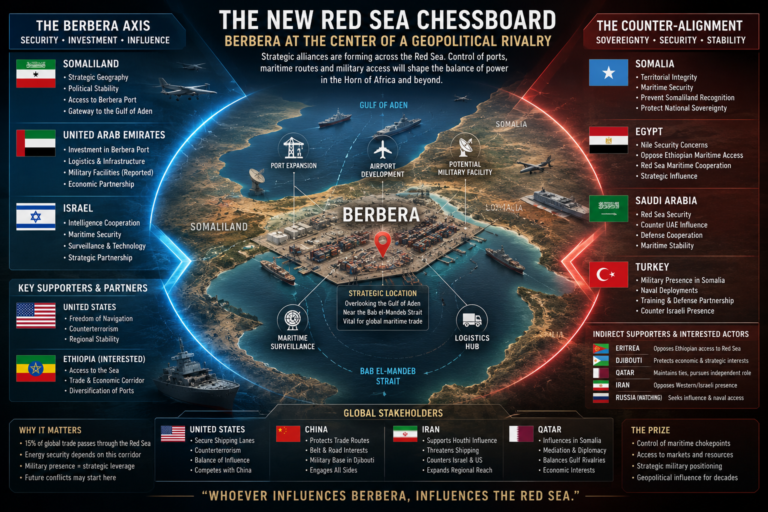
The New Red Sea Chessboard: Competing Strategic Alignments Reshape the Horn of Africa

hornofafricastrategicreview.com July 13, 2026 0

Strategic Analysis

IMG_1407
  • Energy & Strategic Minerals
  • Horn of Africa & Red Sea: Strategy and Analysis

From Livestock to Strategic Ports: The Economic Foundations and Future of Somaliland

hornofafricastrategicreview.com March 7, 2026
U.S Recognition of Somaliland?
  • Energy & Strategic Minerals

Somaliland’s Strategic Offer to the U.S. Gaines New Urgency Amid Red Sea Rivalries and Shifting Global Alliances

hornofafricastrategicreview.com August 6, 2025
U.S.-Somaliland Relationship
  • Energy & Strategic Minerals

Somaliland’s Strategic Offer to America: A Gateway to Mineral Security and Red Sea Stability

hornofafricastrategicreview.com August 5, 2025
Berbera Sawir Fiican
  • Energy & Strategic Minerals

Somaliland’s Bold Gamble: Ports, Minerals, and a Plea for Recognition

hornofafricastrategicreview.com August 1, 2025
Taiwan Semiconductor Manufacturing Company (TSMC)
  • Energy & Strategic Minerals

Taiwan: The Heartbeat of the Modern World

hornofafricastrategicreview.com July 27, 2025
  • Home
  • Horn of Africa Strategic Review
  • About
  • Ownership & Team
  • Editorial Policy
  • Terms of Service
  • Contact Us
Copyright 2025 Horn of Africa Strategic Review Media Company All Rights Reserved. | MoreNews by AF themes.