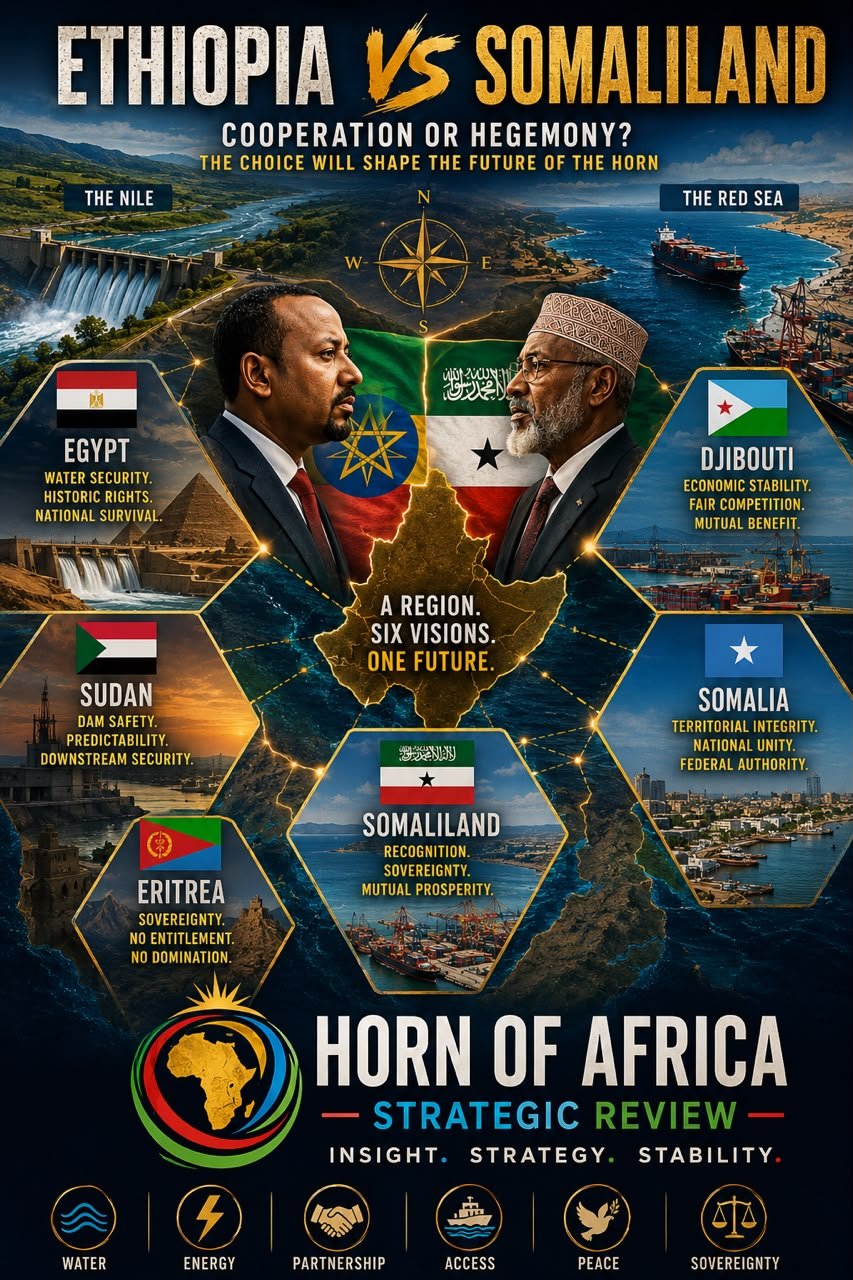
The future of the Horn of Africa may depend on whether Ethiopia’s maritime ambitions evolve into genuine regional cooperation or a new form of geopolitical competition centered on Somaliland and the Red Sea.
By Prof. Nassir Hussein Kahin
Ethiopia Somaliland Maritime Doctrine has become one of the defining geopolitical issues shaping the future of the Horn of Africa and the Red Sea Corridor. Ethiopia’s proposed “new Horn of Africa” is presented as a regional order founded on connectivity, sovereign equality and shared prosperity. Addis Ababa argues that rivers, electricity networks, transport corridors and ports should unite the region rather than divide it. It portrays the Grand Ethiopian Renaissance Dam as an engine of African development and access to the sea as an economic necessity for one of the world’s largest landlocked countries.
The language is constructive. The strategic practice is considerably more complicated.
For Somaliland, Ethiopia’s vision must be judged not by diplomatic slogans but by one decisive question: Does Addis Ababa regard Somaliland as a sovereign strategic partner, or merely as a convenient coastline through which Ethiopia can solve its maritime disadvantage?
That question sits at the centre of the contest now unfolding across the Horn of Africa.
Ethiopia Somaliland Doctrine Explained
Ethiopia’s population, market, military power and geographic position make it indispensable to regional stability. However, these same advantages create legitimate anxiety among its neighbours.
When a major regional power describes its own strategic requirements as the collective interests of the entire Horn, cooperation can gradually become hierarchy. Ethiopia’s need for electricity becomes the region’s development agenda. Its desire for sea access becomes a regional integration project. Its security priorities become the basis for intervention in neighbouring political systems.
The underlying danger is clear: Ethiopia may be attempting to universalize its national ambitions by presenting them as shared regional necessities.
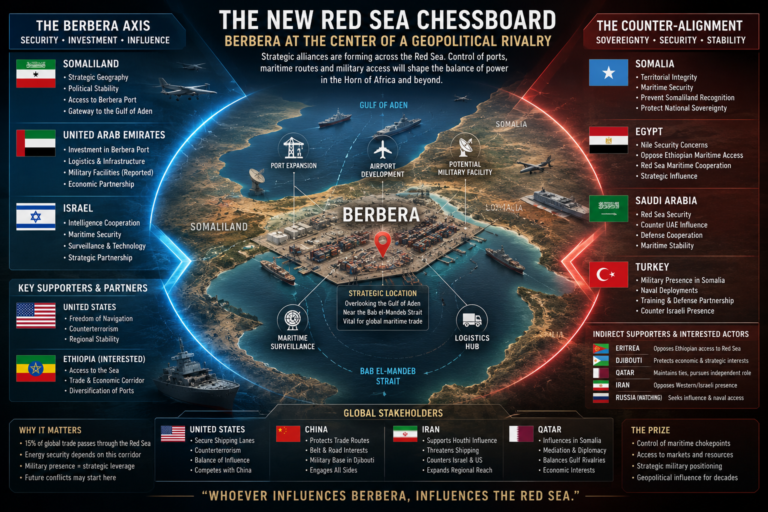
Egypt does not interpret the GERD solely as a development project. It sees a massive upstream state gaining unprecedented control over the river upon which Egypt’s national survival depends. Sudan may benefit from regulated water flows and electricity, but it also faces the immediate consequences of dam failure, uncoordinated releases or political confrontation.
Eritrea hears Ethiopian language about a “right” to the sea through the memory of annexation, armed struggle and the 1998–2000 border war. Djibouti sees maritime diversification as a potential threat to the port economy on which its national revenue and strategic relevance depend.
Somalia interprets Ethiopian engagement with Somaliland as an attack on the territorial claim Mogadishu continues to assert over the Republic of Somaliland.
Somaliland, however, occupies a fundamentally different position. It is neither a downstream Nile state nor an opponent of Ethiopian maritime access. It has consistently demonstrated that it is prepared to offer Ethiopia a peaceful, commercially viable and strategically valuable route to the Gulf of Aden.
The dispute is therefore not over access. It is over the political and sovereign terms under which that access is provided.
Somaliland Offers Ethiopia What Its Geography Denies It
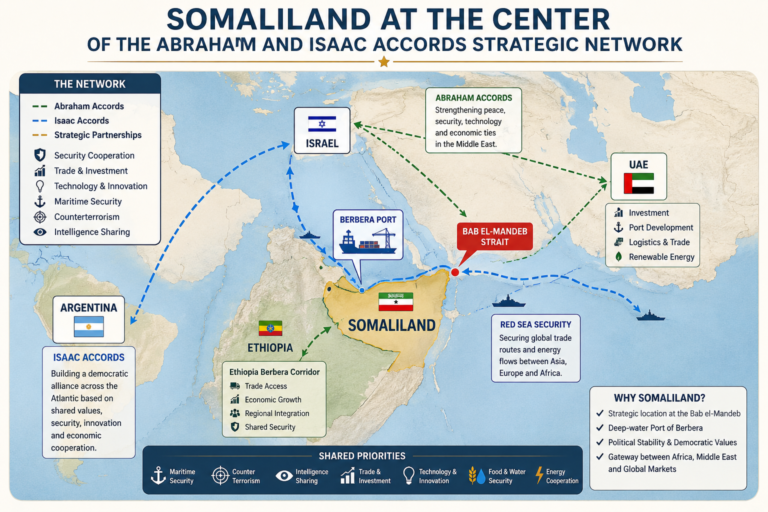
Somaliland possesses precisely what Ethiopia requires: a stable coastline, the Port of Berbera, access to major international shipping lanes and a land corridor connecting the Gulf of Aden with the Ethiopian interior.
Unlike military pressure against Eritrea or indefinite dependence on Djibouti, cooperation with Somaliland offers Ethiopia a negotiated route to maritime diversification.
The memorandum signed on January 1, 2024, represented the clearest expression of this strategic compatibility. Public accounts indicated that Ethiopia would receive long-term access to part of Somaliland’s coastline, while Somaliland understood that Ethiopia would move toward formal recognition of its sovereignty. The full text was not publicly released, but the political exchange was widely described as maritime access for Ethiopia linked to recognition for Somaliland.
The arrangement carried historic significance. Somaliland was prepared to help resolve one of Ethiopia’s most serious structural disadvantages. In return, Ethiopia was expected to acknowledge a political reality that has existed since Somaliland restored its sovereignty in 1991.
That was not charity from either side. It was strategic reciprocity.
Somaliland was offering geography, infrastructure and security. Ethiopia was expected to offer diplomatic recognition, investment and a durable political partnership.
Any Ethiopian attempt to separate these two sides of the bargain would transform cooperation into exploitation.
Recognition vs the Ethiopia Somaliland Maritime Doctrine.
Somaliland must reject any formula under which Ethiopia obtains commercial, naval or logistical benefits while indefinitely postponing recognition.
Such an outcome would establish a dangerous precedent: Somaliland would assume the diplomatic risks of confronting Somalia and its external supporters, while Ethiopia collected the strategic rewards.
Somaliland would expose its coastline to regional competition. It would become a target of diplomatic pressure and potentially military intimidation. Yet Addis Ababa could retain the freedom to retreat from its political commitments whenever relations with Mogadishu, Cairo, Ankara or another external actor changed.
That would not constitute a partnership among equals. It would be strategic extraction.
Somaliland is not merely a strip of coastline available to the highest bidder. Berbera is part of a sovereign national territory governed by institutions, laws and a population that has maintained its political independence for more than three decades.
Ethiopia cannot credibly advocate sovereign equality in the Nile Basin while treating Somaliland’s sovereignty as negotiable. Nor can Addis Ababa argue that inherited regional arrangements should be replaced by contemporary realities while simultaneously refusing to acknowledge the contemporary reality of Somaliland’s statehood.
This is the central contradiction in Ethiopia’s doctrine.
Addis Ababa asks Egypt to abandon inherited privileges and accept a new balance on the Nile. It asks Eritrea and Djibouti to recognize Ethiopia’s modern economic need for diversified maritime access. Yet when Somaliland asks Ethiopia to recognize its restored sovereignty, Ethiopia becomes cautious, procedural and politically ambiguous.
A doctrine that demands flexibility from others but offers none in return is not regional transformation. It is selective revisionism.
The Ankara Contradiction
The December 2024 Ankara Declaration between Ethiopia and Somalia further complicated Somaliland’s position.
In that declaration, Ethiopia and Somalia reaffirmed respect for each other’s sovereignty, unity, independence and territorial integrity. They also agreed to pursue arrangements through which Ethiopia could obtain reliable maritime access under Somali sovereign authority. From Mogadishu’s perspective, this was a diplomatic recovery. Somalia had strongly opposed the Ethiopia–Somaliland memorandum (MoU) and insisted that maritime agreements involving Somaliland could proceed only through Somalia’s federal government.
From Somaliland’s perspective, however, the Ankara process created a profound problem.
Ethiopia had entered a bilateral understanding with Somaliland concerning territory administered exclusively by Hargeisa. It then entered negotiations with Mogadishu based on a declaration affirming Somalia’s claimed territorial integrity, without Somaliland being a party to that process.
No government in Mogadishu administers Berbera, controls Somaliland’s coastline, collects customs revenue there or provides security to the port. Somalia cannot lawfully or practically grant Ethiopia access to territory it does not govern.
Any attempt to secure Ethiopian access through Mogadishu would therefore amount to negotiating over Somaliland without Somaliland.
That approach would contradict the very principles of consent, sovereign equality and dialogue Ethiopia claims to defend.
Somaliland should make its position unmistakable: no government can grant, lease or negotiate Somaliland’s territory except the government and people of Somaliland.
Berbera Is Not Ethiopia’s Entitlement
Ethiopia has a legitimate interest in reliable access to international markets. It does not possess an automatic right to sovereign territory on the Red Sea or Gulf of Aden.
International cooperation can provide Ethiopia with port services, transit rights, bonded corridors, railway connections, customs facilities and commercial partnerships. None of these arrangements requires the transfer of Somaliland’s sovereignty or the establishment of unrestricted Ethiopian military control.
The distinction between access and ownership must remain absolute.
A commercial corridor can benefit both societies. An arrangement that creates extraterritorial authority, unclear military jurisdiction or permanent strategic dependence would endanger Somaliland’s sovereignty.
Somaliland should therefore insist that any future agreement include transparent territorial limits, defined duration, parliamentary oversight, environmental protections, local employment guarantees, revenue-sharing provisions and clear jurisdiction over security matters.
Recognition must not be reduced to an informal promise. It must become an official diplomatic act linked to enforceable implementation.
Somaliland Is a Partner, Not a Bargaining Instrument
Addis Ababa must also resist the temptation to use Somaliland as leverage in negotiations with Somalia, Eritrea or Djibouti.
Somaliland cannot be treated as a negotiating card that Ethiopia displays when seeking concessions from Mogadishu and then puts aside when regional pressure increases. Such behaviour would undermine trust and damage Ethiopia’s long-term credibility.
Ethiopia’s most sustainable maritime strategy is not based on threats against Eritrea, the economic displacement of Djibouti or an agreement with Somalia over territory Somalia does not control.
It is based on a direct, transparent and mutually beneficial partnership with Somaliland.
Somaliland offers Ethiopia something no other option can provide simultaneously: strategic proximity, political willingness, a functioning port, territorial stability and a government actively seeking deeper integration.
In return, Ethiopia must offer more than expressions of friendship. It must demonstrate political courage.
Recognition would not be a reward granted to Somaliland for port access. It would be acknowledgment of an existing state that meets the practical standards of sovereignty far more convincingly than many internationally recognized governments.
Somaliland Must Define Its Own Red Lines
Somaliland should welcome Ethiopian trade, investment and regional integration, but it must negotiate from a position of sovereign confidence.
Its minimum conditions should be clear.
First, maritime access must be connected to explicit and irreversible Ethiopian recognition.
Second, Somaliland must retain full sovereignty over its territory, coastline, territorial waters and security decisions.
Third, no agreement between Ethiopia and Somalia may determine Somaliland’s political status or dispose of its territory.
Fourth, infrastructure investment must create measurable benefits for Somaliland, including employment, transport development, energy connectivity, customs revenue and industrial expansion.
Fifth, any military component must be limited, transparent and subject to Somaliland law and national oversight.
Finally, the government must ensure that no external agreement compromises Somaliland’s relations with other strategic partners or transforms Berbera into an arena for proxy confrontation.
These are not unreasonable demands. They are the basic requirements of a sovereign state defending its national interest.
The Future of Ethiopia Somaliland Maritime Doctrine
Ethiopia claims that the old Horn of Africa—defined by exclusion, inherited privilege and geopolitical rivalry—must give way to a new regional order based on equality and shared development.
Somaliland offers Addis Ababa the opportunity to prove that claim.
If Ethiopia recognizes Somaliland, respects its sovereignty and develops the Berbera corridor through a transparent partnership, it will demonstrate that its maritime policy can produce genuine regional cooperation.
If it seeks access without recognition, negotiates Somaliland’s territory through Mogadishu or uses Somaliland merely to pressure other coastal states, then its language of integration will be exposed as a cover for regional hegemony.
The question is no longer whether Ethiopia needs the sea. That need is evident.
The question is whether Ethiopia is prepared to reach the sea through diplomacy among equals—or whether it believes its demographic and economic weight entitles it to redefine the sovereignty of smaller neighbours.
For Somaliland, Berbera must never become the price of temporary Ethiopian goodwill.
It should become the foundation of a historic strategic partnership—but only one built on recognition, reciprocity and unambiguous respect for Somaliland’s sovereignty.
Ethiopia’s vision for a new Horn of Africa will ultimately be judged at Somaliland’s coast. There, between Addis Ababa and Berbera, the region will discover whether Ethiopia truly seeks cooperation—or merely a more sophisticated form of dominance.
Ultimately. the success or failure of the Ethiopia Somaliland Maritime Doctrine will depend on whether Addis Ababa demonstrates that maritime access is based on sovereign equality, reciprocity and recognition rather than strategic dominance.
About the Author