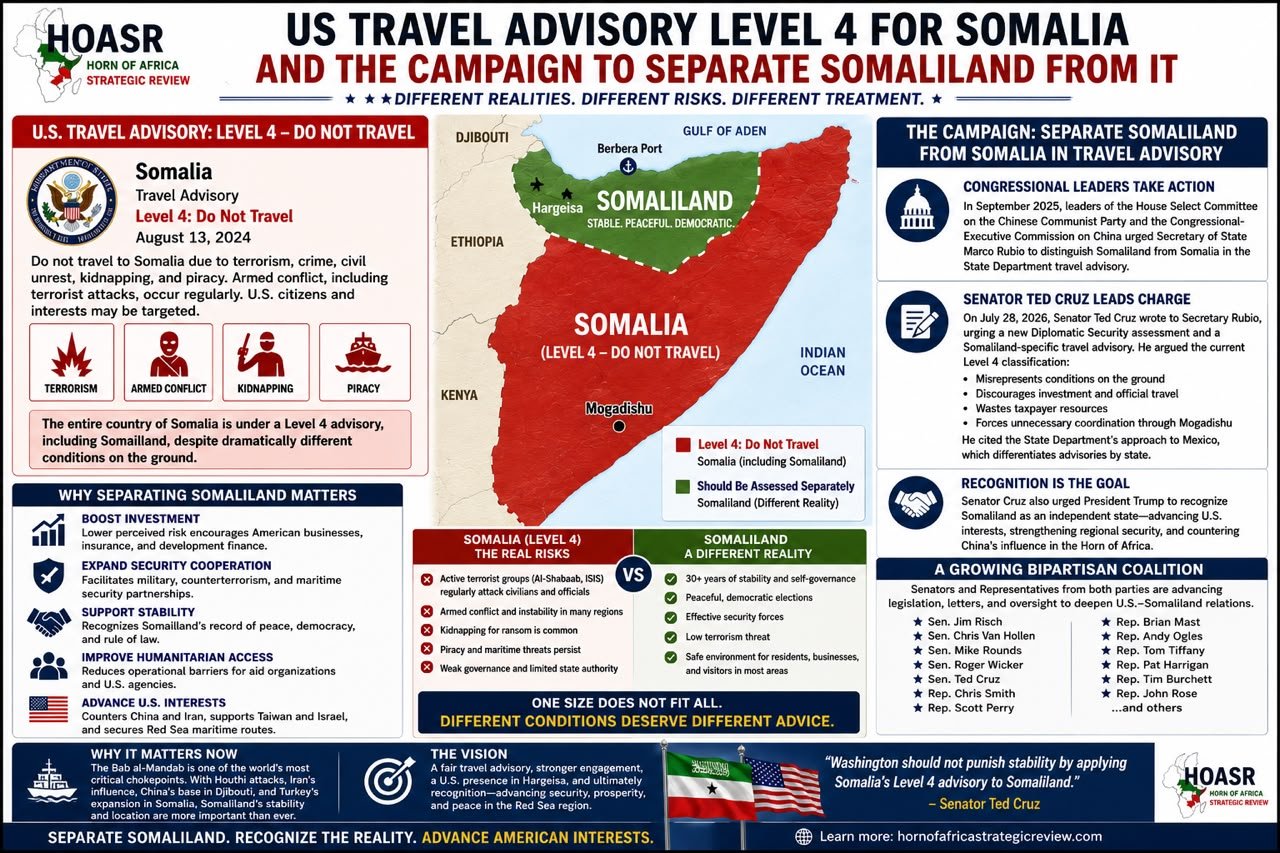
Congressional leaders argue Somaliland deserves a separate U.S. travel advisory reflecting conditions on the ground rather than Somalia’s Level 4 designation.
The Travel Advisory Campaign: Separating Somaliland from Somalia
By Prof. Nassir Hussein Kahin
The question of a separate travel advisory may appear technical, but in diplomacy technical classifications often produce strategic consequences.
The State Department has historically placed Somaliland under the same Level 4 “Do Not Travel” advisory applied to Somalia as a whole. That designation affects private investment, insurance, official travel, diplomatic security requirements and perceptions of political risk.
Congressional supporters argue that this approach ignores the substantial differences between security conditions in Somaliland and those in southern and central Somalia.
In September 2025, leaders associated with the House Select Committee on the Chinese Communist Party and the Congressional-Executive Commission on China wrote to Secretary of State Marco Rubio requesting that the Department distinguish Somaliland from Somalia in its travel advisory.
The letter argued that separate treatment would recognize Somaliland’s cooperation with Taiwan, its resistance to Chinese pressure and its support for American interests. It also noted that the FY2023 NDAA had already treated Somaliland distinctly from Somalia’s federal member states. (Select Committee on the CCP)
This congressional effort subsequently gained an even more prominent advocate.
Senator Ted Cruz of Texas, chairman of the Senate Foreign Relations Subcommittee on Africa and Global Health Policy, wrote to Secretary Rubio on July 28, 2026, urging the State Department to conduct a new Diplomatic Security tiered assessment and establish a region-specific travel advisory for Somaliland.
Cruz argued that applying Somalia’s Level 4 advisory equally to Somaliland did not reflect conditions on the ground. He maintained that the policy discouraged American investment, obstructed official travel, wasted public resources and forced unnecessary coordination through Mogadishu.
His argument was uncompromising: Washington was effectively punishing Somaliland’s stability by subjecting it to the same treatment as the insecurity elsewhere in Somalia.
The senator also invoked the precedent of Mexico, where State Department advisories distinguish among individual states according to actual security conditions.
The significance of Cruz’s request extends beyond tourism.
A separate Diplomatic Security assessment could alter how U.S. diplomats, military personnel, aid officials, investors and congressional delegations operate in Somaliland. It could lower bureaucratic barriers to direct engagement and create the administrative architecture for a future American presence in Hargeisa.
In diplomatic practice, differentiated treatment often precedes differentiated policy.
Senator Cruz Takes Recognition Directly to President Trump
The travel advisory letter followed Senator Cruz’s more consequential appeal to President Donald Trump.
In August 2025, Cruz formally urged the president to recognize Somaliland as an independent state within its 1960 borders.
He presented recognition not as charity or symbolic justice, but as an American national-security requirement.
Cruz highlighted Somaliland’s location along the Gulf of Aden, its security forces, counterterrorism and anti-piracy role, partnership with Taiwan, interest in stronger relations with Israel, support for the Abraham Accords, willingness to host an American military presence and potential role in critical-minerals supply chains.
He also placed China at the centre of the argument.
According to Cruz, Beijing was attempting to punish Somaliland for its Taiwan relationship and was using diplomatic and economic leverage through Somalia to weaken Hargeisa’s sovereignty.
The senator’s conclusion was clear: Somaliland could serve American interests more effectively if Washington granted it the status of a state.
This was not an isolated statement from a backbench legislator.
Cruz held a relevant Senate Foreign Relations subcommittee chairmanship and addressed the recognition decision directly to the president, who possesses the constitutional authority to recognize foreign states on behalf of the United States.
The sequence is revealing.
First, Cruz requested formal recognition.
Then he pressed the State Department for a separate security assessment and travel advisory.
The two letters should therefore be understood as complementary rather than unrelated.
Recognition is the strategic objective.
A separate advisory, revised security classification and expanded direct engagement are practical steps that could prepare the institutional ground.
A Growing Congressional Coalition
The congressional coalition supporting deeper U.S.–Somaliland relations is broader than the sponsors of any single measure.
It has included senior or influential lawmakers from the Senate Foreign Relations Committee, House Foreign Affairs Committee, Senate Armed Services circles, the House Select Committee on China and legislators focused on Taiwan, Africa, maritime security and national defence.
Among the most prominent congressional figures associated with Somaliland-related legislation or advocacy are:
Senator Jim Risch, who sponsored the Somaliland Partnership Act and criticized the limitations of Washington’s traditional “single Somalia” framework.
Senator Chris Van Hollen, whose participation gave the 2022 partnership legislation an explicitly bipartisan character.
Senator Mike Rounds, a senior voice on defence and Africa policy who joined the Somaliland Partnership Act.
Senator Roger Wicker, a leading defence-policy Republican and original cosponsor of the partnership legislation.
Senator Ted Cruz, who has directly urged President Trump to recognize Somaliland and pressed Secretary Rubio to separate Somaliland from Somalia in the travel advisory system.
Representative Chris Smith, who advanced the Somaliland security feasibility study through the FY2023 defence authorization process.
Representative Scott Perry, sponsor of the 2024 and 2025 Somaliland recognition bills.
Representative Andy Ogles, an original supporter of both recognition measures.
Representatives Tom Tiffany, Pat Harrigan, Tim Burchett and John Rose, who joined the current House recognition bill.
Representative Brian Mast, chairman of the House Foreign Affairs Committee and sponsor of the State Department legislation proposing consideration of a U.S. representative office in Hargeisa and separate travel advisories.
This is not yet a majority coalition for recognition.
But it is a sustained and expanding network of legislators using different instruments to advance the same strategic direction.
Some pursue recognition directly.
Others emphasize security cooperation.
Others focus on Taiwan and opposition to China.
Others promote a U.S. office, travel differentiation or commercial access.
Together, they are dismantling the bureaucratic assumption that Somaliland must always be treated through Mogadishu.
What Has Passed—and What Has Not
The political momentum is real, but it must not be exaggerated.
The principal Somaliland-related measure clearly enacted into U.S. law was the FY2023 NDAA provision requiring a feasibility study and report on security cooperation and the conduct of U.S. activities in Hargeisa.
The Somaliland Partnership Act advanced through committee but did not become law.
The recognition bills introduced in 2024 and 2025 have not passed Congress.
The proposal to consider a representative office in Hargeisa and bifurcate travel advisories advanced through the House Foreign Affairs Committee as part of H.R.5300 but had not completed the legislative process in the most recently available record.
The Cruz recognition and travel-advisory letters are influential congressional communications, not binding law.
This does not diminish their importance.
Legislative change in American foreign policy frequently develops through accumulation: hearings, letters, reporting requirements, pilot programs, defence provisions, committee bills and repeated reintroduction.
Somaliland’s congressional campaign has now reached nearly every stage short of final recognition.
The Red Sea Crisis Changes the Strategic Calculation
The acceleration of congressional advocacy cannot be separated from the transformation of the Red Sea into an active theatre of geopolitical confrontation.
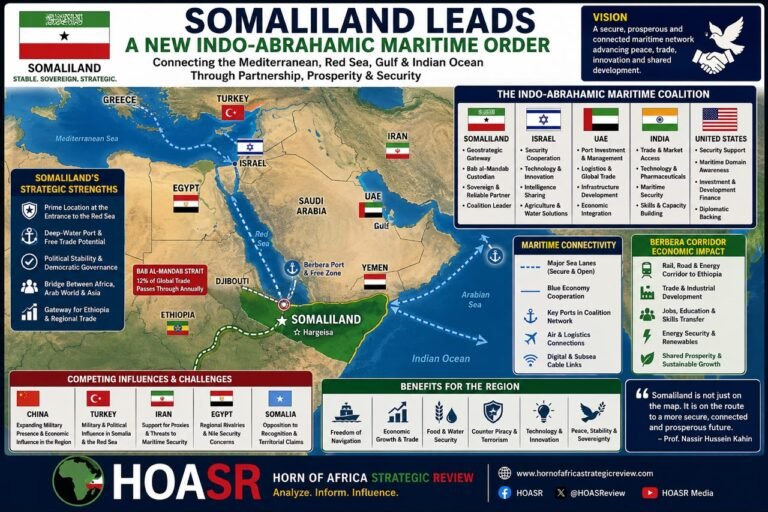
The Bab el-Mandeb connects the Gulf of Aden to the Red Sea and the Suez Canal. Disruption at this narrow corridor affects shipping between Asia, Europe and the Mediterranean.
Iranian-backed Houthi operations, attacks on commercial shipping, regional missile and drone warfare, piracy risks and expanding naval deployments have elevated the strategic importance of every port, airfield and security partner along the waterway.
Djibouti hosts military facilities used by the United States, China, France, Japan and other foreign powers.
China’s base there gives Beijing a permanent military foothold adjacent to the Bab al-Mandab.
Turkey has expanded its military and security position in Somalia.
The United Arab Emirates has developed commercial and strategic interests around Berbera.
Iran and its regional partners have demonstrated the ability to threaten maritime movement well beyond Yemen’s immediate coastline.
Within that environment, Somaliland’s geography is no longer a secondary consideration.
Berbera sits on the southern side of the Gulf of Aden, east of Djibouti and opposite Yemen. Its port, long runway and surrounding territory offer potential relevance for maritime surveillance, logistics, counterterrorism, evacuation operations, naval support and the protection of shipping routes.
This does not mean Somaliland should recklessly militarize its territory or surrender sovereign control to foreign powers.
It does mean that the United States and its allies increasingly view the Somaliland coast through the same strategic map that includes the Bab al-Mandab, Yemen, Djibouti, the Red Sea and the western Indian Ocean.
Geography has become Somaliland’s strongest diplomatic argument.
Trump, Netanyahu and the Wider Iran–Red Sea Confrontation
The latest meeting between President Trump and Israeli Prime Minister Benjamin Netanyahu adds urgency to this evolving strategic picture.
Netanyahu travelled to Washington this week for talks centred primarily on Iran and regional security. Reporting indicated that the two leaders examined diplomatic, economic and potential military options concerning Tehran, while regional maritime and energy-security consequences formed part of the wider strategic environment.
Public reporting has not established that Somaliland recognition was specifically discussed. It would therefore be irresponsible to claim that the issue was formally placed on the Oval Office agenda without evidence.
Nevertheless, the geopolitical overlap is undeniable.
Israel’s security concerns extend across the Red Sea theatre—from Iran and Yemen to maritime access, shipping protection and the security of the approaches to Eilat.
The United States is simultaneously reassessing force posture, regional partnerships, Iran policy, critical shipping routes and the future of the Abraham Accords.
Somaliland intersects with each of those questions.
It occupies territory adjacent to the maritime route threatened by Iranian-aligned forces.
It has openly supported closer ties with Israel and the Abraham Accords.
It maintains a formal representative relationship with Taiwan.
It has offered security cooperation to the United States.
It lies near China’s first overseas military base.
It possesses a major port and an airfield with regional logistical value.
It is therefore reasonable to infer that Somaliland’s strategic relevance is rising within the broader Red Sea policy debate—even where public readouts do not mention it by name.
The distinction between inference and confirmed discussion must remain clear.
Israel’s Role in the Recognition Equation
Israel’s engagement with Somaliland has altered the political context surrounding American recognition advocacy.
For congressional supporters, Somaliland’s orientation toward Israel strengthens the argument that Hargeisa belongs within a network of pro-American partners extending from the eastern Mediterranean through the Gulf and into the Horn of Africa.
Somaliland’s support for the Abraham Accords gives recognition advocates a framework familiar to President Trump.
The case can be presented not simply as recognizing an African state, but as expanding a strategic architecture built around normalization, maritime security, trade, counterterrorism and resistance to Iranian and Chinese influence.
This framing is particularly suited to the Trump administration’s transactional foreign-policy outlook.
Somaliland offers strategic geography, security cooperation, commercial opportunities and alignment with Taiwan and Israel.
In return, it seeks recognition, direct diplomatic relations, investment and security guarantees.
Whether Washington ultimately accepts that exchange remains uncertain.
But congressional advocates are increasingly presenting it as a mutually beneficial bargain rather than a moral favour.
Why the Old “One Somalia” Policy Is Weakening
For decades, the principal argument against recognizing Somaliland was that doing so might destabilize Somalia, undermine African Union principles and encourage secessionist movements elsewhere.
That argument remains influential inside diplomatic institutions.
But it is becoming less persuasive for three reasons.
First, Somaliland’s claim is historically distinct.
It was the former British Somaliland Protectorate, became independent on June 26, 1960, received international recognition and entered a voluntary union with the former Italian-administered territory several days later.
Its argument is therefore restoration of the sovereignty of a previously independent state—not the creation of entirely new colonial boundaries.
Second, more than three decades of attempts to rebuild a unified Somali state have not produced effective authority from Mogadishu over Somaliland.
The legal fiction of unity has not created political unity on the ground.
Third, the costs of the old policy are becoming more visible.
Treating Somaliland as indistinguishable from Somalia obstructs investment, complicates security cooperation, misrepresents travel risk and forces American officials to route engagement through a government that does not administer Somaliland.
Congressional critics increasingly regard that framework as strategically obsolete.
Recognition Is Still an Executive Decision
Congress can authorize, pressure, investigate, legislate and shape the political environment.
But formal diplomatic recognition remains principally an executive power exercised by the president.
H.R.3992 itself recognizes this constitutional reality by authorizing the president to recognize Somaliland rather than attempting to establish full diplomatic relations solely by congressional declaration.
That makes the Trump administration the decisive arena.
President Trump could move incrementally by directing a separate travel advisory, ordering updated security assessments, authorizing a representative office, expanding military engagement or negotiating sector-specific agreements.
Alternatively, he could make the larger decision and recognize Somaliland directly.
Congress is building political justification for both paths.
The Emerging Congressional Strategy
When the legislative and political record is examined as a whole, a coherent progression becomes visible:
First, Congress called for reports on assistance and direct engagement.
Second, lawmakers proposed a formal security partnership.
Third, Congress enacted a defence requirement to study cooperation with Somaliland and how the United States could operate in Hargeisa.
Fourth, members introduced legislation authorizing formal recognition.
Fifth, the House Foreign Affairs Committee advanced language encouraging consideration of a U.S. representative office in Hargeisa and separate travel advisories.
Sixth, congressional China-policy leaders called on the State Department to distinguish Somaliland from Somalia.
Seventh, Senator Cruz appealed directly to President Trump for recognition.
Eighth, Cruz pressed Secretary Rubio for a separate Diplomatic Security assessment and Somaliland-specific travel advisory.
These are not random or disconnected acts.
They represent an escalating ladder of engagement.
The congressional strategy is effectively constructing the components of state-to-state relations before final recognition:
Security assessment.
Direct reporting.
Government presence.
Commercial access.
Differentiated travel policy.
Military cooperation.
Political recognition.
The Risks Somaliland Must Manage
Congressional momentum offers Somaliland an extraordinary opportunity, but it also brings serious risks.
Somaliland must avoid appearing to be merely a platform for foreign military competition.
It must preserve sovereign control over ports, airfields and strategic infrastructure.
It must ensure that any security partnership produces tangible benefits for Somaliland’s population, including investment, employment, maritime capacity, education and institutional development.
It must strengthen internal political cohesion, democratic accountability and national reconciliation.
Recognition advocates in Washington will find their case weakened if Somaliland’s institutions deteriorate, elections are mishandled or domestic divisions are exploited by external actors.
Somaliland must also avoid depending exclusively on one American political party.
Republicans have taken the lead on several recent initiatives, but the 2022 Somaliland Partnership Act demonstrated the value of bipartisan sponsorship.
Recognition will be more durable if it rests on a broad American consensus extending across parties, committees, administrations and strategic institutions.
Washington Is Approaching a Decision Point
Somaliland has not yet secured American recognition.
But the political terrain has shifted decisively.
A Somaliland security study entered U.S. law.
A bipartisan Senate partnership bill reached the legislative calendar.
Recognition legislation has been introduced in two consecutive Congresses.
A House Foreign Affairs Committee bill has proposed consideration of a representative office in Hargeisa and separate travel advisories.
China-policy lawmakers have demanded differentiated treatment.
A senior senator has appealed directly to both the president and secretary of state.
At the same time, the Red Sea has become more dangerous, the Bab al-Mandab more militarized and the strategic competition among the United States, China, Iran, Turkey, Gulf states and Israel more intense.
Somaliland now stands at the intersection of these forces.
The emerging question is whether the United States can afford to ignore a stable, strategically located and willing partner overlooking one of the world’s most critical maritime corridors.
Congress is steadily answering that question.
The White House may soon have to do the same.
Prof. Nassir Hussein Kahin is a researcher, educator, journalist, and geopolitical analyst specializing in the Horn of Africa, the Red Sea, international law, diplomacy, and strategic affairs. To read Full Bio click on this link: ABOUT THE AUTHORProf. Nassir Hussein Kahin