
By Ambassador Ahmed Hassan Egal. Ambassador Egal is a contributing writer for the Horn of Africa Strategic Review and the founder of Horn of Africa Herald, an independent digital newspaper.
Author’s Note (Historical Context)
What I have written here is shaped by memory—by what a child saw, felt, and carried forward into adulthood. The events in Odweine during the early 1950s in British Somaliland, unfolded at a time when illness was common and medical help was scarce. Many details now survive for me not as official records but as lived experience. I cannot recall many names, exact dates, or institutional titles with certainty. What I remember clearly, however, is the atmosphere of fear before help arrived and the profound sense of relief and gratitude that followed.
This account reflects how those events were understood within our community rather than how they might appear in colonial archives or medical reports. In Odweine, the arrival of outside assistance was interpreted through cultural values that emphasize kinship, obligation, and collective survival. The way people spoke about the Americans—as if they had become part of our own clan—reveals less about genealogy than about the depth of appreciation and trust their actions inspired.
I offer this narrative not as a comprehensive historical record but as a personal testimony to how humanitarian intervention was experienced on the ground. Memory may be imperfect, yet it preserves truths of another kind: how fear, suffering, compassion, and hope were felt, and how those emotions continue to shape the way the past is remembered.
When Help Came to Odweine
Part 1
I remember Odweine as it was in the early 1950s, a quiet town of earth-colored houses, broad umbrella thorn trees, and the gentle rhythm of pastoral life. I was only a child then, small enough to slip unnoticed between groups of adults, yet old enough to sense when something in the air had changed.
Before the sickness came, life followed the seasons. The mornings belonged to traders and herders, while the afternoons echoed with the laughter of children and the conversations of elders gathered beneath the shade of ancient acacia trees. To us children, the world seemed timeless, and Odweine felt like the center of it.
Yet Odweine was far more than a small rural settlement. It stood at an important crossroads linking the grazing lands of Ogadenia with the port of Berbera and, beyond it, the great trading routes of the Red Sea and the Indian Ocean.
Long caravans arrived from the south carrying hides, livestock, clarified butter, frankincense, myrrh, and aromatic gums. From Berbera came cloth from India, tea, sugar, dates, rice, kerosene, beads, cooking utensils, and countless other goods that connected our isolated town to distant civilizations whose names fascinated us as children.
The marketplace was the beating heart of Odweine.
There men bargained over livestock, exchanged news from distant settlements, settled disputes, and learned about events taking place hundreds of miles away. Commerce and conversation were inseparable. Every caravan brought not only merchandise but stories—stories from Aden, Mukalla, Bombay, Zanzibar, and ports whose names sounded mysterious and magical to young ears.
Women walked each morning to the wells in the dry river wadi, balancing water containers with effortless grace while laughing and exchanging news. Outside the town, camel herders guided their animals across endless thorn-covered plains, while shepherds watched over flocks of sheep and goats beneath the relentless Somaliland sun.
As evening approached, cooking fires filled the air with the comforting smell of fresh bread, roasted meat, and camel milk warming over charcoal fires. Children chased one another through the dusty streets until darkness settled over the town and families gathered together beneath skies overflowing with stars.
Odweine was never isolated from the outside world.
Several Indian merchant families had established businesses near the market. Their shops displayed polished cooking pots, brightly colored fabrics, fragrant spices, and household goods unlike anything produced locally. Yemeni traders also lived among us, bringing dates, incense, coffee, and goods from across the Arabian Sea.
To us children they represented distant worlds.
The scent of cardamom and curry drifted from their homes, blending naturally with the familiar smells of Somali cooking. Hindi words occasionally slipped into everyday conversations, while Arabic was widely spoken because every child who studied the Qur’an learned something of the language in which it had first been revealed.
These communities lived peacefully beside us, becoming part of the daily rhythm of Odweine.
Then everything changed.
At first there were only whispers.
Someone spoke of a traveler who had arrived already sick.
Another family reported an unexplained fever.
A child developed an unusual rash.
People dismissed these stories as they always had. Illness was not uncommon. Fever came and went. Children recovered.
But this time was different.
The first people to recognize the danger were not the local families.
They were the foreign merchants.
Quietly, almost overnight, Indian and Yemeni traders began packing their goods. Families loaded carts, closed their shops, and departed for Berbera and Burao with surprising urgency.
Their sudden departure unsettled everyone.
If men accustomed to long journeys and uncertain conditions believed it necessary to abandon prosperous businesses, then something far more serious than an ordinary illness must be approaching.
Even before the disease reached every household, fear had already arrived.
Part 2
The sickness entered our home quietly.
My uncle’s fever began like so many others, the sort that families hoped would pass after a few days of rest, herbal remedies, and prayer. At first no one seemed alarmed. Fever was familiar. Children became ill and recovered. Adults fell sick after long journeys and soon returned to work. We believed this would be no different.
Instead, each passing day brought greater cause for concern.
The fever refused to subside. My uncle became weaker, his appetite disappeared, and his eyes grew dull with exhaustion. Then the first small red spots appeared on his face and hands.
Within days those spots became hard, painful bumps. Soon they swelled into fluid-filled pustules that spread relentlessly across his body. Every morning seemed worse than the day before. His breathing became heavier, his body burned with fever, and the pain left him scarcely able to speak.
Fear settled over our household.
Like every family in Odweine, we turned to the one person whose wisdom had comforted generations before us.
Her name was Hadiyo.
To call her simply a traditional healer would never capture the place she occupied in our community. She represented something much deeper. She was the guardian of inherited knowledge, the woman whose remedies, prayers, and presence gave hope when fear threatened to overwhelm families.
People believed she possessed an understanding passed down through generations. Mothers carried sick children to her. Elders sought her counsel. Even those who questioned particular remedies never questioned her compassion or dedication.
When Hadiyo entered our home, a calm seemed to accompany her.
She examined my uncle carefully before preparing herbs gathered from the surrounding countryside. As she worked, her voice rose softly in prayer, ancient words carried across generations that blended faith, hope, and tradition into one quiet act of healing.
Watching as a child, I believed she possessed powers beyond ordinary people.
For a brief moment, so did everyone else.
We convinced ourselves that she would save him.
But smallpox showed no respect for wisdom, reputation, or devotion.
As Hadiyo continued caring for my uncle, she herself began showing signs of illness.
The news spread quickly throughout Odweine.
People could scarcely believe it.
If the woman entrusted with protecting the community from sickness had herself fallen victim to the disease, then perhaps no one remained beyond its reach.
Within only a few days, Hadiyo died.
Her death shook the town in a way few others could.
Families mourned not only the loss of a respected healer but the collapse of a source of collective confidence. It felt as though one of the pillars holding our community together had suddenly disappeared.
If Hadiyo could not survive, what hope remained for everyone else?
Our own sorrow deepened only days later.
By the second week my uncle’s strength had been completely exhausted. His fever never broke. His breathing became shallow, and despite every effort to comfort him, he quietly slipped away.
The disease had claimed him with astonishing speed.
To me as a child, death had always seemed distant, something that belonged to old age or distant stories. Now it had entered our own home.
The grief within our family became inseparable from the grief spreading throughout the entire town.
Almost every household had its own story.
Someone had lost a mother.
Another family buried a father.
Children disappeared from the streets.
Entire households remained behind closed doors.
Within only a few weeks, the epidemic transformed Odweine from a lively commercial town into a place overwhelmed by silence.
The marketplace that had once echoed with bargaining voices stood almost deserted.
Shops remained shuttered.
The laughter of children disappeared.
Even the familiar sounds of livestock seemed strangely subdued, as though the animals themselves sensed the fear surrounding them.
Each afternoon the elders gathered beneath the great acacia tree near the mosque.
Their conversations had changed.
No longer did they discuss caravans, livestock prices, rainfall, or politics.
Every discussion now centered upon the epidemic.
I remember standing nearby, pretending to play while secretly listening.
My grandfather, Haji Abdillahi, stood among the respected elders, his expression more serious than I had ever seen.
One elder spoke quietly of communities farther east.
“The sickness has devastated the Habr Jeelo,” he said.
“They say entire households have disappeared.”
Another elder nodded solemnly.
“Some villages beyond Burao have lost so many people that they can scarcely bury their dead.”
For a long moment no one spoke.
Finally, an elderly man whose beard had turned completely white broke the silence.
“If this continues,” he said softly, “there may be no one left in some of those places.”
Those words frightened me more than the disease itself.
Until then I had believed sickness affected individuals.
Now I understood that it could threaten entire communities.
Odweine itself began to feel trapped.
The caravans from Ogadenia stopped arriving.
Supply trucks carrying rice, sugar, flour, kerosene, tea, and dates no longer appeared.
The foreign merchants who had once filled the marketplace had vanished.
The town seemed cut off from the rest of the world.
The British colonial administration attempted to respond.
A small number of medical personnel visited, but they possessed neither sufficient medicine nor enough equipment to confront an epidemic of this scale.
Their efforts, though genuine, proved painfully inadequate.
Day after day the disease continued its relentless march.
We waited.
We prayed.
And we wondered whether anyone, anywhere, even knew what was happening in our forgotten town.
Then, one unforgettable morning, everything changed.
The silence that had settled over Odweine was broken by a sound none of us had expected.
The distant roar of engines echoed across the plains.
People emerged cautiously from their homes.
Children ran toward the northern edge of town before being called back by anxious parents.
Several vehicles were approaching.
They were painted white.
And with them, hope itself seemed to be arriving.
Part 3
Then, one unforgettable morning, everything changed.
The silence that had settled over Odweine was suddenly broken by the distant rumble of engines.
For a brief moment no one moved.
We listened.
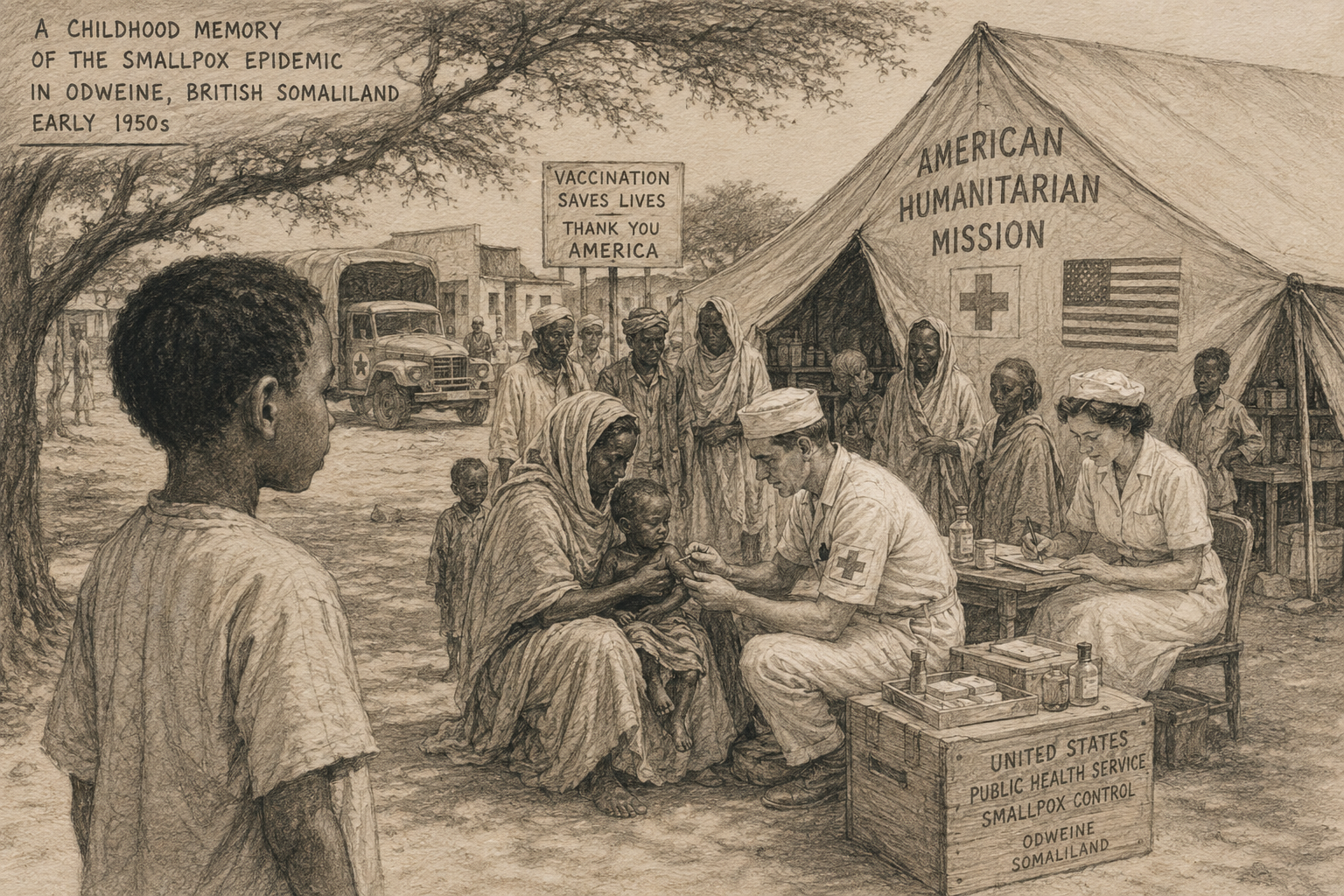
The sound grew louder until several vehicles appeared on the northern road, raising long clouds of dust behind them. They were unlike the supply trucks we had once known. These vehicles were painted white, and on their doors was an unfamiliar emblem—two clasped hands beneath a star-filled flag.
People slowly emerged from their homes.
Some stood in silence.
Others watched cautiously from a distance.
The epidemic had taught us to fear strangers almost as much as the disease itself.
As the vehicles came to a halt, several men climbed down wearing spotless white uniforms. They carried boxes with deliberate care, speaking calmly among themselves as though they had rehearsed every movement countless times before.
Their faces were unfamiliar, their language strange, yet there was something reassuring about their quiet confidence.
Unlike those who had arrived earlier with too few medicines and too little hope, these men looked prepared.
Still, uncertainty spread through the crowd.
Who were they?
Why had they come?
Could they really help us?
Among the townspeople stood several elderly men whose lives had carried them far beyond the borders of Somaliland.
Many years earlier they had served in the King’s African Rifles during the Second World War.
Some had fought in the suffocating jungles of Burma with the 11th Battalion, advancing through the infamous Kabaw Valley—a place Allied soldiers grimly remembered as “Death Valley.” Others had survived the bitter fighting around El Alamein in North Africa under Field Marshal Bernard Montgomery, where they had faced the German Afrika Korps commanded by Field Marshal Erwin Rommel.
My own father was one of those veterans.
Like the others, he had seen foreign armies, distant continents, and battles that few in Odweine could even imagine.
They had marched through deserts and tropical jungles.
They had survived artillery bombardments, disease, hunger, exhaustion, and the constant uncertainty of war.
Most importantly, they understood the customs, discipline, and organization of foreign soldiers.
As the white-clad visitors unloaded their equipment, these veterans quietly stepped forward.
Their experienced eyes studied every detail.
The uniforms.
The equipment.
The medical supplies.
The orderly manner in which the newcomers worked.
One elderly veteran smiled.
He nodded with certainty before turning toward the anxious crowd.
“They are Americans,” he announced.
“They have not come to fight people.”
“They have come to fight the sickness.”
His words immediately changed the atmosphere.
In Odweine, these veterans were more than respected elders.
They were men who had crossed oceans, fought beside soldiers from many nations, and returned home with knowledge of a world that few others had seen.
If they trusted these strangers, then perhaps everyone else could trust them too.
Slowly the crowd relaxed.
Fear gave way to cautious curiosity.
Women emerged carrying frightened children.
Elders approached to greet the visitors.
Young men offered to help unload supplies.
Without wasting a single moment, the Americans began their work.
Within hours large medical tents had been erected.
Separate treatment areas were established for the sick and the healthy.
Families received instructions on preventing further infection.
Boxes of medicine appeared one after another.
Doctors examined patients with remarkable patience.
Nurses cleaned wounds, lowered fevers, and comforted frightened mothers whose children had been suffering for days.
Then the vaccinations began.
One by one, people lined up outside the tents.
Children cried.
Parents tried to reassure them.
Each vaccination left a small scar on the upper arm.
I still carry mine today on my left arm.
More than seventy years have passed, yet whenever I look at that tiny mark, I remember those extraordinary days as clearly as if they had happened yesterday.
The Americans worked tirelessly from sunrise until darkness covered the town.
They asked for nothing in return.
They accepted no special treatment.
Their concern extended equally to every family regardless of wealth, status, or clan.
To a frightened child watching from nearby, they seemed almost tireless.
I remember one doctor kneeling to speak gently to children whose fear was greater than their illness.
A nurse patiently comforted mothers who had scarcely slept for weeks.
Another member of the team joked with young men waiting nervously for their vaccinations, and before long laughter—something our town had nearly forgotten—began to return.
For the first time since the epidemic began, hope became stronger than fear.
Yet what impressed me most was not only what the Americans did.
It was how our own people understood their kindness.
In Somali culture, genuine help in moments of great hardship comes first from family.
When relatives suffer, kin are expected to stand beside them.
Strangers rarely assume such responsibility.
As the days passed and the Americans continued caring for the sick without hesitation, the elders began discussing what their actions meant.
One evening, after prayers, Sultan Hersi Qani gathered with other traditional leaders beneath the acacia tree.
Looking toward the medical tents, he spoke words that would remain in the memory of our town for generations.
“These men cannot truly be strangers,” he said quietly.
“No outsider cares for another people with such devotion unless they have become family.”
Several elders nodded.
One elderly Aqil smiled before adding,
“Then they are no longer outsiders.”
“They are Habr Yoonis.”
No one believed this literally.
The Americans themselves never knew that such words had been spoken.
Yet within our community something remarkable had happened.
Our people had adopted them—not by blood, but by gratitude.
They had earned a place within our collective memory through compassion rather than ancestry.
In Somali culture, there is perhaps no greater honour that can be bestowed upon a stranger.
Part4
Day by day, the atmosphere in Odweine began to change.
The cries that had echoed through the town became less frequent. Fewer families arrived at the medical tents carrying desperately ill relatives. Each morning brought fewer new cases than the day before.
For the first time in many weeks, hope quietly returned.
The Americans never allowed themselves to celebrate too early.
They continued visiting every section of the town, examining patients, administering vaccinations, and teaching families how to prevent further infections. Their discipline never faltered. Every patient received the same attention, every child the same reassuring smile, every frightened mother the same words of comfort.
Gradually, the epidemic began to lose its grip.
The tents that had once overflowed with suffering grew quieter.
Children who had survived ventured outside again.
Their laughter, absent for so long, slowly returned to the dusty streets of Odweine.
The marketplace reopened.
A few merchants cautiously resumed business.
Supply trucks once again appeared on the northern road carrying flour, sugar, tea, dates, kerosene, and other necessities. Before long, caravans from Ogadenia returned, bringing livestock and trade goods as they had done for generations.
Life did not suddenly become normal.
Too many families had empty places around their evening fires.
Too many mothers still mourned children.
Too many children, including myself, had witnessed sorrow long before we were old enough to understand it.
The scars left upon our hearts would remain long after the scars upon our arms had faded.
Eventually the day came when the Americans announced that their work in Odweine was complete.
The epidemic had been brought under control.
The danger had passed.
Word spread quickly throughout the town.
On the morning of their departure, people gathered from every direction.
Old men arrived leaning on walking sticks.
Women came carrying infants whose lives had been saved.
Children crowded around the vehicles, reluctant to let their new friends leave.
No one wished to say goodbye.
There were tears.
There was laughter.
There were prayers of gratitude offered in Somali and Arabic.
Men embraced the visitors as brothers.
Women raised joyful ululations that echoed across the valley.
One by one, the townspeople stepped forward to shake their hands.
Some offered small gifts—perhaps a walking stick carved by hand, a woven mat, or simply words of heartfelt appreciation. The Americans accepted each gesture with humility, seemingly unaware that they had become part of a story that would be remembered for generations.
Then the elders gathered before the visitors.
Speaking on behalf of the community, Sultan Hersi Qani expressed what every family already felt.
“You came to us when others could not.”
“You expected nothing.”
“You treated our children as though they were your own.”
“In our tradition, such kindness cannot remain unanswered.”
“You arrived as strangers.”
“You leave as members of our family.”
Although the Americans could not fully understand the cultural significance of those words, they understood the emotion behind them.
The elders then bestowed Somali names upon several members of the medical team and declared them honorary members of the Habr Yoonis community.
It was one of the highest expressions of gratitude our people could offer.
No document recorded the moment.
No official ceremony marked the occasion.
Yet within the memory of Odweine, that symbolic adoption became part of our shared history.
As the vehicles prepared to leave, one of the doctors walked toward me.
He knelt so that his eyes met mine.
Placing a gentle hand upon my shoulder, he smiled.
“You were very brave,” he said.
“Never forget these days.”
“And always remember…”
“Help can come from anywhere.”
At the time I was too young to appreciate the full meaning of those words.
Only later, after many decades and many countries, would I truly understand them.
Today, whenever I touch the small vaccination scar that remains on my left arm, I am carried back to that frightened little town beneath the umbrella thorn trees.
I remember the silence before the engines arrived.
I remember the white tents rising against the dusty landscape.
I remember the smell of disinfectant mingling with the scent of acacia after the rain.
I remember foreign voices speaking gently to children who understood none of their language but understood kindness immediately.
Most of all, I remember a time when compassion crossed every boundary that divided people.
There were no political calculations.
No strategic interests.
No cameras.
No headlines.
Only human beings helping other human beings because suffering demanded a response.
The world has changed greatly since those days.
Humanitarian workers now often travel under armed protection.
Suspicion too often replaces trust.
Politics frequently overshadows simple acts of compassion.
Yet memory preserves another truth.
It reminds us that there was once a moment when strangers crossed continents to save people they had never met, asking for nothing in return.
Their kindness became stronger than fear.
Their humanity became stronger than disease.
Their actions left an imprint not only upon our community but upon every life they touched.
More than seventy years have passed since that terrible epidemic visited Odweine.
Many of those who witnessed those events have long since departed this world.
The marketplace has changed.
The children have grown old.
The elders who welcomed the Americans now rest beneath the Somaliland soil they loved.
Yet their story lives on.
It survives in the memories passed from one generation to the next.
It survives in the gratitude of families whose lives were spared.
And for me, it survives in the tiny scar that still rests quietly upon my arm.
It is a small mark.
Almost invisible.
But whenever I see it, I remember that in our darkest hour, hope arrived in white uniforms along a dusty road.
The people who stepped from those vehicles came to fight a disease.
They left having healed something even greater.
They reminded an entire community that humanity knows no borders, that compassion can transcend language, culture, race, and nationality, and that the greatest bonds between people are often forged not by blood, but by acts of selfless kindness.
That is how I remember them.
That is how Odweine remembers them.
And that is why, even today, many among the Habr Yoonis still speak of those Americans not as strangers who once visited our town, but as honorary kin whose humanity earned them a permanent place in our collective memory.
The End
About the Author