Somalia’s Parliamentary Fiasco: A Crisis of Legitimacy Decades in the Making.
By Prof. Nassir Hussein Kahin, International Affairs Writer, Geopolitics Analyst and Managing Editor at hornofafricastrategicreview.com
Somalia’s latest parliamentary, chaos is not an isolated breakdown—it is the clearest evidence yet that the country’s political system remains structurally fragile, deeply contested, and fundamentally incomplete more than three decades after state collapse.
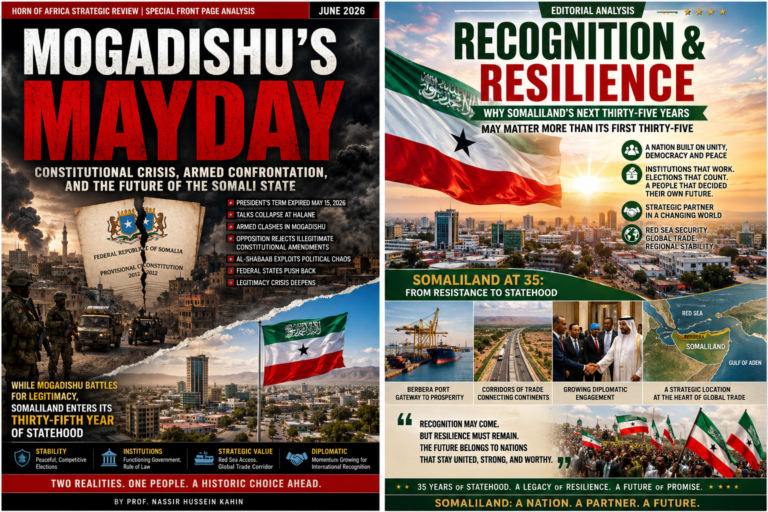
In January 2026, Somalia’s federal parliament in Mogadishu descended into open disorder. What should have been a legislative session quickly turned into shouting matches, procedural confusion, and even physical confrontation. The crisis erupted when Speaker Adan Mohamed Nur Madowbe introduced controversial constitutional amendments without broad consultation, triggering outrage from opposition lawmakers who accused the leadership of attempting to force through sweeping changes.
Documents were torn. MPs clashed. Proceedings collapsed.
But this was not simply parliamentary indiscipline—it was a system exposing its own weaknesses in real time.
At the heart of the crisis lies a deeper struggle over Somalia’s political future under President Hassan Sheikh Mohamud Proposed constitutional reforms have raised alarm among opposition figures and federal member states, who fear they could expand executive power, alter electoral frameworks, and potentially delay or reshape upcoming elections. In March 2026, parliament moved forward with amendments despite these objections, reinforcing the perception that Somalia’s political process is driven more by elite maneuvering than national consensus.
This moment is not accidental—it is the culmination of a long-standing structural problem: Somalia has never fully agreed on the rules of its own political system since 1991.
Unlike functioning democracies, Somalia continues to operate under a provisional constitution adopted in 2012, leaving core questions unresolved—how leaders are elected, how power is shared, and how disputes are settled. Every attempt at reform therefore becomes a high-stakes political confrontation rather than a routine democratic process.
Perhaps the most telling indicator of this dysfunction is electoral legitimacy itself.
Since the fall of Siyaad Barre in 1991, Somalia has never conducted a nationwide one-person-one-vote democratic election.
Instead, political leaders—including the president—are selected through indirect, clan-based systems, where delegates appointed by elders choose members of parliament, who then elect the president. While recent pilot projects in Mogadishu suggest movement toward universal suffrage, the reality remains that Somalia’s leadership is still largely determined through negotiated elite arrangements rather than direct public mandate.
This stands in stark contrast to Somaliland.
Over the same period, Somaliland has held multiple one-person-one-vote elections, including presidential, parliamentary, and local council votes, with peaceful transfers of power. While not without its own challenges, Somaliland has demonstrated a consistent commitment to electoral legitimacy rooted in popular participation.
Somalia, by contrast, continues to negotiate power rather than vote for it.
The consequences of this system are visible in moments like the 2026 parliamentary fiasco. Without a strong electoral mandate, political actors rely on alliances, clan loyalties, and procedural tactics to secure influence. Parliament becomes an arena for contestation rather than legislation. Constitutional reform becomes a struggle for control rather than a framework for governance.
This crisis is further intensified by tensions between the federal government and member states. Regions such as Puntland and Jubaland have openly challenged Mogadishu’s authority, particularly over constitutional changes and electoral processes. In some cases, political disputes have escalated into security confrontations, underscoring how fragile Somalia’s federal arrangement remains.
What emerges is a troubling pattern: a failed state that is internationally recognized but internally unsettled, with institutions that exist but lack full legitimacy, and a political system that operates but has yet to fully democratize.
The parliamentary chaos of 2026 is therefore not just a moment of embarrassment—it is a warning.
It signals that Somalia’s transition from state collapse to stable governance is still incomplete. It highlights the risks of pushing constitutional change without consensus. And it exposes the dangers of maintaining a political system where power is negotiated among elites rather than directly conferred by the people.
Three decades after 1991, Somalia is still asking foundational questions about authority, legitimacy, and governance.
Until those questions are resolved—through genuine constitutional clarity, inclusive political dialogue, and credible one-person-one-vote elections—such crises will not be the exception.
And Somalia’s parliament, rather than symbolizing democratic recovery, will continue to reflect the unfinished nature of the Somali state itself.
They will be the pattern in the future.
Prof. Nassir Hussein Kahin is a researcher, educator, journalist, and geopolitical analyst specializing in the Horn of Africa, the Red Sea, international law, diplomacy, and strategic affairs. To read Full Bio click on this link: ABOUT THE AUTHORProf. Nassir Hussein Kahin