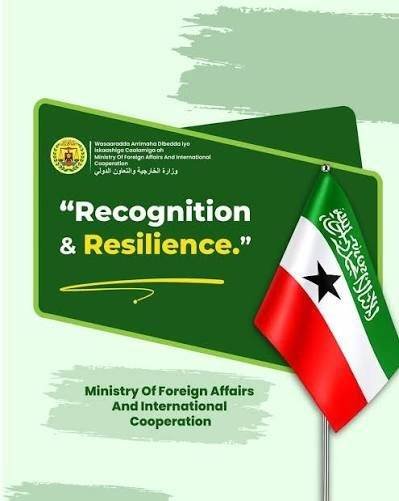
Somaliland Flag with this year's 35th Anniversary of independence in search of international recognition motto: Recognition & Resilience
Why New Governments Must Stop Recycling Old Power Elites
When people vote for a new government, they are voting for change. They expect fresh leadership, better policies, and a clear break from the failures of the past. Elections are not merely about replacing one president with another; they are about renewing how a country is governed. One of the clearest signals of that renewal lies in who is appointed to power—ministers, advisors, and senior officials.
Yet across many African and post-colonial states, this promise of change is quickly undermined. Newly elected leaders often recycle the same political elites who have dominated power for years, sometimes decades. These figures move from one ministry to another, from one administration to the next, regardless of performance. Instead of renewal, citizens see repetition. Instead of reform, they see the return of familiar faces, entrenched networks, and recycled failures.
Somaliland offers a clear illustration of this pattern. Over time, former ministers and senior officials have become permanent fixtures in political life. Their reappointment is rarely driven by proven competence or policy success. Rather, it reflects their embedded position within clan-based power structures. Their influence stems less from governance expertise than from their ability to mobilize clan elders and negotiate political loyalty.
The arrangement is straightforward—and deeply damaging. Former officials present themselves as indispensable intermediaries between the presidency and influential clans. In exchange for positions, they offer short-term political stability and electoral backing. The president gains temporary calm; the recycled elite regains access to state resources and influence. The cost, however, is borne by the nation.
Governance gradually shifts away from merit and accountability toward loyalty and political arithmetic. Ministries become rewards rather than responsibilities. Public office is treated as entitlement rather than trust. The state risks becoming a marketplace where power is traded, rather than an institution that serves its citizens.
Defenders of elite recycling often invoke “experience.” But experience has value only when tied to results. Experience without accountability is not an asset; it is a liability. When the same individuals return to power without reckoning with past failures, institutions do not evolve—they stagnate. Inefficiency becomes normalized, corruption adapts, and reform is quietly obstructed.
In Somaliland, this cycle has fostered a troubling political culture. Many former ministers behave as though public office is their permanent right. They exert pressure through clan channels, suggesting that governance is impossible without their inclusion. This dynamic sidelines capable professionals, discourages emerging leaders, and concentrates power in the hands of a narrow, aging elite.
Citizens are not blind to this reality. When voters repeatedly see the same individuals rotate through positions of authority, confidence in Democracy begins to erode. Political participation declines—not because people reject democratic ideals, but because they doubt that elections produce meaningful change.
This challenge is not unique to Somaliland. Across much of Africa, political transitions often preserve elite continuity rather than disrupt it. Former rivals are absorbed into new administrations to neutralize opposition and maintain stability. While this may reduce short-term friction, it undermines long-term institutional development and democratic maturity. Governments appear new, but power remains fundamentally unchanged.
Against this backdrop, the decision by Abdirahman Mohamed Abdullahi Cirro to appoint younger and less familiar figures is both bold and necessary. Predictably, it has drawn criticism. Detractors argue that governance is being handed to inexperienced individuals. This critique is fundamentally flawed.
Every experienced leader was once inexperienced. Leadership is not inherited; it is developed through responsibility. What critics often fear is not incompetence, but irrelevance. Their resistance reflects anxiety over lost privilege rather than concern for effective governance.
Youth inclusion is not a liability—it is a prerequisite for renewal. New leaders bring energy, innovation, and a greater willingness to challenge entrenched systems. They are less tied to legacy patronage networks and more open to rethinking governance in ways that serve the broader public.
For Somaliland to advance, citizens must reject the normalization of elite recycling. Reform-oriented leadership requires public backing that resists clan-based pressure and challenges the assumption that former officials are entitled to return to power. The president holds both the constitutional authority and democratic responsibility to appoint based on competence, integrity, and vision—not coercion.
A healthy democracy does not treat government as a revolving door for the same individuals. It creates space for new leadership, new ideas, and genuine accountability. Sustainable progress will not come from recycling the architects of past failures. It will come from empowering a new generation committed to serving the public interest over private ambition. For more on Government & Politics from the author click on this link:

Ambassador Egal is a regular contributing writer for HOASR and the founder of Horn of Africa Herald, an independent digital newspaper