The Two Amigos in the Horn
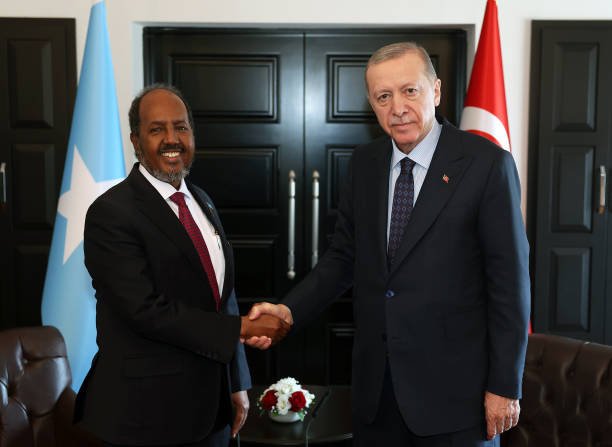
By Ambassador Ahmed Hassan Egal (pictured above). Ambassador Egal is the founder of Horn of Africa Herald, an independent digital newspaper.
While Türkiye publicly frames its opposition to Israel’s recognition of Somaliland in terms of international law, sovereignty, and regional stability, a closer examination suggests that its position is driven by deeper strategic considerations. The preservation of a “unified Somalia” aligns directly with Ankara’s long-term security, economic, and geopolitical investments in the country. These embedded interests help explain why Türkiye treats Somaliland’s recognition not merely as a normative issue, but as a direct challenge to its strategic position in the Horn of Africa.
Control Over Strategic Gateways: Ports, Airports, and State Interfaces
A central pillar of Türkiye’s interest lies in its operational influence over Somalia’s primary gateways to the outside world—critical infrastructure whose value depends on Mogadishu’s uncontested sovereignty over national territory. Turkish firms manage the Port of Mogadishu and Aden Adde International Airport under long-term concession agreements. These arrangements place Ankara at the core of customs revenue collection, logistical coordination, and international connectivity.
A fragmented Somali state would complicate these arrangements by introducing competing authorities and alternative centers of sovereignty. In this context, a unified Somalia is not simply a political preference but a functional requirement for sustaining Türkiye’s embedded role in infrastructure management, revenue systems, and border control across the country’s main commercial arteries.
Maritime and Naval Reach Along a Critical Coastline
A second strategic dimension concerns Türkiye’s expanding maritime and naval presence. In 2024, Ankara and Mogadishu concluded a renewable ten-year maritime defense and security agreement. Under this framework, Türkiye supports the rebuilding and training of the Somali navy while receiving a share of revenue from Somalia’s exclusive economic zone (EEZ).
This arrangement presupposes a single, internationally recognized Somali authority exercising control over its coastline and maritime resources. Recognition of Somaliland would introduce an alternative coastal authority along the Gulf of Aden, potentially limiting Somalia’s—and by extension Türkiye’s—exclusive maritime jurisdiction. From this perspective, Türkiye’s support for Somali unity functions as a mechanism to safeguard access to one of Africa’s longest and most strategically significant coastlines, adjacent to key Red Sea and Indian Ocean shipping routes.
Energy and Resource Consolidation
Türkiye’s strategic interests also extend into Somalia’s offshore hydrocarbons and broader blue economy. Energy agreements between Ankara and Mogadishu grant Turkish state-linked entities exploration and development rights tied explicitly to Somalia’s internationally recognized EEZ.
These agreements rely on the legal continuity of Somalia’s borders and the absence of competing claims over offshore resources. A unified Somali state ensures centralized licensing authority, predictable revenue flows, and enforceable contracts. Fragmentation, by contrast, would introduce legal ambiguity, complicate resource governance, and weaken Türkiye’s leverage in the sector.
Security Architecture and Regional Influence
Türkiye’s largest overseas military installation, Camp TURKSOM in Mogadishu, anchors its role as a primary external architect of Somalia’s security sector. This position is most effective when the federal government serves as the uncontested national authority.
Through Somalia, Türkiye projects influence across the Horn of Africa and into the western Indian Ocean. This strategic posture depends on territorial cohesion. A divided Somalia would dilute Ankara’s ability to operate as a central security partner and reduce its broader regional influence.
From this vantage point, Türkiye’s insistence that “decisions must reflect the will of all Somalia” aligns with a clear strategic preference: maintaining a single Somali state through which it can anchor its military, economic, and diplomatic footprint.
Analytical Implication
Taken together, the evidence suggests that Türkiye’s opposition to Somaliland’s recognition is not driven solely by abstract legal principles. Rather, it reflects material incentives embedded within a unified Somali political order.
A fragmented Somalia would weaken Türkiye’s position across multiple domains—ports, airspace, Maritime Security, natural resources, and defense institutions—undermining investments built over more than a decade. Within this framework, Türkiye’s defense of Somali unity emerges as a strategic effort to preserve accumulated leverage in one of the world’s most geopolitically sensitive regions.

Ambassador Egal is a regular contributing writer for HOASR and the founder of Horn of Africa Herald, an independent digital newspaper