By Nassir Hussein Kahin
There are moments when forgotten nations suddenly reappear before the world with astonishing force. Not through war alone, nor diplomacy alone, but through the convergence of memory, geography, history, and geopolitics. Somaliland is now experiencing such a moment.
For more than three decades, Somaliland existed in what veteran journalist Rageh Omaar described as a form of “diplomatic deep freeze” — functioning as a state in practice while remaining invisible in the formal architecture of international recognition. Yet today, after Israel became the first UN member state to formally recognize Somaliland in December 2025, the strategic calculus surrounding the Horn of Africa has shifted dramatically.
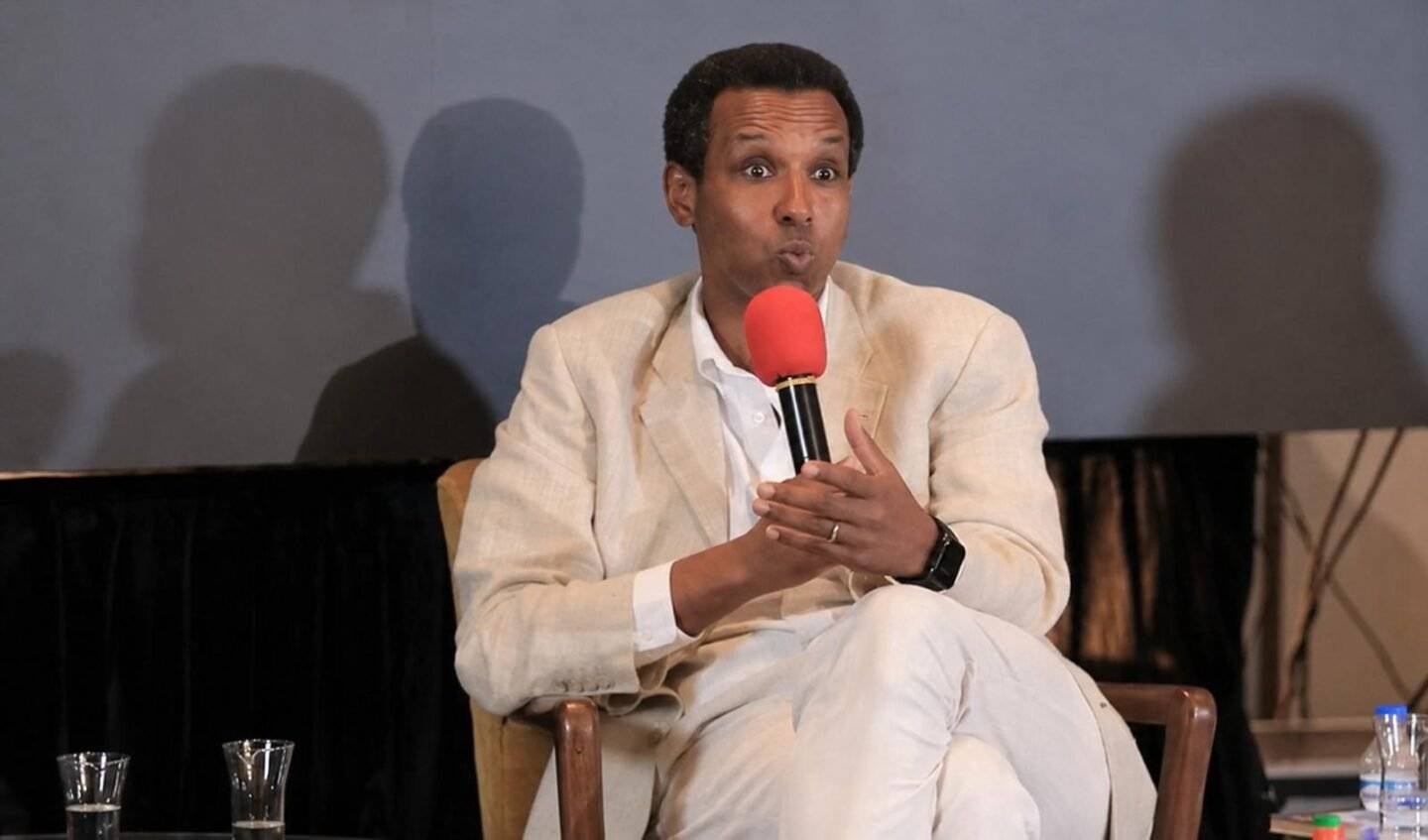
At the center of this transformation stands Rageh Omaar himself: journalist, war correspondent, broadcaster, historian of memory, and perhaps unintentionally, one of Somaliland’s most articulate interpreters to the wider world.
In two interviews separated by twelve years — one at the 2014 UK – Somaliland Trade and Investment Forum and another during the May 18, 2026 Somaliland Independence celebrations on The Brink podcast — Omaar offered not merely commentary, but a sweeping narrative of Somaliland’s destruction, rebirth, and emergence onto the geopolitical chessboard of the Red Sea.
Taken together, the interviews form one of the clearest intellectual frameworks yet articulated about modern Somaliland.
A City of Rubble and Memory
Omaar’s authority comes not simply from journalism, but from lived history.
Born in Hargeisa and raised partly in Britain, educated at University of Oxford, and later becoming one of the world’s best-known war correspondents through the BBC, Al Jazeera, and now ITV, Omaar carries the unusual ability to speak simultaneously as:
- insider and observer,
- journalist and witness,
- Somalilander and British internationalist.
Recalling his return to Hargeisa shortly after the civil war, Omaar described a city annihilated almost beyond recognition.
“The only way to describe it was completely destroyed.”
He remembered buildings riddled with shell holes “like Swiss cheese,” refugee camps overflowing across the Ethiopian border, and entire neighborhoods reduced to ruins. He compared Hargeisa’s devastation to Dresden and Grozny — analogies intended not for exaggeration, but to internationalize Somaliland’s suffering in terms the wider world could understand.
And yet, from those ruins, he observed something remarkable:
“There was a drive and a determination and a sense of pride amongst the people to make a real success.”
That determination would become the defining political psychology of Somaliland itself.
The North Star: “We Exist”
Perhaps the single most important insight Omaar offered during the 2026 interview was this:
“It’s the foundational, north star of Somalilanders… to say: we exist.”
That statement cuts to the core of Somaliland’s recognition struggle.
For Somalilanders, recognition is not merely legal paperwork or diplomatic prestige. It is existential validation after destruction, displacement, and decades of international ambiguity.
The modern Republic of Somaliland traces its claim to sovereignty back to June 26, 1960, when the former British Somaliland protectorate briefly achieved internationally recognized independence before voluntarily uniting days later with the former Italian Somalia to form the Somali Republic.
But the union deteriorated catastrophically.
Military dictatorship, marginalization, civil war, aerial bombardment, and mass killings followed. Somalilanders argue that the violence committed by the regime of Siad Barre constituted genocide.
In 1991, following the collapse of the Somali state, Somaliland reasserted its sovereignty on May 18 — the date now commemorated annually as Somaliland Independence Day.
For decades afterward, Somaliland rebuilt itself without international recognition.
That achievement alone remains extraordinary.
Building a State Without a State
One of the most powerful sections of Omaar’s recent interview was his explanation of what non-recognition actually means in practice.
Somaliland has:
- a president,
- parliament,
- army,
- police,
- courts,
- elections,
- currency,
- passports,
- and functioning institutions.
Yet, as Omaar explained, non-recognition excludes Somaliland from nearly every mechanism governing modern international life.
No SWIFT banking access.
No World Bank loans.
No direct aviation systems.
No WHO membership.
No embassies.
No international financial architecture.
Even importing spare parts or processing visas becomes a bureaucratic nightmare.
And still Somaliland survived.
Not only survived — but built.
Entire cities, telecommunications networks, businesses, universities, fintech systems, and democratic institutions emerged through domestic initiative and diaspora investment.
Omaar noted with fascination the number of diaspora Somalilanders returning home:
London accents in Hargeisa.
Welsh accents in marketplaces.
Professionals returning to rebuild a country once reduced to rubble.
That reverse migration may be one of the strongest indicators of Somaliland’s internal confidence.
Israel Changes the Equation
The geopolitical earthquake arrived in December 2025.
Israel’s recognition of Somaliland altered the conversation overnight.
As Omaar explained:
“It blew open the doors for international attention.”
And more importantly:
“It shut Somaliland out of diplomatic deep freeze.”
These were not casual phrases.
They were strategic descriptions of a diplomatic transformation.
The significance was not merely that Somaliland gained recognition.
It was who recognized it.
Israel’s recognition inserted Somaliland directly into:
- Red Sea security politics,
- Middle Eastern rivalries,
- maritime strategy,
Omaar carefully traced the historical roots of the relationship:
- Israel’s early recognition of Somaliland in 1960,
- Israeli condemnation of atrocities during the civil war,
- and correspondence between Somaliland’s founding president Muhammad Haji Ibrahim Egal and Israeli Prime Minister Yitzhak Rabin.
He argued that the relationship did not emerge suddenly, but evolved quietly over decades.
Israeli flags reportedly appeared across parts of Hargeisa.
Printing presses worked overnight producing banners and symbols.
Ordinary Somalilanders celebrated openly.
In a deeply conservative Sunni Muslim society, the images stunned many international observers.
But Omaar offered a blunt explanation:
recognition mattered more.
The Muslim Democracy the World Ignored
One of the interview’s most striking themes was Somaliland’s unusual political identity.
The hosts repeatedly emphasized the contrast:
a devout Muslim society that is simultaneously:
- pro-Western,
- democratic,
- relatively stable,
- and openly friendly toward Israel.
That combination is rare in contemporary geopolitical discourse.
Omaar did not ignore the controversy surrounding relations with Israel during the Gaza conflict. He acknowledged discomfort and criticism inside Somaliland itself. Yet he framed the issue pragmatically rather than ideologically.
Small states, he implied, cannot afford diplomatic absolutism when survival and recognition are at stake.
This reflects a sophisticated realism increasingly visible in Somaliland’s foreign policy:
alliances are judged through state interests, strategic utility, and national aspirations.
The Red Sea Chessboard
The interviews increasingly widened beyond Somaliland itself into a larger geopolitical framework.
Omaar repeatedly stressed Somaliland’s strategic geography.
Its coastline stretches roughly 850 kilometers along the Gulf of Aden near the Bab al-Mandab Strait — one of the world’s most important maritime chokepoints connecting the Red Sea to the Indian Ocean.
Around 15 percent of global trade passes through nearby waters.
Nothing about Somaliland’s geography has changed since the British Empire established the Somaliland protectorate to secure maritime routes to India.
But global politics have changed dramatically.
Today:
- China is expanding influence through Djibouti and Somalia,
- Turkey maintains major military infrastructure in Mogadishu,
- Gulf powers compete for Red Sea access,
- Taiwan deepens ties with Somaliland,
- Israel seeks strategic partnerships,
- and Western powers increasingly worry about Maritime Security.
As Omaar put it:
“There is a new scramble for Africa.”
That phrase may ultimately define the emerging era.
Britain’s Fork in the Road
No country faces a more delicate Somaliland dilemma than United Kingdom.
Britain remains the UN Security Council “penholder” on Somalia — the lead diplomatic actor shaping international policy on the Somali question.
Historically, Britain pursued a “dual-track” approach:
engaging both Somalia and Somaliland separately.
But after the 2012 London Conference on Somalia convened by former Prime Minister David Cameron, British policy shifted strongly toward rebuilding Somalia as a unified state.
Omaar now argues that policy no longer reflects reality.
“That 2012 position… doesn’t meet reality.”
This may be the interview’s most consequential geopolitical argument.
Somalia remains deeply fragile, struggling against the insurgency of Al-Shabaab, while Somaliland functions with comparatively greater stability and institutional continuity.
The contradiction is becoming increasingly difficult for Western policymakers to ignore.
Not a War Between Peoples
Perhaps the most intellectually important aspect of Omaar’s analysis is his insistence that the Somaliland-Somalia dispute is not fundamentally rooted in hatred between ordinary people.
He repeatedly rejected simplistic analogies to:
- sectarian conflict,
- ethnic warfare,
- or civilizational struggle.
There is intermarriage.
Trade.
Migration.
Shared language.
Shared religion.
Shared families.
Even senior officials have moved between Somaliland and Somalia.
The dispute, Omaar argued, lies primarily at the level of political sovereignty and state identity.
That nuance gives Somaliland’s case greater sophistication and maturity than many separatist conflicts elsewhere.
From Survival to Emergence
For decades, Somaliland was discussed mainly through the lens of:
- civil war,
- famine,
- piracy,
- and humanitarian crisis.
That era is ending.
The conversation now centers on:
- maritime trade,
- minerals,
- ports,
- logistics,
- Red Sea security,
- Israel,
- Taiwan,
- China,
- Turkey,
- and global strategic competition.
Somaliland is no longer merely asking the world to recognize its survival.
It is positioning itself as strategically indispensable.
And few people have articulated that transformation more effectively than Rageh Omaar.
Through memory, history, journalism, and geopolitical fluency, he has helped translate Somaliland from an overlooked post-conflict territory into one of the most consequential unrecognized states in the world.
For years Somaliland stood outside the gates of international diplomacy, visible only to those who cared enough to look closely.
Now the world is beginning to look.
And Somaliland, after decades in the shadows, is stepping onto the global stage.
Prof. Nassir Hussein Kahin is a researcher, educator, journalist, and geopolitical analyst specializing in the Horn of Africa, the Red Sea, international law, diplomacy, and strategic affairs. To read Full Bio click on this link: ABOUT THE AUTHORProf. Nassir Hussein Kahin