By Nassir Hussein Kahin
Hargeisa, Somaliland.
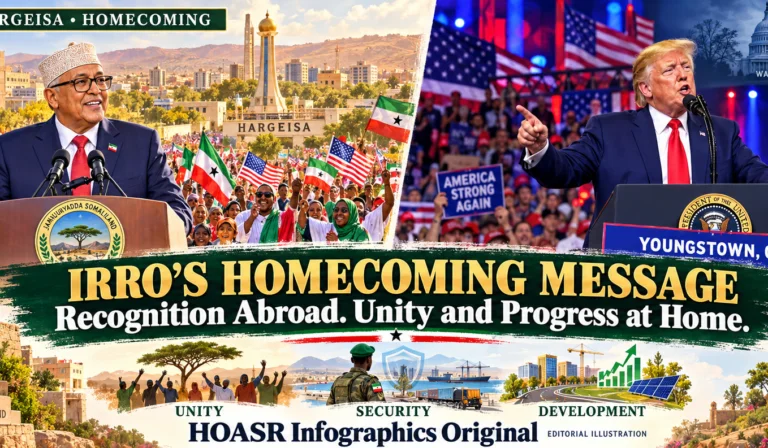
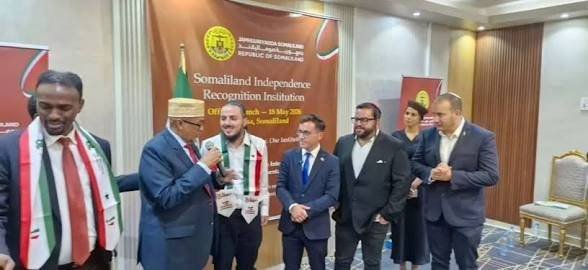
Under exploding fireworks, military parades, patriotic songs, and crowds waving the flag of Somaliland during the May 18 celebrations marking the 35th anniversary of Somaliland’s restoration of sovereignty, a new chapter quietly but dramatically began unfolding in the Horn of Africa.
Inside packed halls at the Presidential Palace in Hargeisa, Somaliland President Abdirahman Mohamed Abdullahi Irro officially launched what many are already describing as the most ambitious international recognition initiative in Somaliland’s modern history: a new Somaliland Independence Recognition Institution and Commission designed to coordinate legal, diplomatic, academic, media, and geopolitical advocacy for Somaliland’s long quest for international recognition.
At the center of this new campaign stand two influential British figures now deeply associated with Somaliland’s global recognition movement:
- Jason McCue, founder of McCue Jury & Partners, the prominent international law firm known for major human rights and international litigation cases.
- Sir Gavin Williamson, the former British Defence Secretary and one of the strongest political advocates for Somaliland within the United Kingdom Parliament.
Together, they delivered passionate speeches that electrified audiences and signaled a dramatic escalation in Somaliland’s international strategy.
What emerged from the celebrations was not simply ceremonial nationalism.
It was the unveiling of a sophisticated international campaign that increasingly combines:
- legal warfare,
- diplomatic lobbying,
- strategic communications,
- academic research,
- media influence,
- and geopolitical positioning.
Many Somaliland observers now believe the republic is preparing to elevate its recognition case toward the highest levels of international law and diplomacy — potentially including the International Court of Justice and the United Nations Security Council.
Jason McCue: “The Day of Justice Is Coming”
The emotional centerpiece of the celebrations came when Jason McCue delivered one of the most forceful pro-Somaliland speeches heard publicly in years.
Speaking as an international human rights lawyer who has visited Somaliland for more than three decades, McCue praised Somaliland’s Democracy, resilience, humor, strategic location, and natural resources before launching into a sweeping legal and moral defense of Somaliland’s sovereignty claims.
“The jewels in Somaliland’s crown are its people, its geography here on the Red Sea, and of course its natural resources,” he declared.
McCue argued that Somaliland’s historical suffering under the regime of Siad Barre constituted genocide and systematic human rights abuses against Somalilanders.
“As an international human rights lawyer,” he said, “the injustices you’ve faced and still face today drive me to support you in any small way I can.”
In one of the speech’s most memorable moments, McCue declared in Somali:
“Waxaan Ahay Somaalilander.”(I am a Somalilanders”)
The crowd erupted.
But it was McCue’s legal argument against the 1960 Act of Union between British Somaliland and Italian Somalia that sent shockwaves across international political circles.
Holding up the document before the audience, he shredded it into pieces and argued the union was “void ab initio” — legally invalid from the outset.
“The law demands rectification and reparations,” McCue stated. “Somaliland will restore its independence to how it was before.”
Observers described the speech as unprecedented in its directness, legal framing, and open warning toward authorities in Mogadishu.
“Before that Act of union, that was a time when Somaliland had recognised independence by the United Nations, and you did not. That’s a time before you usurped Somaliland’s designated UN seats as your own through the artifice of this bloody act of union.”
“Rule of law and democratic means, that’s what Somalilanders do, and with that they are going to take back those UN seats and restore back the rightful position of Somaliland’s independence since 1960”, he warned Mogadishu.
Sir Gavin Williamson: The British Statesman Who Stood With Somaliland.
————————————————————————-
If McCue represented the legal spearhead of Somaliland’s campaign, Sir GavinWilliamson, embodied its political and geopolitical dimension.
Long before many Western politicians were willing to publicly discuss Somaliland Recognition, Williamson repeatedly raised the issue in the British Parliament and international forums.
Now, under President Irro’s administration, Williamson has formally been appointed to a leading international role within Somaliland’s new Recognition Commission as its Director General.
For many Somalilanders, the appointment represents more than diplomacy.
It symbolizes loyalty to Somaliland’s cause.
“This commission,” President Irro announced, “will coordinate Somaliland’s diplomatic, legal, historical, and strategic case for international recognition.”
Williamson’s speech in Hargeisa deeply resonated with Somalilanders.
“Somaliland is a beacon of democracy, freedom, and rule of law in the Horn of Africa,” he declared.
He then delivered the line that dominated Somaliland social media afterward:
“I am deeply privileged to call myself a Somalilander.”
Across Hargeisa, young people rushed to take photographs with the British politician. Veterans saluted him. Intellectuals praised him. Diaspora communities flooded social media with tributes.
To many Somalilanders, Williamson distinguished himself because he openly acknowledged the trauma of the 1980s destruction of Hargeisa and Burao and the suffering endured by civilians during the war against the Siad Barre regime.
Unlike many cautious diplomats, Williamson directly linked Somaliland’s democratic achievements to its painful history of destruction and reconciliation.
The Rise of Somaliland’s Global Advocacy Network.
—————————————————————————-
Perhaps the most remarkable development surrounding the new institution is the scale of the international intellectual network now forming around Somaliland.
Officials and organizers involved in the initiative say approximately 2,000 scholars, professors, academics, lawyers, policy experts, journalists, media figures, and researchers are expected to contribute to various aspects of Somaliland advocacy, diplomacy, legal analysis, historical documentation, and strategic communications.
Among internationally respected media figures associated with Somaliland advocacy discussions is Rageh Omaar, whose global profile symbolizes Somaliland’s growing ability to attract influential voices from journalism, academia, and diplomacy.
The institution reportedly aims to coordinate:
- historical archives,
- genocide documentation,
- legal research,
- diplomatic outreach,
- strategic media campaigns,
- diaspora engagement,
- and geopolitical policy analysis.
Several Somaliland intellectuals now compare the strategy to long-term international campaigns historically used by emerging states and liberation movements seeking legitimacy through law, media, and diplomacy simultaneously.
From Forgotten Territory to Geopolitical Hotspot.
—————————————————————————
The timing of Somaliland’s new international campaign is not accidental.
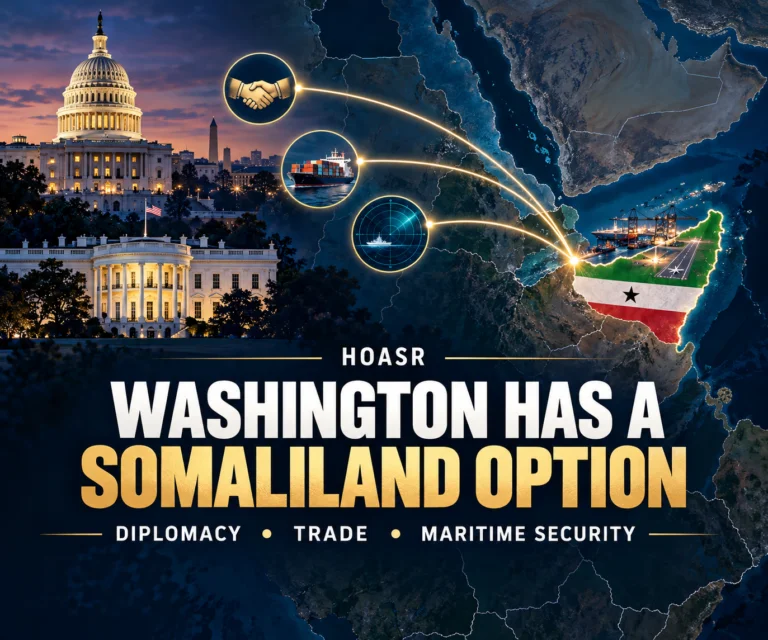
The Horn of Africa and Red Sea corridor have become among the most strategically contested regions in the world.
Global powers — including the United States, China, Russia, Gulf states, Turkey, Iran, and Israel — increasingly view the Red Sea as central to:
- maritime trade,
- energy security,
- military logistics,
- submarine cable infrastructure,
- counterterrorism,
- and global supply chains.
Somaliland’s position near the Bab-el-Mandeb Strait has elevated its geopolitical importance dramatically.
Williamson repeatedly emphasized this reality in speeches and policy discussions, arguing Somaliland should not merely be viewed as a humanitarian issue but as a strategic democratic ally in a volatile region.
That argument now appears to be gaining traction internationally.
The Recognition Campaign Enters a New Phase
For decades, Somaliland’s pursuit of recognition was often viewed as symbolic or aspirational.
Now, many analysts believe the movement is evolving into something far more organized and internationally coordinated.
The new institution appears designed not only to lobby governments, but to systematically construct:
- legal arguments,
- historical evidence,
- diplomatic alliances,
- academic legitimacy,
- and public opinion campaigns.
Supporters increasingly believe Somaliland’s strategy may eventually involve formal legal initiatives touching international judicial mechanisms, including advisory opinions, state responsibility arguments, reparations debates, and questions surrounding historical sovereignty.
But one fact is increasingly undeniable:
Somaliland is no longer conducting its recognition campaign quietly.
And with figures like Jason McCue and Sir Gavin Williamson now publicly leading major components of that campaign, the republic’s long struggle for recognition has entered an entirely new geopolitical era.America Must Act Now: Somaliland Is the Strategic Opportunity Washington Cannot Miss.
Prof. Nassir Hussein Kahin is a researcher, educator, journalist, and geopolitical analyst specializing in the Horn of Africa, the Red Sea, international law, diplomacy, and strategic affairs. To read Full Bio click on this link: ABOUT THE AUTHORProf. Nassir Hussein Kahin