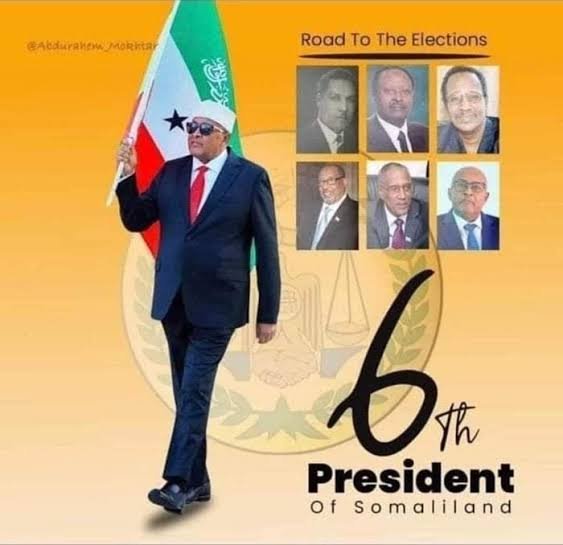
The 6th President of Somaliland carry on the spirit of recognition from predecessors
By Prof. Nassir Hussein Kahin
For decades, the African Union has defended its refusal to recognize Somaliland by invoking “territorial integrity,” African unity, and the sanctity of colonial borders. Yet the more the Horn of Africa evolves politically, the more the AU’s position begins to look less like a principled legal stance and more like a deeply political contradiction shaped by regional interests and authoritarian alliances.
Nothing exposes this contradiction more sharply than the growing comparison between Somaliland’s democratic record and the entrenched political system in Djibouti.
One territory remains internationally unrecognized despite repeatedly holding competitive elections, peaceful transfers of power, and building functioning democratic institutions from the ground up.
The other enjoys full diplomatic legitimacy despite decades of centralized rule dominated by one political establishment, heavily controlled elections, weak opposition space, and a security-driven political environment critics increasingly describe as resembling a police state.
And yet, in one of the greatest ironies in modern African diplomacy, the African Union continues isolating Somaliland while empowering political figures tied to Djibouti’s ruling system inside the AU structure itself.
The contrast could not be more striking.
Since restoring its sovereignty in 1991, Somaliland has gradually built a political culture rare in the Horn of Africa. Presidents have faced real opposition. Political parties campaign openly. Elections are contested vigorously. Opposition candidates have won parliamentary and presidential races. Most importantly, power has changed hands peacefully through ballots rather than violence.
International election observers have repeatedly praised Somaliland’s democratic process for transparency and political maturity.
In a region where leaders often manipulate constitutions to extend their rule indefinitely, Somaliland developed a political system where electoral competition became normalized.
Meanwhile, Djibouti has moved in the opposite direction.
President Ismail Omer Geeleh has remained in power since 1999, extending a political order critics say relies on tight state control, weakened opposition participation, extensive security oversight, and heavily managed electoral outcomes.
Opposition groups in Djibouti have long accused the government of restricting political freedoms, suppressing dissent, and orchestrating elections whose outcomes are largely predetermined before voting even begins.
While Somaliland celebrates opposition victories and peaceful political transitions, Djibouti’s elections have often been viewed by critics as carefully stage-managed exercises designed to preserve continuity of rule.
Yet the African Union treats these two political systems in completely opposite ways.
Somaliland’s democratic achievements are ignored. Djibouti’s authoritarian stability is rewarded with diplomatic influence and continental legitimacy.
This contradiction became even more politically explosive following the African Union’s own 2005 fact-finding mission to Somaliland.
That mission concluded Somaliland’s case was “unique and self-justified in African political history.” It acknowledged Somaliland’s political stability, institutional maturity, and democratic governance. Crucially, it also rejected the argument that Somaliland’s recognition would automatically destabilize Africa through endless separatist claims.
In short, the AU’s own investigators quietly admitted Somaliland satisfied the political and legal conditions for recognition.
But instead of acting on those findings, the report was effectively buried.
Nearly twenty years later, the AU rarely even references it publicly.
That silence has become increasingly revealing.
Especially now that Djibouti’s former foreign minister occupies a senior leadership position within the African Union system itself, as the Chairman.
For critics across Somaliland and beyond, this reinforces the perception that the AU’s Somaliland policy is no longer driven by principle but by political interests tied to governments determined to block Somaliland’s emergence.
Djibouti’s motivations are obvious.
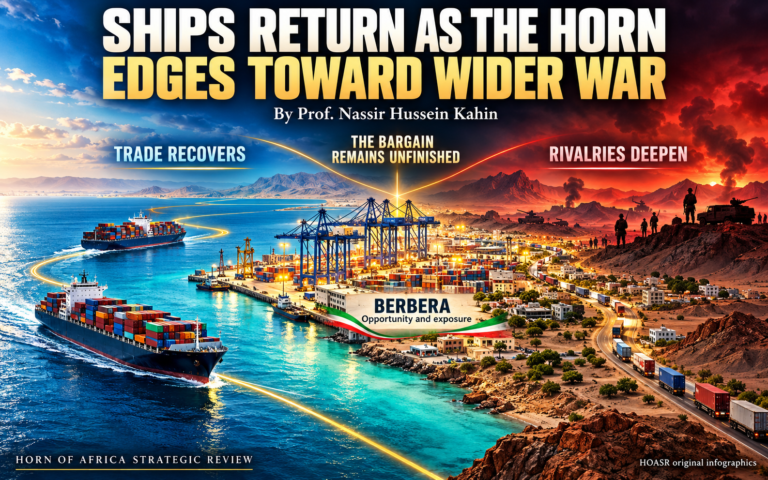
Recognition of Somaliland would fundamentally reshape economic and strategic balances in the Horn of Africa. Somaliland’s Berbera Port, backed by partnerships involving DP World and growing cooperation with Ethiopia, threatens Djibouti’s long-standing dominance as the primary regional gateway for Ethiopian trade.
A recognized Somaliland would become an even more attractive commercial, diplomatic, and military partner for regional and global powers.
This is why Djibouti, Somalia, and their allies reacted so aggressively following Israel’s recognition of Somaliland and the appointment of Ambassador Michael Lotem to Hargeisa.
Their condemnations invoked “territorial integrity” and “African unity.”
But they conspicuously avoided mentioning the African Union’s own 2005 fact-finding conclusions.
Because acknowledging that report would expose the entire contradiction at the heart of the AU’s position.
The African Union claims to support Democracy, self-determination, stability, and constitutional governance.
Yet Somaliland — which has demonstrated those principles consistently for over three decades — remains excluded.
At the same time, political systems built around prolonged one-man rule, security-state governance, and tightly controlled elections continue exercising major influence inside continental institutions.
The hypocrisy is becoming increasingly difficult to hide.
Particularly because Somaliland’s democratic credentials increasingly compare favorably not only with Djibouti, but with several internationally recognized African states.
In practical terms, Somaliland already functions like a sovereign country.
It has its own flag, military, police, judiciary, parliament, currency, and passport. It signs international agreements. It protects its territory. It conducts elections. It maintains internal stability.
Meanwhile Somalia — whose territorial claims the AU continues defending — struggles to maintain authority without international military assistance and foreign security missions.
The result is a diplomatic paradox that exposes a painful truth about modern African politics:
Recognition is often shaped less by democratic legitimacy or legal consistency than by geopolitical calculations, strategic alliances, and institutional self-interest.
And nowhere is that reality more visible than in the African Union’s treatment of Somaliland.
The tragedy for the AU is that it already had an opportunity to resolve this contradiction responsibly.
Its own 2005 mission provided the intellectual and political foundation for serious engagement with Somaliland’s case.
Instead, politics buried the findings.
Now, as the Horn of Africa becomes one of the world’s most strategically contested regions — shaped by Red Sea rivalries, Middle Eastern competition, Maritime Security concerns, and new diplomatic alignments — the AU increasingly risks looking outdated, ineffective, and disconnected from realities on the ground.
Somaliland’s democracy continues evolving.
Djibouti’s centralized rule continues consolidating.
And the African Union continues pretending not to notice the difference.

Prof. Nassir Hussein Kahin is a researcher, educator, journalist, and geopolitical analyst specializing in the Horn of Africa, the Red Sea, international law, diplomacy, and strategic affairs. To read Full Bio click on this link: ABOUT THE AUTHORProf. Nassir Hussein Kahin