By Prof. Nassir Hussein Kahin
For more than three decades, the African Union has insisted that Somaliland’s quest for international recognition is blocked by the organization’s commitment to preserving Africa’s colonial borders. Yet the deeper one examines Somaliland’s case, the more the contradiction becomes impossible to ignore: Somaliland’s borders are precisely the colonial borders the Organization of African Unity (OAU), now the African Union (AU), pledged to protect in 1963.
The principle of respecting inherited colonial frontiers was designed to prevent endless territorial disputes across post-colonial Africa. Ironically, Somaliland’s case fits that principle more cleanly than many African states whose territorial arrangements the AU eventually accepted under political pressure and geopolitical realities.
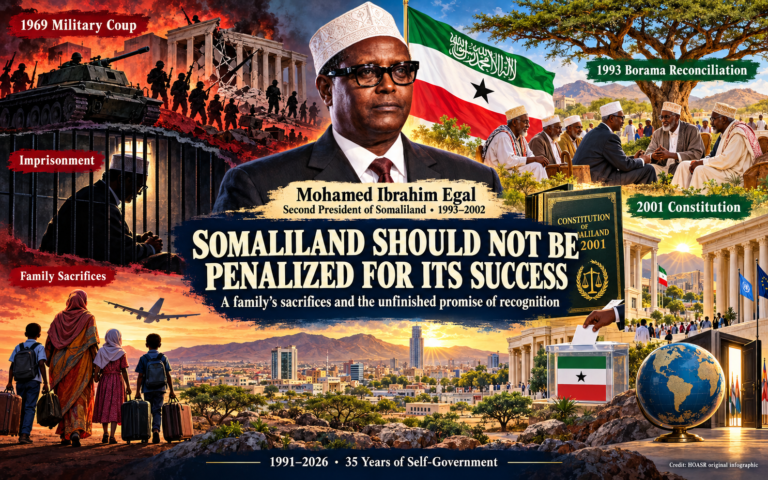
Somaliland was not carved out of Somalia through rebellion or separatism. It existed as the independent State of Somaliland after gaining full independence from Britain on June 26, 1960. More than 35 countries recognized it diplomatically before it voluntarily entered into union with the former Italian Somalia on July 1, 1960. That union itself was never fully ratified through a binding legal act recognized equally by both sides.
When Somaliland restored its sovereignty in 1991 following the collapse of the Somalia state and the atrocities committed by the Siad Barre regime, it did not create new borders. It returned to the exact colonial boundaries recognized at independence. In legal and historical terms, Somaliland’s case is closer to state restoration than secession.
This is where the African Union’s position begins to unravel.
The AU repeatedly invokes “territorial integrity” against Somaliland while simultaneously ignoring the fact that Somaliland’s territorial boundaries are the very colonial borders the OAU Charter declared sacrosanct. Instead, the organization has increasingly drifted into political maneuvering shaped by member-state interests rather than legal consistency.
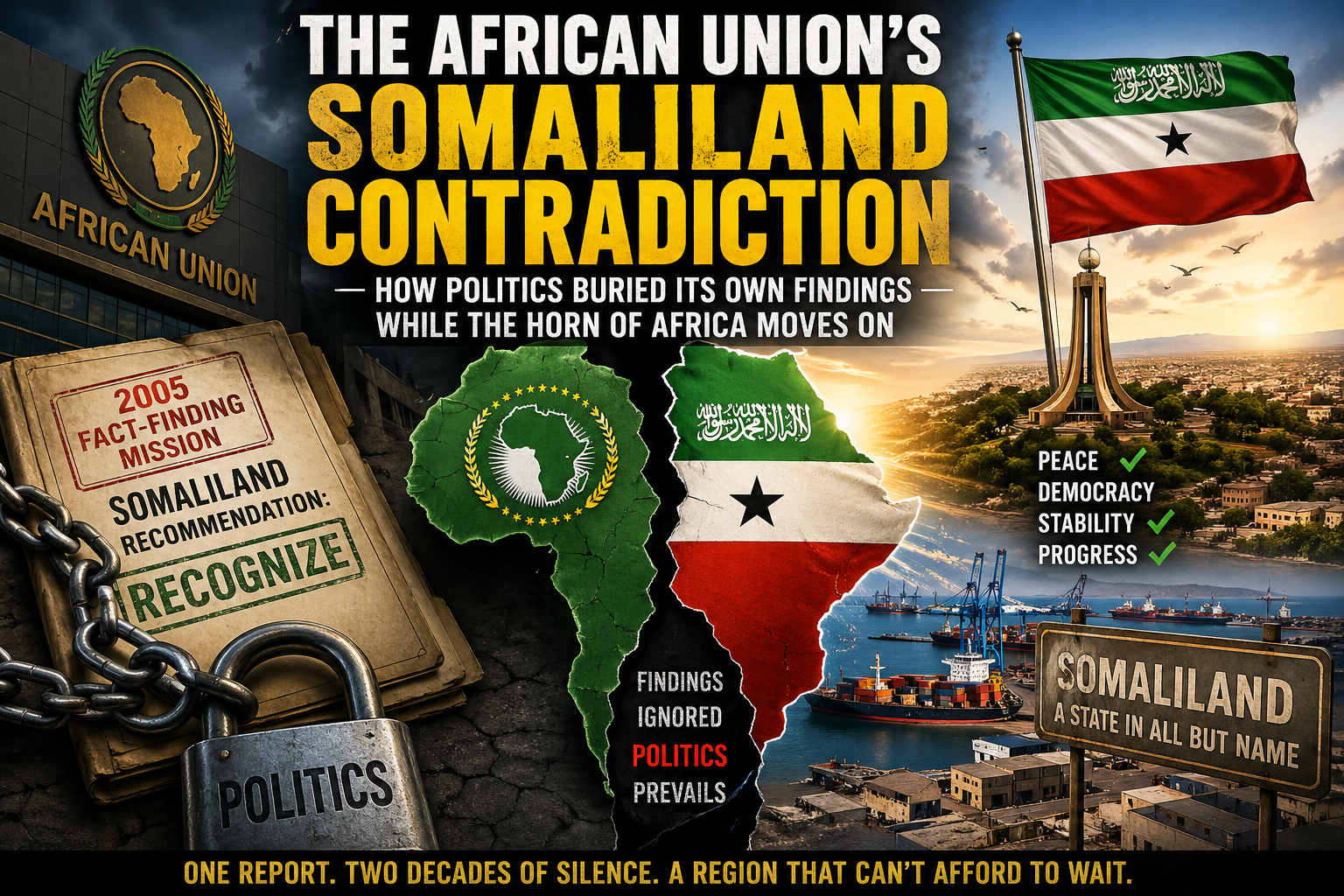
Nothing exposes this contradiction more clearly than the African Union’s own 2005 fact-finding mission to Somaliland.
That mission, dispatched by the AU itself, traveled to Somaliland and conducted an extensive assessment of the political, legal, historical, and security realities on the ground. Its conclusions were extraordinary.
The mission acknowledged that Somaliland’s case was “unique and self-justified in African political history.” It concluded that Somaliland’s search for recognition was not linked to “opening a Pandora’s box” of separatist conflicts across Africa. It further observed that Somaliland had demonstrated political stability, democratic governance, institutional maturity, and internal legitimacy unmatched in many recognized African states.
In effect, the AU’s own investigators quietly admitted what many diplomats privately concede today: Somaliland already functions as a sovereign state.
Yet nearly two decades later, the African Union has buried its own findings.
The report was never seriously debated, never implemented, and gradually disappeared into diplomatic silence. The AU chose political paralysis over institutional honesty.
Nowhere is this contradiction more visible than in the AU’s recent reaction following Israel’s formal recognition of Somaliland and the appointment of Ambassador Michael Lotem to Hargeisa.
The condemnations that followed from Somalia, Djibouti, and AU officials were immediate and emotional. They invoked “Somalia’s territorial integrity,” “African unity,” and “international law.” But strikingly absent from those statements was any reference whatsoever to the African Union’s own 2005 findings.
Not one of the officials condemning Israel’s recognition addressed the inconvenient reality that the AU itself had already concluded Somaliland’s case was historically unique and legally defensible.
That omission was not accidental.
Because acknowledging the 2005 mission would expose the political hypocrisy now driving AU policy.
The issue is no longer legal. It is geopolitical.
For years, Somalia has used the African Union as a diplomatic shield to block Somaliland’s recognition despite lacking effective sovereignty over Somaliland territory since 1991. Mogadishu continues to claim Somaliland’s Red Sea coastline while struggling to exercise authority even within parts of southern Somalia without the protection of foreign troops and international security missions.
At the same time, Somalia has increasingly aligned itself with regional powers whose interests revolve less around Somali unity and more around strategic competition in the Horn of Africa. Defense and political arrangements involving Egypt, Eritrea, and Türkiye have transformed Somalia into a theater for broader geopolitical rivalries aimed largely at countering Ethiopia’s regional ambitions and Somaliland’s growing strategic relevance.
Djibouti’s role is equally revealing.
Officially, Djibouti presents itself as defending African unity and territorial integrity. In reality, Somaliland’s emergence as a recognized Red Sea partner threatens Djibouti’s long-standing monopoly over regional maritime logistics and Ethiopia’s sea access.
The political sensitivity becomes even sharper considering that Djibouti’s former foreign minister now occupies a senior leadership role within the African Union structure itself. Critics increasingly argue that AU neutrality on Somaliland has been compromised by the direct political interests of states that view Somaliland’s recognition as an economic and strategic threat.
This helps explain why the AU has remained largely silent on Somaliland’s democratic achievements while rushing to condemn moves toward its recognition.
And the contrast between Somaliland and Somalia has become increasingly difficult to ignore.
While Somalia continues battling insecurity, political fragmentation, and dependence on foreign peacekeeping forces, Somaliland has spent more than three decades building functioning institutions largely without international recognition or significant aid.
Somaliland has held multiple competitive elections with peaceful transfers of power. It maintains its own currency, security forces, judiciary, parliament, and diplomatic engagements. International observers have repeatedly praised its electoral process and political stability.
In many respects, Somaliland today functions more effectively than several internationally recognized states.
The AU’s inconsistency becomes even more glaring when viewed against African precedents.
Eritrea separated from Ethiopia in 1993 with continental acceptance. South Sudan gained independence in 2011 following political realities the AU eventually accepted. The Senegambia Confederation between Senegaland The Gambia dissolved peacefully without triggering continental panic over territorial integrity.
Yet Somaliland — which restored sovereignty within already recognized colonial boundaries — remains trapped in diplomatic limbo.
The reality is increasingly obvious: the African Union’s Somaliland policy is no longer driven by legal doctrine or historical consistency. It is driven by fear of political fallout, regional rivalries, and institutional weakness.
Israel’s recognition of Somaliland has now intensified that contradiction dramatically.
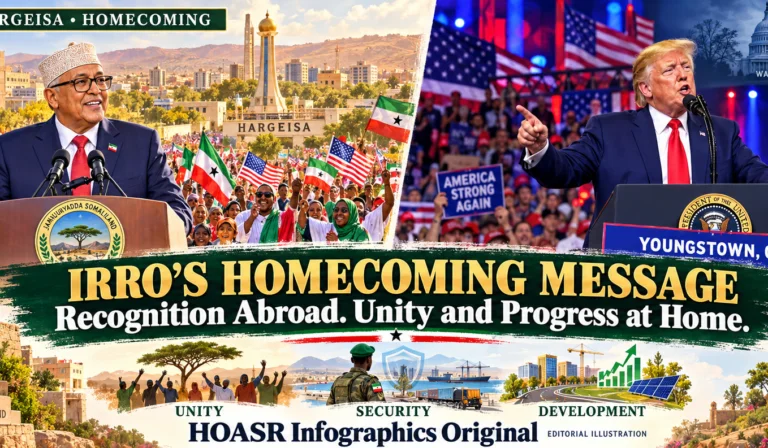
For the first time, a strategically significant state has openly challenged the diplomatic fiction surrounding Somaliland’s status. The appointment of an Israeli ambassador to Hargeisa transforms Somaliland from a “frozen African dispute” into an emerging geopolitical reality tied directly to Red Sea security, maritime trade, Middle Eastern alignments, and great-power competition.
That is why the reaction has been so intense.
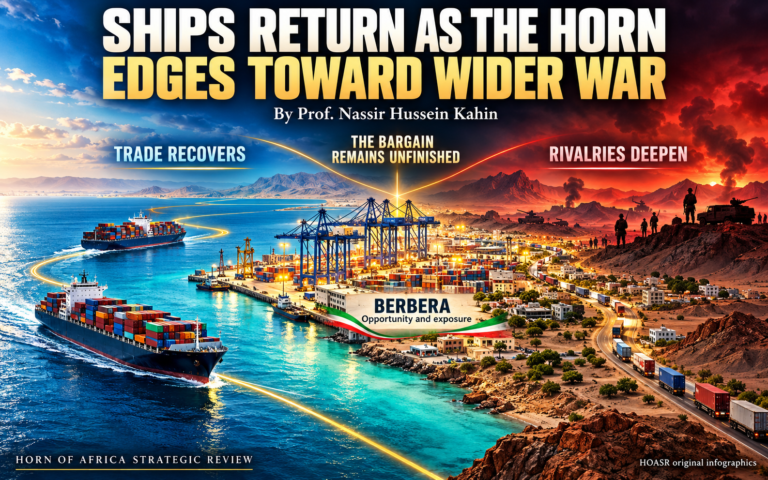
The Horn of Africa is no longer operating according to the assumptions of the 1990s. The Red Sea has become one of the world’s most contested strategic corridors. Global and regional powers are recalculating alliances based on ports, shipping lanes, counterterrorism cooperation, and Maritime Security.
In that environment, the African Union increasingly looks disconnected from realities on the ground.
Its institutions issue statements, but external powers shape events.
Its charter speaks of stability, but its paralysis often prolongs uncertainty.
Its own investigative mission acknowledged Somaliland’s legitimacy, yet politics prevented action.
The deeper irony may be this: the AU was created to preserve African stability and prevent conflict. Yet by refusing to address Somaliland’s case honestly despite overwhelming historical and political evidence, it may have prolonged one of Africa’s most avoidable diplomatic contradictions.
Somaliland has already demonstrated statehood in practice.
The only thing missing is formal acknowledgment of a reality the African Union recognized privately nearly twenty years ago — but still lacks the political courage to admit publicly. For more analysis and insight click on this link: The African Union’s Contradictions: Why it’s Charter Doesn’t Apply to Somaliland’s Right to Reclaim its 1960 De’jure International Recognition.

Prof. Nassir Hussein Kahin is a researcher, educator, journalist, and geopolitical analyst specializing in the Horn of Africa, the Red Sea, international law, diplomacy, and strategic affairs. To read Full Bio click on this link: ABOUT THE AUTHORProf. Nassir Hussein Kahin