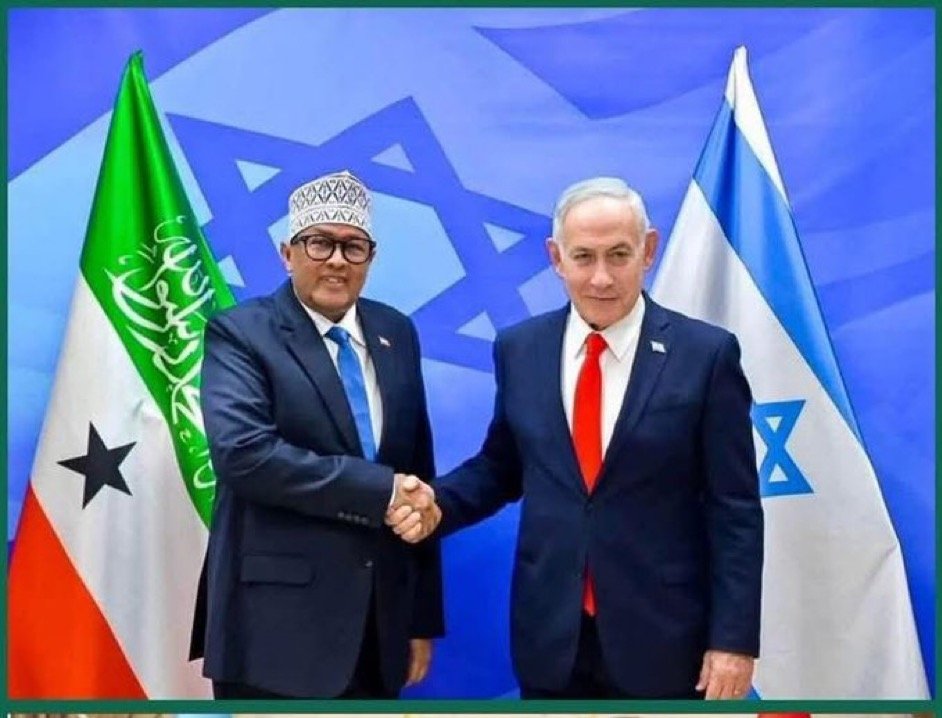
Israel broke the assumption that no UN member would ever move first.
Containment Is Not a Settlement: Why Somalia’s Campaign Cannot Reverse Somaliland’s Recognition
By Prof. Nassir Hussein Kahin
A recent Dawan Africa opinion article, “Israel’s Recognition of Somaliland Reshapes the Strategic Landscape in the Horn of Africa”, August 7, 2026, by Omar Abubakar Mohamed offers one of the clearest descriptions yet of Mogadishu’s emerging strategy for containing Somaliland’s diplomatic advance. View the article: Opinion: Israel’s Recognition of Somaliland Reshapes the Strategic Landscape in the Horn of Africa
The article acknowledges an important reality: Israel’s recognition of Somaliland on December 26, 2025 fundamentally changed the political landscape. Yet it proceeds from that admission to a questionable conclusion—that Somalia’s diplomatic campaign has successfully contained the recognition and can prevent other countries from following Israel.
That conclusion confuses delay with defeat, diplomatic opposition with sovereign authority and international caution with acceptance of Somalia’s claim. Somalia may be able to slow the recognition process. It cannot erase Somaliland’s history, dissolve its institutions or permanently prevent other sovereign states from reassessing a policy inherited from a failed union.
Recognition Is Not Controlled by Mogadishu
The central weakness in the Dawan argument is its assumption that Somalia possesses something approaching a veto over Somaliland’s recognition.
It does not.
Recognition is a sovereign political decision made by individual states. Israel exercised that authority when it formally recognized Somaliland as an independent and sovereign state and signed a declaration of mutual recognition with President Abdirahman Mohamed Abdillahi. The decision established diplomatic relations and contemplated cooperation in agriculture, health, technology and economic development. It was not merely symbolic. It created a new interstate relationship. The Israeli government’s official announcement confirms the mutual declaration.
Somalia and its partners are entitled to oppose that decision. Opposition, however, does not invalidate recognition.
The United States defended Israel’s legal capacity to make its own recognition decision, even though Washington had not adopted the same policy. That distinction is crucial: one government may disagree with another government’s recognition decision without claiming that the decision is legally impossible.
International law does not give an existing state an absolute power to prevent recognition of a territory that has established the population, government, territorial base and capacity for foreign relations commonly associated with statehood. The generally cited Montevideo criteria identify a permanent population, defined territory, government and capacity to enter relations with other states as the principal qualifications of statehood. Somaliland has demonstrated those capacities for more than three decades.
Somaliland Is Not an Ordinary Secessionist Case
The Dawan article treats Somaliland primarily as an administration seeking to separate from an existing Somali state. That framing omits the most important historical fact.
British Somaliland became the independent State of Somaliland on June 26, 1960. The former Italian-administered territory became independent several days later. The two entered a union on July 1.
35 UN members including the five permanent members of the UN Security Council had officially recognized Somaliland as the former British protectorate became independent on June 26 before joining Somalia, the former Italian trust territory on July 1.
Somaliland’s case is therefore not simply a demand to carve a new country out of Somalia. It is a claim that a previously independent state voluntarily entered a union whose legal, constitutional and political foundations subsequently collapsed—and that Somaliland restored its former sovereignty in 1991 after state-sponsored mass violence and the disintegration of the Somali Republic.
This history does not automatically compel every country to recognize Somaliland. It does, however, distinguish the case from conventional separatist movements and weakens repeated attempts to present recognition as the arbitrary dismemberment of a functioning state.
Somalia has not exercised effective governmental authority in Hargeisa, Berbera, Borama or most of Somaliland since 1991. It does not collect taxes there, administer its ports, appoint its government, operate its courts or provide its public security. The international community’s continued diplomatic recognition of Somalia’s claimed borders cannot substitute indefinitely for actual governance.
Eight Months Without Another Recognition Proves Very Little
The Dawan article argues that because no second state immediately followed Israel, Somalia’s diplomatic campaign must have successfully contained the recognition.
That is an inference, not an established fact.
Recognition decisions are rarely made as a rapid cascade. They involve domestic politics, alliance management, legal reviews, security calculations and negotiations over the practical consequences of diplomatic relations. Governments may deepen unofficial relations, open representative offices, sign agreements or expand security cooperation before announcing formal recognition.
A period of eight months is far too short to establish that Israel’s decision has been isolated permanently.
Recognition can also change the behaviour of states that are not yet prepared to recognize. Governments may begin treating Somaliland separately in travel guidance, development programming, defence legislation, investment policy, security cooperation or diplomatic engagement. These incremental distinctions weaken the practical fiction that Somaliland is administered from Mogadishu.
The correct question is not merely how many governments have formally followed Israel. It is whether Israel’s decision has made Somaliland recognition a more credible and discussable policy option.
Plainly, it has.
Before December 26, recognition was often presented as hypothetical. Afterwards, it became a diplomatic precedent established by a United Nations member state. Mogadishu can campaign against that precedent, but it cannot return the situation to what existed before it.
Collective Statements Are Not Permanent National Policies
Somalia has mobilized support from the African Union, the Arab League, the Organization of Islamic Cooperation and several individual governments. These statements matter politically, but they should not be exaggerated.
Multilateral organizations frequently default to preserving the recognized territorial status quo. Their collective declarations do not prevent member states from reconsidering their national policies when strategic interests change.
The coalition opposing Israel’s decision is itself driven by interests extending far beyond Somali territorial integrity. Egypt evaluates Somaliland partly through its rivalry with Ethiopia. Turkey’s position is connected to its extensive military, commercial and political investment in Somalia. Iran views Israel’s presence across the Gulf of Aden through the confrontation involving the Houthis and the Red Sea. Djibouti must consider the competitive implications of Berbera’s development.
These governments are not neutral guardians of an uncontested legal principle. They are strategic actors protecting particular interests.
Somaliland must therefore avoid portraying every opposing government as permanently hostile. Diplomatic alignments can change. States that oppose recognition today may adopt a different position when maritime security, investment, military access, trade corridors or regional balances make direct relations with Somaliland more advantageous.
Trying to Manufacture Internal Opposition Is Not Dialogue
The Dawan article recommends that Somalia combine international pressure with political engagement inside Somaliland to emphasize the costs of relations with Israel.
This deserves close attention. It effectively outlines a strategy to turn Somaliland’s internal political debate into an instrument of Mogadishu’s recognition-containment campaign.
Somaliland, like any democratic society, contains disagreements about foreign policy, relations with Israel, the location of diplomatic missions and the terms of international security cooperation. Such debate is legitimate.
But disagreement over a particular alliance does not necessarily translate into support for reunification with Somalia. Nor does criticism of the Somaliland government erase the wider population’s attachment to the political order constructed since 1991.
Somaliland’s sovereignty is not the property of one president, party or clan. It rests on institutions and on a political identity developed across generations. Many Somalilanders alive today have never lived under a government based in Mogadishu.
Efforts to exploit internal divisions may therefore produce the opposite of reconciliation. They can reinforce the belief that Mogadishu regards Somaliland’s democratic openness not as an opportunity for honest dialogue but as a vulnerability to manipulate.
Territorial Disputes Do Not Erase Somaliland’s Statehood Claim
The Dawan article also points to Mogadishu’s increasing involvement in the eastern contested territories as part of its broader strategy.
Somaliland must take disputes in Sool and eastern Sanaag seriously. Questions of local consent, political representation, security and administration cannot be dismissed. A credible state must address grievances through negotiation, constitutional inclusion and accountable government.
But territorial disagreement does not automatically invalidate statehood. Numerous internationally recognized states have disputed borders or lack effective control over parts of the territory they claim including Somalia.
Somalia itself struggles to exercise consistent authority across areas internationally recognized as belonging to it. If complete territorial control were an absolute condition of international personality, Somalia’s own position would become difficult to defend.
Eastern disputes require a negotiated political response. They should not be used to deny the existence of the functioning state institutions, settled population and sustained self-government found across most of Somaliland.
Dialogue Cannot Begin With a Predetermined Verdict
The Dawan article calls for negotiations between Somalia and Somaliland while insisting that the process must preserve Somalia’s sovereignty and territorial integrity.
That is not an open negotiation. It predetermines the outcome before talks begin.
A meaningful process must allow both sides to present their respective positions: Somalia’s claim to territorial unity and Somaliland’s claim to restored sovereignty. Dialogue may address security, trade, airspace, assets, borders, citizenship, movement and regional cooperation. It may reduce tensions even when final-status agreement remains difficult.
However, Somaliland cannot reasonably be expected to enter negotiations whose stated purpose is to negotiate the terms of its own political disappearance.
If Mogadishu wishes to demonstrate confidence in its position, it should accept internationally facilitated talks without preconditions and allow the legitimacy of both claims to be examined historically, legally and democratically.
Recognition Based on Interests Is Still Recognition
The Dawan article suggests that Israel recognized Somaliland primarily for strategic and security reasons. That is likely at least partly correct. It is not the rebuttal the author assumes it to be.
States rarely make recognition decisions from altruism. Security, geography, trade, ideology and alliance politics have always influenced international recognition.
Somalia itself asks other governments to defend its territorial claim by invoking their strategic interests. Turkey, Egypt and several Arab states do not support Mogadishu in a geopolitical vacuum.
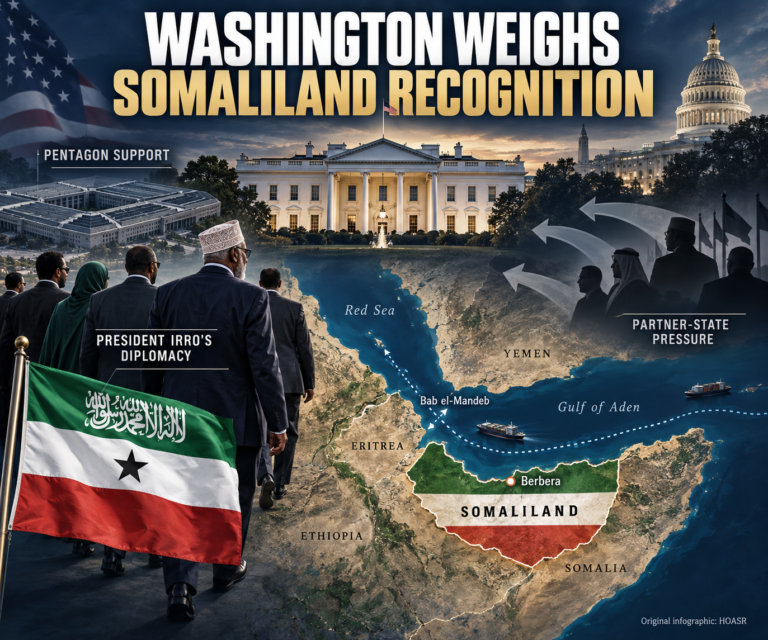
Israel’s interest in Somaliland’s position near Yemen and Bab al-Mandab does not invalidate Somaliland’s statehood. Instead, it demonstrates that Somaliland’s geography, governance and capacity for partnership have acquired international strategic value.
The more Somaliland proves itself capable of contributing to maritime security, counterterrorism, trade, investment and regional stability, the stronger its diplomatic case becomes.
The challenge for Hargeisa is to ensure that new partnerships remain transparent, reciprocal and consistent with Somaliland’s long-term national interests. Recognition should not become a blank cheque for any foreign power. Sovereignty requires the ability to form partnerships—and the judgment to define their limits.
Containment Cannot Replace a Political Settlement
Somalia may persuade some governments to postpone recognition. It may secure supportive resolutions from organizations predisposed toward existing borders. It may intensify its presence in contested territories and seek to cultivate Somaliland voices opposed to particular foreign partnerships.
None of these measures resolves the central issue.
Somaliland has maintained a separate political order since 1991. It possesses its own government, security institutions, currency, electoral system and foreign relationships. Its population has developed a distinct civic and political identity. Israel’s recognition has now given that reality formal interstate expression.
Mogadishu’s strategy is therefore a strategy of containment, not settlement.
Containment may buy time, but time does not necessarily favor Somalia. Every additional year of separate governance strengthens Somaliland’s institutional distinctiveness. Every new generation raised under Somaliland’s flag makes compulsory reunion less plausible. Every direct international agreement demonstrates capacity for foreign relations. Every strategic partnership reduces the credibility of treating Somaliland as merely an internal administrative region.
Israel’s recognition did not complete Somaliland’s diplomatic journey. Nor did it guarantee an immediate succession of recognitions. It did something more fundamental: it broke the assumption that no state would ever move first.
Somalia may delay others from moving second. It cannot permanently prevent sovereign governments from deciding that recognition of Somaliland serves justice, stability and their own national interests.
The real choice facing Mogadishu is therefore not between successfully preserving unity and surrendering territory. It is between negotiating responsibly with an enduring political reality or continuing a containment campaign that postpones—but cannot answer—the question of Somaliland’s final international status.
Prof. Nassir Hussein Kahin is a researcher, educator, journalist, and geopolitical analyst specializing in the Horn of Africa, the Red Sea, international law, diplomacy, and strategic affairs. To read Full Bio click on this link: ABOUT THE AUTHORProf. Nassir Hussein Kahin