Skip to content
HOASR

Horn of Africa Strategic Review (HOASR)

Geopolitics| Strategy| Analysis| Insights

Primary Menu
  • Home
  • Israel Somaliland Relations
  • Energy & Strategic Minerals
  • Somaliland Recognition
  • Global Power Geopolitics
  • Politics & Government
  • Security and Military Affairs
  • Editorial Analysis
  • Horn of Africa & Red Sea Security
  • Media Hub
  • Opinion & Analysis
Home
  • Home
  • Horn of Africa & Red Sea Security
  • Somaliland Is the Red Sea’s Missing Ally
  • Horn of Africa & Red Sea Security

Somaliland Is the Red Sea’s Missing Ally

As the Red Sea becomes a theater of confrontation, the absence of Somaliland from the international system is no longer sustainable. It is a strategic blind spot.
hornofafricastrategicreview.com April 2, 2026
Written by hornofafricastrategicreview.com

By Prof. Nassir Hussein Kahin, International Affairs Writer, Geopolitics Analyst and Managing Editor at Horn of Africa Strategic Review.

In a world increasingly defined by strategic chokepoints and proxy conflicts, the question of Somaliland’s recognition is no longer a matter of diplomatic caution—it is a test of geopolitical clarity.

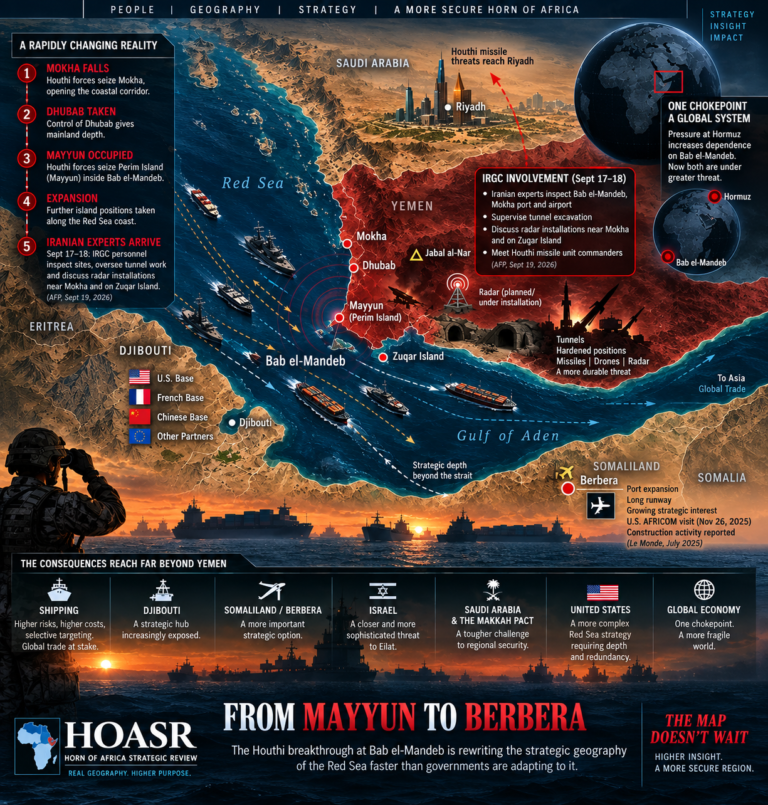
The recent call by  U.S.  Republican Congressman of Tennessee for the recognition of Somaliland, following the precedent set by Israel, comes at a decisive moment. The entry of the  Houthi Movement into a widening Middle Eastern war—paired with threats to shut down the  Bab -el- Mandab Strait transformed the Red Sea into one of the most dangerous corridors in global trade.

This is no longer a regional issue. It is a global one.

Nearly 12 percent of the world’s seaborne oil and a significant share of global commerce pass through the Bab El-Mandeb, linking the Suez Canal to the Indian Ocean. If this artery is severed, the consequences will ripple across Europe, Asia, and beyond—fueling inflation, disrupting supply chains, and destabilizing markets.

Yet directly across from this volatile chokepoint lies Somaliland: a functioning Democracy, a stable partner, and an unrecognized state.

For over three decades, Somaliland has maintained peace, conducted elections, and built institutions in stark contrast to the instability of southern Somalia. It has done so without international recognition, without access to global financial systems, and without the security guarantees afforded to recognized states.

This is precisely why recognition now matters.

For Israel, Somaliland represents a forward line of defense against Iranian expansion via Yemen. Its recognition aligns naturally with the logic of the Abraham Accords -expanding a network of pragmatic, security-oriented partnerships.

For the United States and its allies, the stakes are even higher.

Iran is no longer confined to the Persian Gulf. Through its proxies, it now threatens both the Straits of Hormuz and the Bab el-Mandeb—effectively positioning itself to choke global trade from two directions.

At the same time, China’s expanding footprint in Djibouti underscores a parallel strategic competition. With its only overseas military base located just miles from Somaliland’s coast, Beijing has already recognized the importance of this geography.

Unfortunately, the West so far has not.

Recognition of Somaliland would immediately unlock a series of strategic advantages: a reliable partner for Maritime Security, a potential host for military and intelligence infrastructure, and a democratic counterweight in a region increasingly shaped by authoritarian influence.

It would also send a powerful message—that democratic resilience, even in the absence of recognition, is not ignored but rewarded.

The argument against recognition has long rested on fears of setting precedents. But Somaliland is not a typical secessionist case. It is a former sovereign entity that voluntarily united with Somalia and later withdrew following state collapse and mass atrocities. Its case aligns closely with the principle of remedial secession under international law.

The greater risk now lies not in recognition, but in continued hesitation.

As the Red Sea becomes a theater of confrontation, the absence of Somaliland from the international system is no longer sustainable. It is a strategic blind spot.

Recognition is not merely an act of diplomacy. It is an act of necessity.

Prof. Nassir Hussein Kahin
hornofafricastrategicreview.com
Publisher & Managing Editor at Horn of Africa Strategic Review | Web

Prof. Nassir Hussein Kahin is a researcher, educator, journalist, and geopolitical analyst specializing in the Horn of Africa, the Red Sea, international law, diplomacy, and strategic affairs. To read Full Bio click on this link: ABOUT THE AUTHORProf. Nassir Hussein Kahin
  • hornofafricastrategicreview.com
    From Cyprus to Berbera: Israel and Türkiye’s Expanding Contest for the Eastern Mediterranean and Red Sea
  • hornofafricastrategicreview.com
    Horn & Red Sea Weekly Review: Uganda’s Exit, Turkey at Sea and Cairo’s Sool Card
  • hornofafricastrategicreview.com
    The Pact, the Panic and the Counter-Pact: Why the Makkah agreement is already changing calculations before it has proved that it can change a battlefield  
  • hornofafricastrategicreview.com
    The Recognition Front: Amichai Chikli’s Makkah Pact Warning Places Somaliland at the Centre of Israel’s Emerging Counter-Alignment
Tweet
Share
Pin
Share

Post navigation

Previous: From Clan to Citizen: Can Somaliland Reconcile Culture and Statehood?
Next: Bab al-Mandeb, Berbera, and the New Strategic Map of the Horn of Africa

Media Hub

New-Ethiopia-Somaliland-MoU-Partnership
  • Editorial Analysis
  • Horn of Africa & Red Sea Security

Ethiopia’s Sea Ambition Needs a Partner, not a Pressure Campaign

Prof. Nassir Hussein Kahin August 27, 2026 0
Saudi tanker facing Houthi attacks across the Red Sea from Berbera Port and Somaliland, illustrating Saudi Arabia’s strategic failure to engage Somaliland.
  • Horn of Africa & Red Sea Security

The Geography Riyadh Ignored: How Saudi Arabia’s Somaliland Blind Spot Deepened Its Red Sea Vulnerability

hornofafricastrategicreview.com August 8, 2026
Can a landlocked Armenia become a strategic actor in the Red Sea?
  • Horn of Africa & Red Sea Security

From Yerevan To Berbera: Could Armenia Join A New Red Sea Axis?

hornofafricastrategicreview.com August 2, 2026 1

Israel Somaliland Relations

Israeli Minister Amichai Chikli’s response to the Makkah Joint Defence Agreement explicitly named Somaliland among the partnerships Israel should deepen.
  • Israel Somaliland Relations
  • Somaliland Recognition

The Recognition Front: Amichai Chikli’s Makkah Pact Warning Places Somaliland at the Centre of Israel’s Emerging Counter-Alignment

hornofafricastrategicreview.com August 11, 2026
Geopolitical illustration of Israel strengthening relations with Somaliland to secure the Red Sea and counter Houthi threats
  • Israel Somaliland Relations

Why Israel Chose Somaliland as Its Strategic Partner in the Horn of Africa and the Red Sea

hornofafricastrategicreview.com August 6, 2026 1
Why-Israel-Chose-Somaliland
  • Israel Somaliland Relations

The Return of the Periphery? Israel, Somaliland and the Horn of Africa after October 7

Dr. Asher Lubotzky August 6, 2026 1
Somaliland Leads
  • Editorial Analysis
  • Israel Somaliland Relations

Beyond Recognition: Can the Israel–Somaliland Partnership Help Build a New Indo-Abrahamic Maritime Order?

hornofafricastrategicreview.com August 3, 2026
HOASR Media Hub
  • Israel Somaliland Relations
  • Media Hub

Inside the new Muslim state that proudly supports Israel: The brink in Somaliland with Rageh Omaar

hornofafricastrategicreview.com July 5, 2026
  • Home
  • Horn of Africa Strategic Review
  • About
  • Ownership & Team
  • Editorial Policy
  • Terms of Service
  • Contact Us
  • ABOUT THE AUTHOR
Copyright 2025 Horn of Africa Strategic Review Media Company All Rights Reserved. | MoreNews by AF themes.