Controversial-MoU
By Prof. Nassir Hussein Kahin, Political Scientist, Journalist and Executive Managing Editor, Bridgingsomaliland.
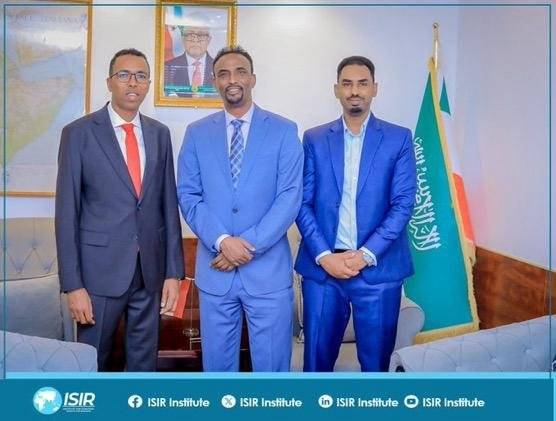
When news broke that Somaliland’s Ministry of Foreign Affairs and International Cooperation, Director General, Mr. Mohamed Abdirahman, signed a Memorandum of Understanding (MoU) for Strategic Cooperation with an NGO (ISIR Think Thank Institute) whose director, Mr. Hassan Suudi, recently described Somaliland as a “secessionist” entity on the South African TV channel Firstpost, televised live interview, he plainly said the following:
“Somaliland is a secessionist. If we assume Trump were to recognize Somaliland’s full independence, it would set a precedent in a highly volatile region. Just like Eritrea and South Sudan, other secessionist movements such as the TPLF in Ethiopia or Puntland in Somalia might be encouraged to follow suit, and American politicians are well aware of this.”, the initial reaction ranged from disbelief to outrage. But this is not just a case of poor diplomatic judgment—it is a deeper institutional crisis, one that threatens to erode the very foundation of Somaliland’s sovereign standing in the international system.
I have studied political science in the United States for four years with major concentration in International Relations, International Law, U.S. Constitutional Law, U.S. Government and Politics, Political Theory, Ancient and Modern Western Political Thought, Comparative Political Systems, Dynamics of African, Middle East and Latin American History and Politics, Journalism and since have been a political Journalist for the past 25 years.
Let me be clear: no aspiring or restored state can afford to fund, empower, or politically validate actors who actively deny its existence.
Diplomatic Language Is Not Innocent — It Is Strategic Ammunition.
The director of the NGO didn’t simply misspeak. He directly advanced a false narrative that Somaliland is a “secessionist” “breakaway state” — a line routinely pushed by Villa Somalia and echoed by its backers in Cairo, Ankara, and elsewhere. By describing Somaliland as comparable to the TPLF or Puntland, the director publicly contradicted the historical and legal reality that Somaliland was an internationally recognized state in 1960. Its 1991 withdrawal from a failed, unratified union with Somalia was a restoration of sovereignty—not “secession”.
Words carry consequences in diplomacy. To allow this narrative to go unchallenged—and worse, to formally sign an strategic MoU with the person who uttered it—is more than a gaffe. It is an act of self-sabotage.
How Did This Happen — and Why Was It Allowed?
The question troubling many Somalilanders isn’t just about the NGO’s statement, but about the Ministry’s decision to sign an MoU with it. Did the Foreign Ministry fail to vet this organization and its leadership which is being alleged to be funded by Turkey and is sympathetic to Villa Somalia’s delusions of One Somalia Policy? Or is there a deeper connection that the public doesn’t know—possibly involving financial, ideological, or political ties?
Public speculation is now rife. Some even question whether the Director General himself is linked to the NGO—if not as a founder, then as a hidden backer. The Ministry’s silence has only deepened public distrust. In international affairs, perception can quickly become reality if prolonged silence continues.
The Larger Crisis: “Weak Institutions, No Accountability”, say many critics.
The bigger concern here is structural, they argue: “If Somaliland’s most important ministry—tasked with advancing its bid for international recognition—lacks internal safeguards to prevent such missteps, “what other vulnerabilities exist? What other partnerships are being signed without scrutiny?”
This controversy should serve as a wakeup call or as a sobering reminder that meritless appointments, lack of institutional checks, and failure to control diplomatic narrative strategy all carry real-world costs. Somaliland has already done the hard work of building democratic institutions and peace from the ashes of brutal civil war. It must now prove that it can manage those institutions competently and strategically on the global stage.
Recommendations: Time to Fix the System, Not Just the Mistake.
This controversy must not be swept under the rug. Here’s what needs to happen—immediately:
1. Suspend and Review the MoU: The Ministry must freeze the agreement, initiate an independent investigation, and explain to the public why the MoU was signed in the first place.
2. Issue a Government Clarification:
President Abdirahman Mohamed Abdilahi “Cirro” must reaffirm Somaliland’s position as a restored sovereign state and reject that uttured “secessionist” label unequivocally.
3. Reform the Ministry’s Internal Vetting Process:
No partnerships or MoUs should be signed without political, diplomatic, legal, strategic, and narrative impact assessments. Qualified professionals with a background in political science, law, and national strategic interest must lead these reviews.
4. Create a Sovereignty Strategy Unit:
Somaliland must establish a body tasked with safeguarding its political and legal narrative, monitoring hostile narratives such as “Secessionist” or “Break-away Region”, from within and without, building a diplomatic doctrine and effective global communications narrative that aligns with its international de jure re-recognition quest and sovereignty agendas.
Final Thought: The Time for Professionalism Is Now
This is not a minor controversy—it’s a moment of reckoning. Somaliland’s struggle for recognition isn’t just about lobbying or legal argument. It’s also about discipline, self-awareness, and the professional maturity of the institutions charged with telling the world its brand and who Somaliland is.
If Somaliland fails to manage its narrative from within, no one else will protect it from the outside. And if its own foreign ministry cannot distinguish between friend and foe, it risks becoming a tool in the very campaign designed to deny its enemies to infiltrate in the highest circles of foreign policy decision-making.
Prof. Nassir Hussein Kahin is a researcher, educator, journalist, and geopolitical analyst specializing in the Horn of Africa, the Red Sea, international law, diplomacy, and strategic affairs. To read Full Bio click on this link: ABOUT THE AUTHORProf. Nassir Hussein Kahin