Skip to content
HOASR

Horn of Africa Strategic Review (HOASR)

Geopolitics| Strategy| Analysis| Insights

Primary Menu
  • Home
  • Israel Somaliland Relations
  • Energy & Strategic Minerals
  • Somaliland Recognition
  • Global Power Geopolitics
  • Politics & Government
  • Security and Military Affairs
  • Editorial Analysis
  • Horn of Africa & Red Sea Security
  • Media Hub
  • Opinion & Analysis
  • Culture & Society
  • Horn & Red Sea Weekly Review
  • Archive
  • Strategic Research Digest
Home
  • Home
  • Editorial Analysis
  • Power, Profiteering, and Public Outcry: Hargeisa’s Electricity Crisis Demands Legislative Action
  • Editorial Analysis

Power, Profiteering, and Public Outcry: Hargeisa’s Electricity Crisis Demands Legislative Action

Parliament must prioritize passing a comprehensive electricity law that licenses providers, enforces meter and billing standards, and establishes an independent regulatory body with investigative and enforcement powers.
hornofafricastrategicreview.com July 8, 2025
Electricity is Not a Luxury

Electricity is Not a Luxury

Written by hornofafricastrategicreview.com


By Prof. Nassir Hussein Kahin.

In the capital of Somaliland, a silent struggle is playing out behind closed doors and dimly lit rooms. Across Hargeisa, families, small business owners, and students are facing a punishing wave of electricity bills—charges that far exceed their actual usage and, in many cases, defy explanation. The cost of powering a modest household has become unbearable, with some residents paying as much as $1 per kilowatt-hour, one of the highest rates in the world.

This is not merely a case of economic hardship. What is unfolding appears to be a deeply flawed and potentially abusive system, driven by unregulated private electricity providers operating without oversight or accountability. These providers, which have proliferated since the collapse of national regulation, set their own prices, supply their own meters, and maintain fragmented mini-grids that leave the consumer vulnerable and powerless in more ways than one.

Allegations of fraud are mounting. Residents report meters spinning even when appliances are turned off, unexplained spikes in bills, and dramatic differences in usage compared to neighbors with similar households. Some consumers have even resorted to importing meters from abroad to verify their suspicions—often finding that bills drop by half once the new meters are installed. Such findings raise serious concerns about meter tampering, voltage manipulation, and the use of rigged or faulty equipment designed to inflate consumption.

A public guide titled “Community Guide: How to Detect Electricity Overcharging / Hagaha Bulshada: Sida Loo Ogaado Xatooyada Korontada” is now circulating throughout Hargeisa. It teaches users to monitor their meters, record readings daily, compare usage with neighbors, and be wary of pre-programmed meters when switching providers. It also outlines how some companies may use fraudulent methods such as installing tampered software, delivering high voltage to push up consumption, or manipulating wiring—especially the neutral line—to distort readings.

While these grassroots efforts to raise awareness are commendable, they are not enough. It is time for residents to act collectively, not just as consumers, but as citizens. I urge every reader to call or write to their elected representatives in parliament and demand urgent legislative action. This is no longer a private inconvenience—it is a public crisis that undermines household stability, business sustainability, and public trust in basic infrastructure.

Parliament must prioritize passing a comprehensive electricity law that licenses providers, enforces meter and billing standards, and establishes an independent regulatory body with investigative and enforcement powers. Without such action, the market will remain a patchwork of unchecked profiteering, where the poor suffer the most and no one is held accountable.

Consumers need protection—but that protection will only come when voters raise their voices. Constituents must push their MPs to recognize that electricity is not a luxury, nor is it an open field for exploitation. It is a right, and its fair access is essential to Somaliland’s dignity, development, and democratic promise.

The situation in Hargeisa should serve as a wake-up call for all of Somaliland. We cannot expect progress or recognition on the world stage while our own citizens are being overcharged and underserved in their own homes. This is not just about watts and wires—it is about justice, transparency, and the role of government in defending the people.

The time to act is now. Not just by switching providers or changing meters, but by demanding that lawmakers fulfill their duty to the public. Light up your homes, yes—but also shine a light on the system itself. And if your bill is suspiciously high, your meter spinning wildly, or your neighbors paying half what you do, don’t just complain—call your MP and call for change.
Prof. Nassir Hussein Kahin
hornofafricastrategicreview.com
Publisher & Managing Editor at Horn of Africa Strategic Review | Web

Prof. Nassir Hussein Kahin is a researcher, educator, journalist, and geopolitical analyst specializing in the Horn of Africa, the Red Sea, international law, diplomacy, and strategic affairs. To read Full Bio click on this link: ABOUT THE AUTHORProf. Nassir Hussein Kahin
  • hornofafricastrategicreview.com
    The Horn Nears a Wider War as Somaliland Gains a Washington Opening
  • hornofafricastrategicreview.com
    Ethiopia and the Widening Strategic Conflict in the Horn
  • hornofafricastrategicreview.com
    HOASR Strategic Weekly Review October 3-8: The Coast Changes Hands. The Red Sea Contest Deepens.
  • hornofafricastrategicreview.com
    HOASR Strategic Weekly Review 26 September to 2 October 2026: Two Shores Two Alignments
Tweet
Share
Pin
Share
0 Shares

Post navigation

Previous: “The Hallway to Recognition”: President Cirro’s Visit to Qatar and Somaliland’s Expanding Foreign Policy Frontier
Next: This Is Bigger Than a Blunder: What the NGO MoU Controversy Reveals About Somaliland’s Foreign Policy Crisis.

Media Hub

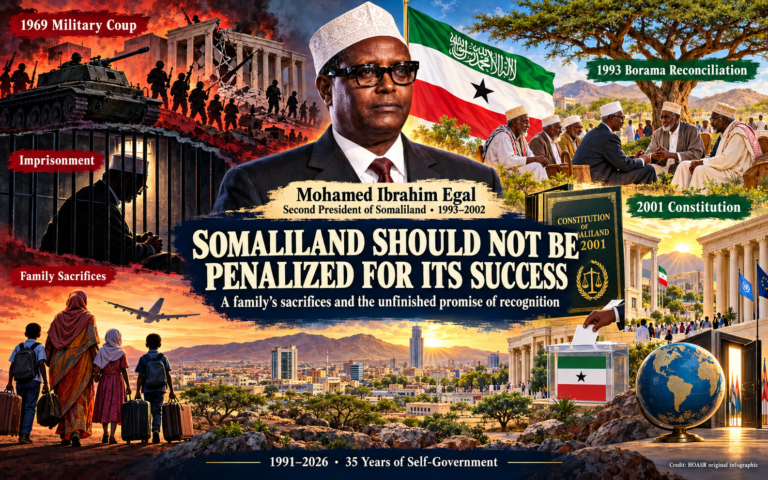
Illustration of Mohamed Ibrahim Egal showing the 1969 coup, imprisonment, family exile and Somaliland’s reconciliation and constitutional rebuilding.
  • Editorial Analysis
  • Somaliland Recognition

Somaliland Should Not Be Penalized for Its Success: A family’s sacrifices and the unfinished promise of recognition

Ali Mohamed Ibrahim Egal October 14, 2026 0
2ADDFAA9-BA83-4795-8669-3EBE999AC14D
  • Editorial Analysis

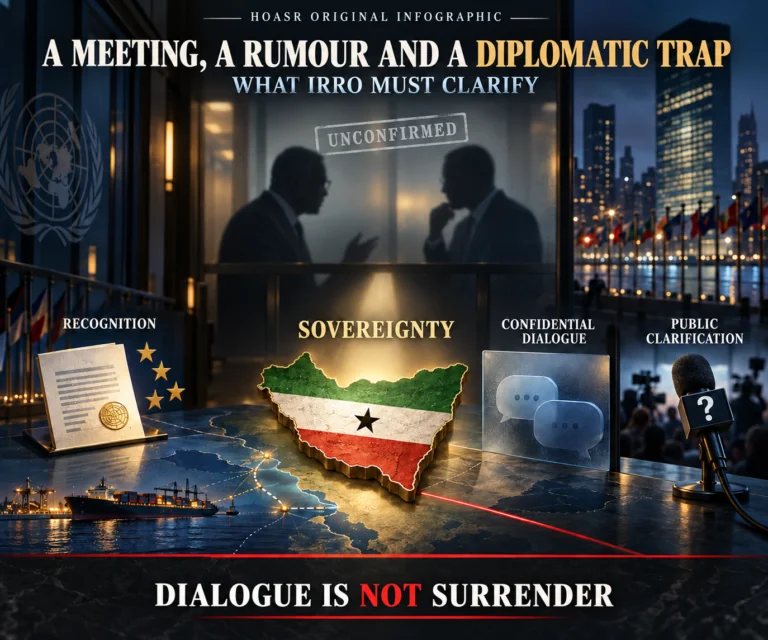
Meeting, a Rumour and a Diplomatic Trap: What Irro Must Clarify

hornofafricastrategicreview.com September 28, 2026
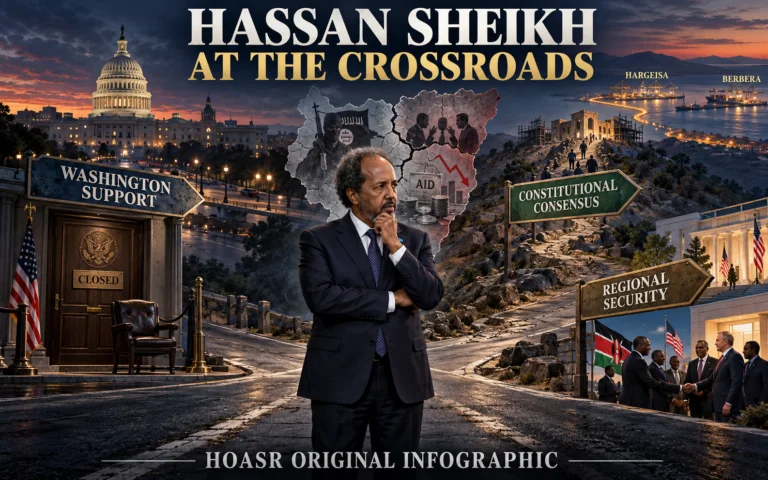
Hassan Sheikh Mohamud standing at a crossroads after his failed American mission as US support for Somalia weakens.
  • Editorial Analysis

Sovereignty Without Confidence: Hassan Sheikh’s Failed American Mission

hornofafricastrategicreview.com September 27, 2026

Israel Somaliland Relations

Israel and Somaliland flags symbolizing diplomatic unity and growing strategic relations between the two countries.
  • Israel Somaliland Relations

Israel Somaliland Diplomatic Relations

hornofafricastrategicreview.com September 22, 2026
Israeli Minister Amichai Chikli’s response to the Makkah Joint Defence Agreement explicitly named Somaliland among the partnerships Israel should deepen.
  • Israel Somaliland Relations
  • Somaliland Recognition

The Recognition Front: Amichai Chikli’s Makkah Pact Warning Places Somaliland at the Centre of Israel’s Emerging Counter-Alignment

hornofafricastrategicreview.com August 11, 2026
Geopolitical illustration of Israel strengthening relations with Somaliland to secure the Red Sea and counter Houthi threats
  • Israel Somaliland Relations

Why Israel Chose Somaliland as Its Strategic Partner in the Horn of Africa and the Red Sea

hornofafricastrategicreview.com August 6, 2026 1
Why-Israel-Chose-Somaliland
  • Israel Somaliland Relations

The Return of the Periphery? Israel, Somaliland and the Horn of Africa after October 7

Dr. Asher Lubotzky August 6, 2026 1
Somaliland Leads
  • Editorial Analysis
  • Israel Somaliland Relations

Beyond Recognition: Can the Israel–Somaliland Partnership Help Build a New Indo-Abrahamic Maritime Order?

hornofafricastrategicreview.com August 3, 2026
  • October 2026
  • September 2026
  • August 2026
  • July 2026
  • June 2026
  • May 2026
  • April 2026
  • March 2026
  • September 2025
  • August 2025
  • July 2025
  • June 2025
  • May 2025
  • April 2025
  • March 2025
  • February 2025
  • Home
  • Horn of Africa Strategic Review
  • About
  • Ownership & Team
  • Editorial Policy
  • Terms of Service
  • Contact Us
  • ABOUT THE AUTHOR
Copyright 2025 Horn of Africa Strategic Review Media Company All Rights Reserved. | MoreNews by AF themes.