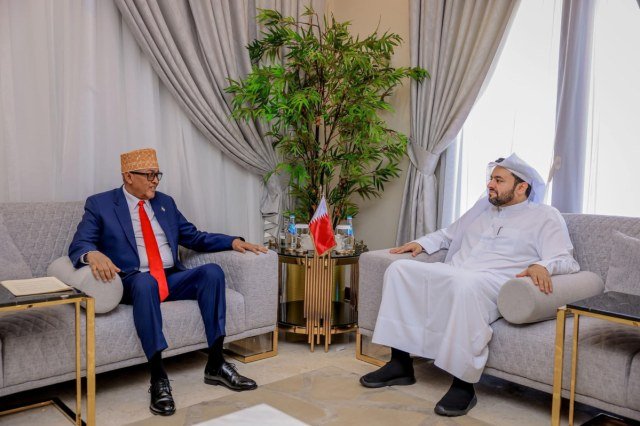
A New Era of Global Engagement
“The Hallway to Recognition”: President Abdirahman Mohamed Abdillahi Cirro’s Visit to Qatar and Somaliland’s Expanding Foreign Policy Frontier
By Prof. Nassir Hussein Kahin, Political Analyst & International Affairs Writer, and Managing Editor, Bridgingsomaliland.com
In a region where rumor often speaks louder than treaties and diplomacy is measured as much by who you don’t meet as by who you do, the image of President Abdirahman Mohamed Abdilahi “Cirro” stepping off a plane in Doha was both historic and symbolic.
It was deliberate, daring, and dramatic. No Somaliland president had ever visited Qatar. For decades, Doha remained a diplomatic no-go zone due to its unwavering commitment to Somalia’s “One Somalia” policy. Prior administrations viewed it as politically risky, if not entirely futile, to engage a country so closely aligned with Mogadishu.
But President Cirro chose to change the script. Where others saw a wall, he saw a door worth trying to open—even if just slightly. His visit to Qatar wasn’t an accident, nor a whim; it was a calculated step forward in what appears to be a bold, multi-faceted foreign policy—one not defined by a single issue like recognition, but by a comprehensive vision rooted in economic opportunity, strategic influence, regional engagement, and the long game of diplomacy.
What followed the visit was a an “earthquake” of rumors and speculation. Qatar, like Nairobi, unsurprisingly, a standard internationally used for “unrecognized states” released such a statement reiterating its support for “Somali unity” and encouraged a resumption of Somaliland-Somalia talks. For the president’s domestic critics, this was enough to declare the trip a “failure”. Opposition figures accused Cirro of walking blindly into a trap, arguing that he should have sent a lower-level official to test the waters first. Some labeled the move an “embarrassment”, citing Qatar’s public stance as evidence that Somaliland gained nothing.
But such criticism oversimplifies the nuanced purpose of diplomacy, particularly for a “de facto” but internationally unrecognized state like Somaliland. President Cirro’s visit was not solely, or even primarily, about recognition. It was about engagement. It was about expanding Somaliland’s voice and footprint in a region increasingly defined by fierce geopolitical competition. And it was about challenging the rigid binary thinking that has for too long defined Somaliland’s foreign affairs strategy—where countries are either allies or adversaries, where every trip must deliver recognition or it is deemed a waste.
President Cirro’s new approach recognizes that in the real world of diplomacy, relationships evolve slowly. Influence is built through consistency, not confrontation. Conversations today can lead to policy shifts tomorrow, even among countries that once dismissed Somaliland outright. In this context, Qatar’s willingness to officially host the president of Somaliland—despite its formal alignment with Somalia—was in itself a diplomatic breakthrough. One former Somaliland diplomat, requesting anonymity, put it plainly: “He took the risk none before him would take. He stood before Qatar, not begging—but representing. That alone reshaped our image.”
In Doha, President Cirro and his high-level delegation didn’t just engage in symbolic gestures. During their 7 day visit, they met with Qatar’s Prime Minister and at the same time the Minister for Foreign Affairs, Shiekh Mohamed Bin Abdirahman Bin Al-Thani, Minister of Government for Foreign Policy, Dr. Mohamed Bin Abdiaziz Bin Al-Khuleifi, who is well-known for making peace between Rwanda and the Democratic Republic of Congo, and the Minister of Government, Foreign Trade and Commerce, Dr. Ahmed Al-Said as well as Representatives from Qatar Security Agencies, Representatives from Qatar development Box, Qatar Charity Agency,and also held
several meetings with the Somaliland community in Qatar including businessmen, intellectuals, and professionals who settled there in the early 40’s. The Qatari officials who welcomed the President at the airport reported that they are among the best immigrants in Qatar.
President Cirro also met with a host of Qatari institutions dealing with development, finance, and security. Their conversations focused on investment opportunities in agriculture, livestock, energy, and infrastructure; cooperation on education and vocational training; media and cultural exchanges; and regional security coordination.
While no shift occurred in Qatar’s formal recognition policy, President Cirro opened critical new channels for future collaboration. In diplomacy, such outcomes are foundational—not decorative.
“Those who oppose our visit to Qatar, be they supporters or non-supporters, I can tell you that the majority of the people are in terms of our diplomacy well ahead of you. our seven day visit, a part of our new strategic diplomacy vision by our Political Party (Wadani)was aimed at strengthening diplomatic, economic development, regional security, and to playing an active role in the Gulf region” said President Cirro in a press release shortly after his arrival back in Hargeisa.
Still, opposition parties in Somaliland weren’t satisfied. “We didn’t need a red-carpet humiliation,” said one senior opposition official. “He went to a country that openly supports Somalia and got told exactly what we expected. Why risk the presidency’s prestige?”
But this critique reflects a static, outdated understanding of diplomacy—as though Somaliland must only speak to those who already agree with it. This is the very mindset that has kept the cause of recognition stagnant for three decades. President Cirro’s strategy flips that logic on its head.
His doctrine is one of engagement with all countries, even those currently opposed to Somaliland’s recognition. It’s about creating leverage, not just goodwill. It’s about understanding that economic development, foreign investment, trade, and regional stability are all diplomatic currencies that can influence recognition in the long run. It’s also about rejecting the toxic culture of micromanagement—where every step the president takes abroad is dissected on social media and measured against the impossible yardstick of immediate recognition.
As one government source put it, “Foreign policy is not theater. It’s a long chess game. You don’t reveal every move on Twitter.” Indeed, real diplomacy takes place behind closed doors, through layered conversations, delicate compromises, and strategic ambiguity. The public deserves transparency, but not every detail. Especially when national interests, security, and long-term positioning are at stake.
President Cirro’s visit must also be understood in the context of a rapidly changing regional landscape. The Red Sea is emerging as one of the world’s most strategic corridors, with the U.S., China, Russia, Turkey, UAE, and now Qatar jostling for influence. Somaliland, by virtue of its geographic position and its peaceful, democratic governance, is becoming an increasingly attractive partner. But to take advantage of that, it must engage broadly—not just with familiar friends but with former skeptics.
That is exactly what President Cirro is doing.
Whether it’s inviting U.S. generals to Berbera, signing investment deals with the UAE, opening diplomatic missions in Nairobi, or now, stepping foot in Doha. “We also talked about regional security and stability, since we live in an area of geo-strategic location that is also a volatile Red Sea, cooperation in Red Sea security in the area of risk prevention, such as human trafficking and smuggling sea piracy,and to build cooperation ties between local security agencies on both sides.” President Cirro said in his press conference back in Hargeisa.
President Cirro is transforming Somaliland’s foreign policy from a reactive stance to a proactive strategy. He’s not waiting for recognition to come to Somaliland. He’s making Somaliland too significant to ignore.
Critics may see missteps. But the bigger picture tells a different story. By engaging Qatar, President Cirro humanized Somaliland’s leadership in the eyes of a key regional power. He opened doors to trade and development. He gave the international community a new signal: Somaliland is open, confident, and ready to lead.
“In short, the major reason or objective of our visit was to establish a diplomatic relations with Qatar which confirmed it was fully interested in establishing such a relationship which will be build upon as an official permanent relationship with Somaliland through mutually respectful diplomatic relations based on mutual benefit and cooperation. The second objective was to get or obtain investment funds and trade between our nations. They emphasized investment opportunities in Somaliland, specifically economic development, agriculture and livestock, mining, renewable energy, and emphasized the opportunities for Somaliland to take advantage in these sectors”, President Cirro explained.
In the end, recognition is not a door you wait for others to open. It’s a hallway you build—brick by brick, handshake by handshake, policy by policy. President Cirro isn’t just chasing recognition. He’s laying the foundation for it.
“I believe that I opened a door that was closed for Somaliland for 34 years and that will upstart a new era of good bilateral relations for economic prosperity, regional security and stability.” he concluded.
Let the critics shout. Let the doubters doubt. Somaliland isn’t just asking the world to recognize it.
It’s showing the world why it must.
Prof. Nassir Hussein Kahin is a researcher, educator, journalist, and geopolitical analyst specializing in the Horn of Africa, the Red Sea, international law, diplomacy, and strategic affairs. To read Full Bio click on this link: ABOUT THE AUTHORProf. Nassir Hussein Kahin