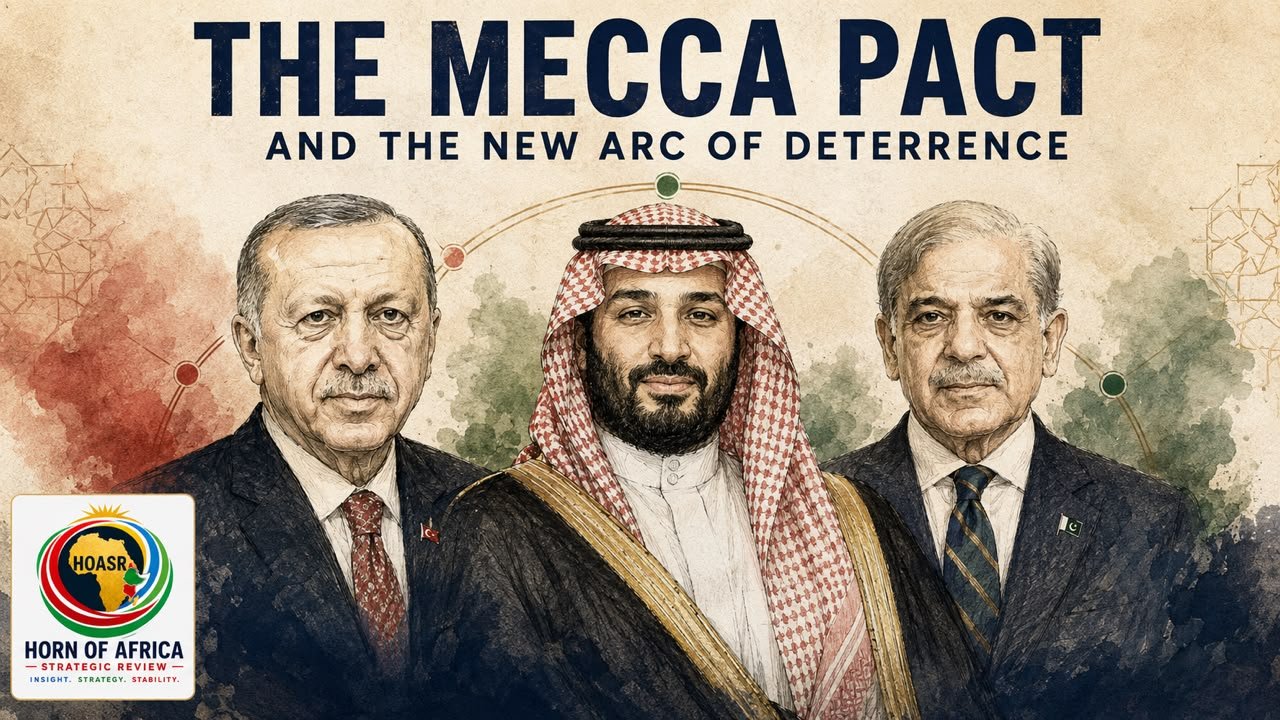
THE MECCA PACT AND THE NEW ARC OF DETERRENCE
Article One in HOASR’s continuing series on the Makkah Pact
By Prof. Nassir Hussein Kahin
Why Saudi Arabia, Pakistan and Türkiye Chose Collective Defence Now—and How Egypt Could Reorder Security from the Red Sea to the Indo-Pacific
The Makkah Joint Defence Agreement is neither an instant “Islamic NATO” nor an empty declaration. It is the first draft of a new regional security architecture connecting Anatolia, Arabia and South Asia. If Egypt joins, that architecture would also command strategic weight at Suez and along the Red Sea—but its internal contradictions could become as consequential as its military strength.
Editorial status note
Three facts must be separated at the outset.
First, Saudi Arabia, Pakistan and Türkiye did sign the Makkah Joint Defence Agreement in Mecca on August 7, 2026. Their official joint statement says that an armed attack against any one of the three states will be regarded as an attack against them all.
Second, Egypt has not yet joined. Turkish Foreign Minister Hakan Fidan said Egypt is a “natural partner” that could enter at the next stage after technical matters are resolved. As of publication, HOASR found no Cairo-issued declarations or any intent to join the Pact. This analysis therefore treats Egyptian membership as a serious and plausible next step—not as a completed fact.
Third, the complete treaty text has not been made public. The available joint statement establishes the collective-defence principle, while Fidan has outlined planned ministerial and military committees, a Saudi-based secretariat and case-by-case decisions on assistance. The agreement’s precise geographic scope, decision rules, nuclear implications, accession conditions and definition of an “armed attack” remain undisclosed.
Those distinctions are essential. A serious strategic analysis must examine what has been signed without inventing provisions that the public has not seen.
A Pact Meets Its First Test Almost Immediately
An alliance often spends years preparing for its first credibility test. The Mecca Pact received one within forty-eight hours.
On August 9, Yemen’s Houthis claimed that they had attacked Saudi Aramco’s Jazan refinery with a drone. The Saudi Energy Ministry confirmed that a fire had been extinguished and that there were no injuries, but it did not publicly identify the cause. The refinery can process approximately 400,000 barrels a day, making it a significant element of Saudi energy infrastructure. Reuters reported the competing claims without independently establishing that a Houthi weapon caused the incident.
This is precisely the kind of episode that will determine whether the new pact becomes a stabilising deterrent or an escalation mechanism.
Was there an armed attack? Who carried it out? Was it directed independently by the Houthis, coordinated by Iran or falsely claimed for propaganda value? Would damage to a refinery meet the treaty threshold? Must Saudi Arabia formally request assistance? Would assistance mean intelligence, interceptors, naval patrols, ammunition, cyber support or combat operations?
The public text answers none of those questions yet.
That does not make the agreement meaningless. It means the alliance has moved from declaration to institution-building under fire.
The Mecca Pact’s importance lies in this transition. Three powerful Muslim-majority states have decided that informal understandings, separate bilateral relationships and reliance on an external guarantor are no longer sufficient. They are attempting to convert overlapping interests into an organised system of deterrence.
But overlapping interests are not identical interests. The future of the pact will depend on whether Riyadh, Ankara and Islamabad can agree not only on whom they fear, but also on what they are actually prepared to fight for.
What the Agreement Does—and Does Not Yet Do
The official formulation is deliberately broad. The three governments committed themselves to strengthening collective deterrence, treating an armed attack on one as an attack on all and expanding defence cooperation.
Fidan subsequently described the provision as “technically” comparable to NATO’s Article 5. He explained that an attacked state would request assistance and identify the support it needed; the other members could then provide anything from intelligence and logistics to ammunition or military units. He also announced plans for political and military committees and a permanent secretariat in Saudi Arabia. Reuters reported that many operational details will be determined at the first ministerial meeting.
Even NATO’s Article 5 does not automatically require every ally to declare war. NATO’s official explanation makes clear that each member may provide the action it considers necessary and that the nature of an armed attack is assessed case by case.
The Mecca Pact is therefore best described as Article 5-style political solidarity without NATO-level institutional capacity—at least not yet.
Its first years will probably centre on intelligence sharing, joint threat assessments, exercises, logistics, air and missile defence, maritime coordination, defence production and crisis consultation. Those activities can create serious deterrence long before the alliance develops a standing combined command.
Why Now? Five Strategic Pressures Converged
- The region has been shocked from two directions
The origins of the new arrangement predate the present emergency. Saudi Arabia and Pakistan signed their bilateral Strategic Mutual Defence Agreement in September 2025. That agreement followed an Israeli strike in Qatar, an event that intensified Gulf doubts about whether close relations with Washington could reliably prevent attacks by either adversaries or partners of the United States. Reuters described that bilateral pact as a response to a changed regional calculus, even while Saudi officials said it was not directed at a particular country.
The second shock came from the opposite direction. The United States–Israel war with Iran, which began on February 28, 2026, brought Iranian missile and drone attacks onto Gulf states and their infrastructure. Saudi Arabia consequently found itself worried about both revolutionary Iran and an increasingly unconstrained Israeli military posture.
That dual anxiety explains why the pact names no enemy. It is designed for a threat environment rather than against one declared adversary.
- Hormuz and Bab al-Mandab became one interconnected crisis
Iranian pressure in the Strait of Hormuz increased the importance of Saudi Arabia’s western oil infrastructure and Red Sea outlets. The Houthi declaration of a blockade against Saudi-linked shipping then threatened the alternative route at Bab al-Mandab.
This created strategic compression. Pressure in the Gulf pushed trade and energy westward; pressure from Yemen then endangered the western exit.
Riyadh responded by promoting a separate multinational maritime-defence coalition. Fourteen states—including Türkiye, Pakistan, Egypt, Sudan and Djibouti—formally supported that initiative, according to Reuters. The maritime coalition and the Mecca Pact are not the same institution, but they emerge from the same conclusion: energy security can no longer be separated from regional military coordination.
- Saudi Arabia wants diversification, not a complete American exit
The pact should not be read as Riyadh abandoning Washington. Saudi Arabia still depends heavily on American aircraft, missile-defence systems, intelligence, maintenance, training and political support. Türkiye remains a NATO ally, while Pakistan has long cooperated with the United States even as it maintains a close relationship with China.
What has changed is the willingness of these states to outsource nearly all strategic reassurance to the United States.
Fidan articulated the logic months before the signing. In a January interview, he argued that regional states should build sufficient trust and institutional capacity to solve their own problems instead of repeatedly waiting for an external hegemon and then paying the strategic and financial cost. His officially published remarks described regional ownership as the alternative to permanent security dependence.
The Mecca Pact is therefore a hedge against American uncertainty, not yet an anti-American alliance.
- A diplomatic quadrilateral already existed
Saudi Arabia, Pakistan, Türkiye and Egypt did not suddenly discover one another in August. Their foreign ministers had already formed the R-4 consultation mechanism and met repeatedly during the Iran conflict.
The R-4 combined diplomacy with security coordination. Its members supported negotiations between Washington and Tehran, discussed maritime routes, energy markets and supply chains, and backed the June Islamabad memorandum intended to reduce escalation. The fourth R-4 statement explicitly linked regional stability to energy security, international trade and peaceful conflict resolution.
The Mecca Pact is the military institutionalisation of a political relationship already tested through crisis diplomacy.
- The three founders possess complementary assets
Saudi Arabia supplies finance, bases, energy leverage, diplomatic reach and religious legitimacy as custodian of Islam’s two holiest mosques. Türkiye contributes NATO experience, a large conventional force and a rapidly expanding defence industry in drones, missiles, naval platforms, electronic warfare and armoured systems. Pakistan contributes a large, combat-experienced military, defence production, strategic geography and the political weight—though not a publicly extended guarantee—of being the only nuclear-armed Muslim-majority state.
This is not merely a coalition of flags. Pakistan has already deployed significant forces to the kingdom. In May, Reuters reported approximately 8,000 Pakistani troops, combat aircraft, drones and an air-defence system in Saudi Arabia under the earlier bilateral agreement.
Türkiye’s accession connects that existing manpower and air-defence relationship to an advanced defence-industrial base and NATO-standard operational experience.
What Egypt Would Change
Egyptian membership would not simply add a fourth army. It would change the geography and political identity of the pact.
With Egypt, the alliance would stretch from Türkiye’s control of the approaches between the Black Sea and Mediterranean, through the eastern Mediterranean and Suez, down both shores of the Red Sea, across Saudi Arabia and into Pakistan at the Arabian Sea. The resulting system would sit beside several of the world’s most consequential maritime arteries.
Egypt would contribute:
- control of the Suez Canal and direct exposure to Red Sea disruption;
- one of the Arab world’s largest armed forces;
- Mediterranean and Red Sea naval infrastructure;
- political legitimacy that would make the pact more visibly Arab as well as Islamic;
- influence in Palestine, Libya, Sudan, Somalia and other African theatres;
- longstanding military relationships with the United States, Gulf states and European partners;
- and direct leverage in the Horn of Africa through its Nile dispute with Ethiopia and its security relationship with Somalia.
But Egypt would also import additional disputes.
Cairo’s strategic competition with Ethiopia over the Grand Ethiopian Renaissance Dam, its support for Somalia’s territorial claim over Somaliland and its concern about Red Sea access would all enter the alliance’s political discussions. Unless the treaty clearly distinguishes collective defence from support in pre-existing disputes, Egyptian accession could make the pact more powerful while also making it more vulnerable to entanglement.
Egypt’s absence from the Mecca signing may reflect precisely these technical and political questions. Cairo has taken part in R-4 diplomacy, but joining an unconditional defence clause is more consequential than attending a ministerial consultation.
The most important fact is therefore not that Egypt is “certain” to join. It is that the institutional pathway has been prepared and Ankara publicly expects Cairo to take the next step.
A Pact With No Named Enemy
Iran: the obvious context, but not the only target of deterrence
Türkiye insists the agreement is not directed at Iran. Iran’s response has been deliberately mixed. Foreign Minister Abbas Araghchi called for Muslim solidarity and regional self-reliance, while Iranian parliamentarians dismissed the arrangement as incapable of guaranteeing Saudi security. This combination of public welcome and internal suspicion reveals Tehran’s dilemma.
Iran can portray the pact as compatible with its demand that regional states reduce dependence on the United States. But it cannot ignore that the alliance brings together three Sunni-majority powers at the moment Iranian missiles, allied militias and Houthi operations are threatening Saudi infrastructure and shipping.
The pact’s message to Tehran is therefore twofold: attacks on Saudi Arabia may now produce coordinated assistance from Türkiye and Pakistan, but the founders still want to preserve diplomatic space for an eventual regional settlement.
That second message matters. Pakistan and Türkiye border Iran and cannot treat it as a permanently isolated enemy without assuming substantial costs. Both have economic, energy and security interests in avoiding an uncontrolled conflict. Saudi Arabia also requires a workable relationship with Tehran if it is to secure long-term stability in the Gulf and Yemen.
The most productive future would be deterrence with a diplomatic door: the pact should make aggression more costly while the R-4 maintains channels for negotiated de-escalation.
Israel: concern, leverage and an indirect security benefit
The Mecca Pact is not formally an anti-Israel alliance. Nothing in the published statement names Israel, and the founders have emphasised that no peaceful state is considered a target.
Yet Israel cannot dismiss the pact as irrelevant.
Saudi Arabia, Türkiye and Pakistan have all criticised Israeli military conduct. The R-4 places Palestinian statehood at the centre of its regional diplomacy. The earlier Saudi–Pakistan agreement followed an Israeli attack in Qatar, and Reuters reported that the three founders share concern about the increasingly assertive military postures of both Israel and Iran.
The pact raises the prospective cost of any future Israeli attack on the sovereign territory of a member. It also gives Riyadh additional leverage in negotiations over Palestinian statehood, American security guarantees, civilian nuclear cooperation and possible Saudi entry into the Abraham Accords. President Donald Trump has publicly linked the proposed U.S.–Saudi civil-nuclear agreement to Saudi normalisation with Israel, according to Reuters.
But Israel could also benefit indirectly if the pact improves air defence, restricts Iranian proxy warfare and restores freedom of navigation in the Red Sea. A regional shield aimed at preventing missiles and drones from crossing borders is not inherently contrary to Israeli security.
The Israeli strategic choice should therefore be engagement rather than reflexive hostility. If Israel interprets every independent Muslim security mechanism as an enemy bloc, it may help transform a defensive hedge into the very anti-Israel coalition it fears.
The United States: burden sharing or strategic dilution?
For Washington, the agreement is both useful and uncomfortable.
It is useful because stronger regional air defence, maritime patrols, intelligence cooperation and counterterrorism capacity could reduce demands on American forces. The United States has repeatedly urged allies to assume greater responsibility for their security. A pact that protects energy infrastructure and shipping could serve that objective.
It is uncomfortable because greater regional autonomy reduces American control over escalation. Washington will worry about sensitive U.S. and NATO technology being operated beside Pakistani and Chinese-origin systems; intelligence compartmentation; divergent threat designations; and the possibility that an ambiguous proxy attack could draw three American partners into a conflict the United States is trying to contain.
The correct American policy is not to attempt to veto the pact. It is to shape its safeguards: transparent activation rules, secure intelligence channels, airspace deconfliction, end-use protections for military technology and a standing consultation mechanism between the Mecca secretariat, U.S. Central Command and NATO.
The alliance is most likely to supplement the American security architecture, not replace it. The United States still provides capabilities—space-based surveillance, strategic lift, high-end missile defence, global logistics and political reach—that the three founders cannot rapidly reproduce.
NATO’s Türkiye Problem—and Opportunity
Türkiye is the only Mecca Pact member already bound by another collective-defence treaty.
This does not automatically create a legal contradiction. Article 8 of the North Atlantic Treaty requires allies not to enter international commitments that conflict with NATO. A separate defensive agreement is not inherently incompatible, and Ankara says the Mecca Pact does not replace existing alliances.
The operational questions are more difficult.
If Türkiye assists Pakistan during a future conflict with India and Turkish forces are then attacked in South Asia, NATO would not automatically inherit that war. NATO’s collective-defence obligations have geographic and legal limits, and an attack on forces deployed outside the treaty area is not equivalent to an attack on Turkish territory. Ankara could still seek consultations, but NATO would decide its own response under its own treaty.
Conversely, if Türkiye itself were attacked on its sovereign territory, it could potentially seek help under both systems. That overlap could widen deterrence, but it could also create confusion over command, intelligence and escalation.
Türkiye also offers NATO an opportunity. If Ankara brings disciplined planning, interoperability, civilian control, logistics standards and defensive doctrine into the new pact, it can act as a bridge between regional ownership and the transatlantic system. If it transfers sensitive capabilities without safeguards or uses the alliance to support unilateral operations, it will deepen distrust on both sides.
The first Mecca ministerial meeting should therefore define a NATO compatibility protocol before a crisis defines it by accident.
The Gulf: A New Centre of Gravity—or Another Layer of Rivalry?
The agreement strengthens Saudi Arabia’s claim to regional leadership. The secretariat will be based in the kingdom, the pact was signed in Mecca and Riyadh already hosts the Islamic Military Counter Terrorism Coalition. Saudi Arabia is building a hub around which political consultation, military cooperation and maritime security may increasingly revolve.
Other Arab and Muslim states will evaluate the pact according to three questions:
- Does membership provide real protection?
- Does it require accepting Saudi, Turkish or Pakistani leadership?
- Could it drag a member into disputes unrelated to its own security?
Kuwait and Bahrain have explored deeper arrangements with Pakistan, while Jordan has shown interest in defence cooperation, according to Reuters. Qatar may welcome a mechanism that raises the cost of cross-border attack but will carefully protect its own diplomatic independence. Oman is likely to preserve its mediating role and avoid a bloc perceived as anti-Iranian. Smaller Muslim states may prefer training, procurement or observer status over a full mutual-defence obligation.
The Gulf Cooperation Council already declares that its members’ security is indivisible. A new pact can reinforce that principle, but it can also expose the GCC’s weakness if Saudi Arabia builds its most meaningful guarantees outside the council.
The future may therefore be modular rather than universal: full members, maritime partners, counterterrorism partners, defence-industrial partners and political observers operating at different levels.
That is more realistic than attempting to turn the entire Organisation of Islamic Cooperation into a military alliance.
The UAE: The Most Important State Outside the Room
The United Arab Emirates was not a founding member, and it was not among the Gulf states Reuters listed as formally supporting Saudi Arabia’s new maritime coalition. Its absence matters.
Saudi–Emirati competition now extends across oil policy, Yemen, Sudan, Somalia, Somaliland, ports, investment and relations with Israel. The UAE has developed its own strategic network through the Abraham Accords, a defence partnership with India and commercial and security positions across the Horn of Africa.
Abu Dhabi may view the Mecca Pact as both a useful shield against Iran and a Saudi-led attempt to create a rival centre of regional power. Türkiye’s participation adds complexity because Ankara and Abu Dhabi have repaired much of their earlier rivalry but still compete in several theatres.
The UAE’s likely response will be hedging rather than confrontation. It can deepen bilateral defence ties with the United States, France, India and Israel; protect its relationships with Pakistan and Türkiye; and preserve its strategic position in Somaliland through DP World and its longstanding ties with Hargeisa.
This creates a dangerous possibility: two partially overlapping security networks operating along the same sea lanes while competing for political influence on the African shore.
Saudi Arabia and the UAE do not need identical foreign policies. They do need deconfliction. A formal Saudi–Emirati maritime hotline, shared warnings on missile and drone threats, protection of commercial ports and a non-interference understanding concerning emergency access would reduce the risk that intra-Gulf competition undermines Red Sea security.
Berbera could become a test of whether cooperation is possible. Saudi participation in food security, energy storage, ship services, coast-guard support and logistics could complement rather than displace Emirati investment.
Yemen: The Likely First Operational Theatre
No theatre will test the pact more quickly than Yemen.
The Houthis can threaten Saudi border provinces, energy facilities, ports and shipping without mounting a conventional invasion. That means the alliance’s most likely initial functions are defensive and technical:
- intelligence, surveillance and reconnaissance;
- counter-drone and missile-defense support;
- protection of ports, refineries and desalination plants;
- naval escort and mine countermeasures;
- logistics, maintenance and ammunition;
- cyber defenseand communications security;
- and training for Saudi and Yemeni government forces.
These measures could reduce the Houthis’ ability to coerce Riyadh. They could also prevent every claimed attack from producing an immediate retaliatory campaign.
But a defensive pact cannot solve Yemen’s political war. If it becomes a blank cheque for another large ground intervention, it may reunify divided Houthi constituencies, intensify Iranian support and deepen the humanitarian crisis. Türkiye and Pakistan should not allow their forces to become substitutes for an inclusive Yemeni settlement.
The alliance must also distinguish attacks by the Houthis from automatic proof of Iranian direction. Iran’s material support and strategic relationship with the movement are important, but attribution for a specific incident requires evidence. Collective defence based on assumption rather than verification could turn a local drone strike into a regional war.
The Jazan incident is therefore not merely an early attack claim. It is a warning that the pact needs an independent joint-attribution mechanism immediately.
India: Deterrence, Anxiety and the Risk of a Blank Cheque
India will view the agreement through the Pakistan question, but New Delhi’s interests are more complicated than simple opposition.
India benefits if the pact protects Gulf energy supplies and Red Sea shipping. Millions of Indians live and work in the Gulf, and Indian trade depends on stable western maritime routes. Saudi Arabia also maintains an important strategic partnership with India in energy, investment, defenseand technology.
The danger is that Pakistan may interpret the collective-defense clause as external backing in a future crisis with India. Türkiye’s strong political support for Pakistan and growing defense-industrial ties will heighten that concern. Saudi Arabia is far less likely to sacrifice its relationship with India, which is why New Delhi initially adopted a cautious position and said it was closely monitoring the agreement.
After the Mecca signing, false reports claimed that India had immediately sought a defensepact with Israel. India’s Ministry of External Affairs publicly rejected the allegation as AI-generated misinformation, as reported by Indian media. The incident demonstrates how quickly alliance politics can generate fabricated escalation.
The most important safeguard is a protocol excluding automatic support in per-existing territorial disputes or conflicts initiated by a member. If violence breaks out between India and Pakistan, the pact should first require emergency consultation, verified attribution and mediation—not presume that every Pakistani claim constitutes an attack on all members.
Such a rule would strengthen deterrence against genuine aggression while denying any member a blank cheque.
India’s longer-term response will probably be selective reinforcement rather than a mirror alliance. New Delhi is likely to deepen maritime-domain awareness, missile defence and defence cooperation with the UAE, Israel, France and the United States while preserving its own relationship with Saudi Arabia. Its 2026 strategic defence framework with the UAE already provides an important platform.
China and the Indo-Pacific: A Maritime Alliance Without a Single Great-Power Camp
The Mecca Pact is not neatly pro-American, pro-Chinese or anti-Western.
Türkiye is a NATO member and has just secured a formal dialogue partnership with ASEAN. Pakistan is China’s “all-weather” strategic partner and is developing the China–Pakistan Economic Corridor and Gwadar. Saudi Arabia maintains major economic relationships with China while relying heavily on U.S. defence systems and simultaneously cultivating India.
This mixture is a defining feature, not an anomaly. The pact reflects middle powers assembling issue-specific coalitions without surrendering all other alignments.
For China, improved security around Hormuz, Bab El-Mandab and Suez would protect energy imports and Belt and Road investments. Beijing may also welcome greater protection for Gwadar and regional infrastructure. At the same time, China will watch whether Turkish NATO standards and Western-origin systems gain access to Chinese-origin Pakistani equipment, or whether the alliance constrains Iran, an important Chinese partner.
For Japan, South Korea and ASEAN states, the central concern will be freedom of navigation. Türkiye’s new ASEAN dialogue partnership and Pakistan’s location on the Arabian Sea give the pact a diplomatic and logistical connection to the wider Indo-Pacific even if it never becomes an Indo-Pacific alliance in the formal sense.
The emerging arc is maritime:
Suez → Red Sea → Bab El-Mandeb → Gulf of Aden → Arabian Sea → Indian Ocean.
What happens within the Mecca Pact will therefore influence insurance, energy prices, naval deployments and supply chains far beyond the Middle East.
The Horn of Africa: Where Egypt’s Accession Could Be Most Disruptive
The Horn is not peripheral to the pact. It lies opposite Yemen, borders the Gulf of Aden and contains the ports, airfields and political disputes that shape access to Bab El-Mandab.
Egypt’s accession would connect the alliance directly to Cairo’s contest with Ethiopia and its support for Somalia. Türkiye is already Somalia’s most important external security partner, while Saudi Arabia signed a military-cooperation agreement with Mogadishu in February 2026. Pakistan has publicly supported Somalia’s territorial position in multilateral forums.
At the same time, Türkiye maintains important ties with Ethiopia and mediated the Ankara process between Addis Ababa and Mogadishu. Saudi Arabia has economic influence in Ethiopia, and all four prospective members have an interest in preventing the Horn from collapsing into a wider war.
The pact could therefore play one of two roles.
It could become a mechanism through which Egypt, Türkiye and Saudi Arabia coordinate pressure on Ethiopia and reinforce Somalia’s territorial claims. That path would intensify Ethiopian fears of strategic encirclement and push Addis Ababa closer to the UAE, Israel and other partners.
Or it could use its collective influence to impose restraint: no military settlement of the Nile dispute, no forced redrawing of maritime access, no proxy competition in Sudan and Somalia, and negotiated commercial access to ports.
The second path is more consistent with the alliance’s declared objective of peace. It is also far more difficult.
Somalia: new support, but no automatic guarantee
Somalia may seek membership, associate status or expanded security assistance from the new alliance. No public evidence shows that it has been invited to join.
Mogadishu could benefit from better training, intelligence, counter-drone systems and support against Al-Shabaab and ISIS-Somalia. Türkiye’s role could make Somalia a major beneficiary of the pact’s counterterrorism work even without formal accession.
But the agreement must not be transformed into an instrument for prosecuting Somalia’s sovereignty claim against Somaliland. Somaliland is not attacking a Mecca Pact member by administering the territory it has governed since 1991. Even if Somalia later joined, a per-existing political and territorial dispute would not automatically become external aggression.
Any accession protocol should state this explicitly.
Ethiopia: risk of encirclement, opportunity for restraint
Ethiopia will be particularly sensitive to Egyptian participation. Cairo’s Nile dispute, Somalia’s opposition to Ethiopian sea-access ambitions and Türkiye’s military role in Mogadishu could be interpreted in Addis Ababa as an emerging alignment against Ethiopian interests.
That interpretation is not inevitable. Türkiye’s relationship with Ethiopia and Saudi Arabia’s economic ties give both states leverage to reassure Addis Ababa. The pact should establish a Horn consultation forum involving Ethiopia, Somalia, Somaliland and Djibouti rather than importing each dispute into a collective-defence mechanism.
Ethiopia needs reliable commercial access to the sea. Somalia needs protection from coercion. Somaliland requires respect for its sovereignty and political reality. Djibouti needs stable trade flows. These interests are difficult but not inherently irreconcilable.
What would make them irreconcilable is a military bloc deciding that one party’s maximal territorial narrative must prevail over every other interest.
Somaliland: Strategic Opportunity Inside a Diplomatic Threat
For Somaliland, the pact presents a paradox.
Its founders—and Egypt, if it joins—have generally supported Somalia’s claim to Somaliland in international forums. Türkiye publicly opposed Israel’s recognition of Somaliland and has deep military ties with Mogadishu. A Saudi-led security structure that relies heavily on Ankara could reinforce Riyadh’s existing preference for dealing with the Horn through Somalia.
That is the diplomatic threat.
The strategic opportunity arises from geography.
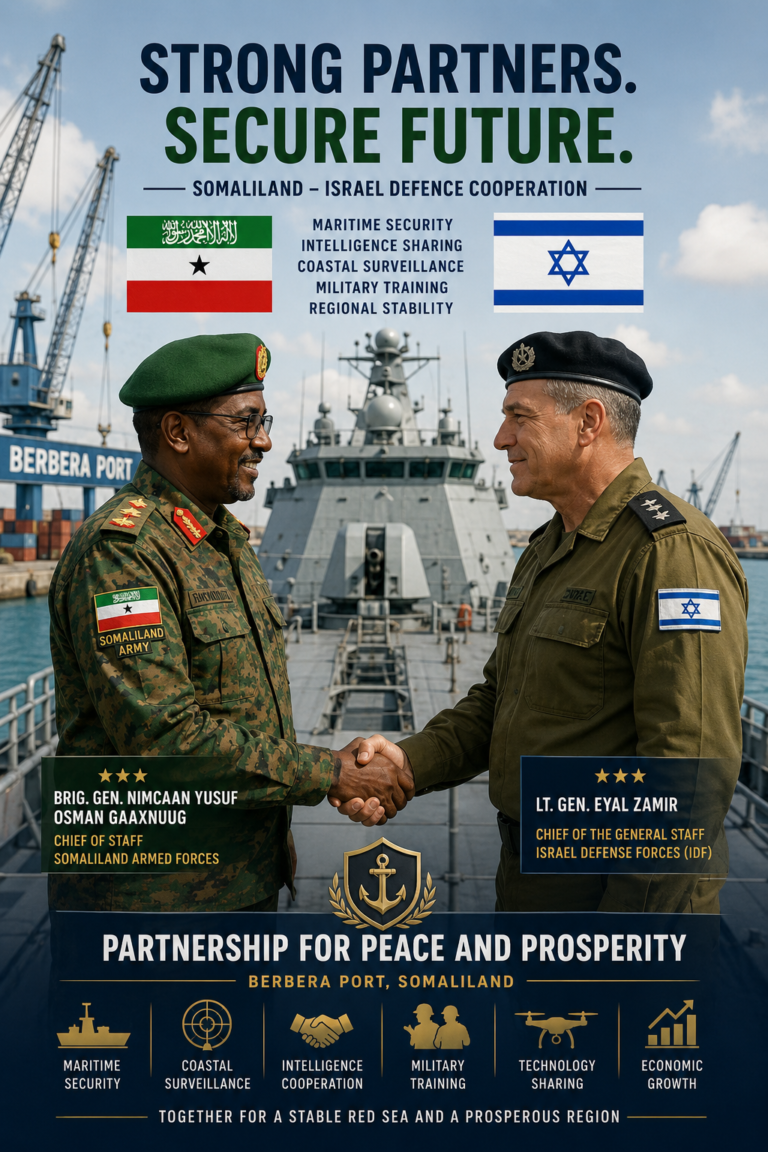
Israel formally recognized Somaliland on December 26, 2025, and the two governments have expanded cooperation. Somaliland’s defense minister has confirmed Israeli training for police and military personnel while denying reports of negotiations for an Israeli base. Reuters documented both the cooperation and the denial.
The UAE has developed Berbera through DP World and maintains deep relationships with Hargeisa. Somaliland governs a long Gulf of Aden coastline east of Bab al-Mandab, operates Berbera’s port and airfield, and offers a comparatively stable platform for maritime surveillance, search and rescue, logistics, counter-smuggling and coast-guard cooperation.
Yet Somaliland was not among the fourteen states Reuters reported as formal supporters of the Saudi maritime coalition. A system intended to secure the Gulf of Aden while excluding the authority administering Berbera and much of the opposite shore contains an obvious operational gap.
The correct Somaliland response is not to define the Mecca Pact as an enemy. Hargeisa should instead offer a formal maritime-security dialogue to Saudi Arabia and the new secretariat covering:
- radar and maritime-domain-awareness data;
- coast-guard training and equipment;
- search and rescue;
- port and aviation security;
- counter-smuggling and counterterrorism;
- emergency ship repair, refuelling and medical support;
- protection of submarine cables and energy infrastructure;
- and transparent access arrangements at Berbera.
Somaliland should also maintain its principle of multi-alignment. It can deepen its recognised partnership with Israel and preserve its relationship with the UAE while engaging Saudi Arabia, Pakistan and Türkiye where interests overlap. It should not permit its territory to become an exclusive forward platform for one bloc against another.
The strategic message should be simple: Somaliland is prepared to help secure the Red Sea, but no sustainable Red Sea architecture can be built by pretending Somaliland does not exist.
This argument extends HOASR’s earlier analysis in The Geography Riyadh Ignored: How Saudi Arabia’s Somaliland Blind Spot Deepened Its Red Sea Vulnerability.
Cross-Border Terrorism: The Pact’s Most Practical Mission
Collective defence attracts headlines, but counterterrorism may become the alliance’s most frequent work.
The members face different threats: transnational jihadist organisations, separatist insurgencies, proxy militias, maritime sabotage, drone attacks, terrorist financing, arms smuggling and cyber operations against critical infrastructure. Egypt would add its experience in Sinai and border security; cooperation with Somalia would add the fight against al-Shabaab and ISIS-Somalia.
The pact could produce real gains through:
- shared watchlists and biometric information with due-process protections;
- terrorist-financing investigations and sanctions coordination;
- joint border and port-security training;
- intelligence fusion on foreign fighters and arms routes;
- counter-drone research and rapid warning;
- protection of oil facilities, airports, water systems and submarine cables;
- cyber incident response;
- maritime interdiction based on international law;
- and coordinated rehabilitation and prevention programmes.
It should build on, rather than duplicate, the Saudi-based Islamic Military Counter Terrorism Coalition.
The danger is that members do not share identical definitions of terrorism. An organisation considered a terrorist group by one state may be viewed by another as an insurgency, a political movement, a useful local partner or part of an unresolved national conflict. If the alliance accepts every national designation automatically, counterterrorism could become a cover for suppressing dissidents, targeting diaspora critics or intervening across borders.
Three safeguards are indispensable.
First, cross-border operations must rest on host-state consent, a clear United Nations mandate or a defensible claim of individual or collective self-defence under Article 51 of the UN Charter.
Second, attribution must distinguish an armed group’s presence in a country from direction or control by that country’s government.
Third, counterterrorism cooperation must include civilian protection, judicial review, evidence standards, humanitarian exemptions and a prohibition on collective punishment.
A security pact that protects citizens from terrorism can strengthen peace. A pact that allows every government to call every opponent a terrorist will manufacture new conflicts.
The Trigger Problem
The agreement’s credibility will depend less on its headline promise than on how it handles ambiguous incidents.
The central principle should be consultation before automatic escalation.
The alliance needs the equivalent of “Article 4 before Article 5”: except during an unmistakable ongoing attack requiring immediate defence, members should consult, verify attribution, assess legality and agree on proportional objectives before collective military action.
Four Plausible Futures
Scenario One: Defensive maturation
This is the most plausible near-term outcome. The pact establishes its secretariat, holds exercises, integrates selected air-defence and maritime information, expands defence production and develops crisis procedures. Egypt joins after negotiating reservations or protocols. The alliance remains politically significant but avoids a major combat activation.
This scenario would strengthen deterrence without transforming the pact into a fully integrated military bloc.
Scenario Two: Limited activation in the Gulf or Red Sea
A verified Houthi, militia or Iranian attack causes Saudi Arabia to request assistance. Pakistan and Türkiye provide intelligence, interceptors, aircraft, naval escorts, ammunition and technical personnel, but avoid offensive strikes on Iran.
This would demonstrate credibility while preserving an escalation ceiling. It is also the scenario for which the alliance appears best prepared, given Pakistan’s existing deployment in the kingdom.
Scenario Three: Modular expansion
Egypt joins, while Kuwait, Bahrain, Jordan, Qatar or other states enter through different levels of participation. A maritime arm, counterterrorism centre, defence-industry council and observer mechanism emerge around the Saudi secretariat.
The pact becomes a regional security platform rather than a four-state NATO. Its influence expands, but so do disputes over leadership, threat definitions and relations with Iran, Israel and the United States.
Scenario Four: Entrapment or fracture
A Pakistan–India crisis, Turkish external operation, Israeli strike, disputed proxy attack or Horn confrontation forces members to choose between treaty solidarity and national interest. One member requests military action; another offers only diplomatic support. The gap between political language and actual obligation becomes visible.
The alliance could survive such a disagreement, just as mature alliances do. But if it has not established clear rules beforehand, its first refusal may destroy its deterrent credibility.
How the Pact Could Become an Instrument of Peace
The Mecca Pact will not promote peace simply because its leaders call it defensive. It will do so only if its institutions make miscalculation less likely.
The founders should take nine steps.
- Publish an implementation protocol. Define armed attack, geographic scope, assistance, decision rules, accession, withdrawal and the relationship between the public joint statement and any confidential annexes.
- Create an independent joint-attribution mechanism. Technical experts should assess missiles, drones, cyber incidents, maritime attacks and proxy responsibility before the alliance assigns state blame.
- Require consultation before escalation. Establish emergency hotlines and a presumption of diplomatic consultation, except where immediate defence is necessary to stop an ongoing attack.
- Exclude blank cheques. Pre-existing territorial disputes, member-initiated hostilities, internal political crises and unauthorised external operations should not receive automatic collective backing.
- Clarify the nuclear question. Pakistan’s nuclear status creates deterrent ambiguity, but ambiguity can become instability. The members should state publicly whether the pact changes any nuclear doctrine. Current official statements indicate that it does not.
- Prioritise integrated defence over combined offence. Air and missile warning, counter-drone systems, maritime awareness, cyber defence, logistics and critical-infrastructure protection are less escalatory and more politically sustainable than a standing expeditionary strike force.
- Coordinate with existing systems. Formal liaison should connect the secretariat with NATO, the GCC, the Islamic Military Counter Terrorism Coalition, the United States, relevant European maritime missions and the United Nations.
- Pair deterrence with an R-4 peace track. The same states that prepare collective defence should continue mediating between Washington and Tehran, supporting a Yemeni settlement and advancing a credible political pathway for Palestinians.
- Build an inclusive Red Sea and Horn compact. Maritime safety requires functional cooperation with Egypt, Saudi Arabia, Yemen’s legitimate institutions, Djibouti, Somalia, Somaliland, Ethiopia, Sudan and other coastal stakeholders. The pact must not use maritime security to predetermine disputed sovereignty questions.
These safeguards would not weaken collective defence. They would make the commitment believable by showing members and adversaries exactly when it applies.
Conclusion: Not an Islamic NATO, but the First Draft of a New Order
The Mecca Pact is too consequential to dismiss and too incomplete to mythologise.
It combines Saudi financial and geopolitical weight, Turkish military-industrial power and NATO experience, and Pakistani manpower, strategic geography and nuclear prestige. Egypt’s probable accession would add Suez, Red Sea reach, Arab legitimacy and another major military.
Together, these states could build a formidable system of air defence, maritime security, counterterrorism cooperation, military production and crisis diplomacy.
But power will not erase contradiction.
Pakistan’s rivalry with India is not Saudi Arabia’s war. Türkiye’s disputes in Syria and the eastern Mediterranean are not Pakistan’s priorities. Egypt’s competition with Ethiopia is not automatically a collective-defence concern. Saudi Arabia’s relationship with the United States and possible future accommodation with Israel will not always match Turkish or Pakistani politics. Iran is simultaneously an adversarial source of missiles and proxies, a neighbour that cannot be removed and a state with which the founders still seek negotiation.
The alliance will succeed only if it converts these differences into procedures rather than pretending they do not exist.
For Israel, the pact is a warning against assuming unlimited regional freedom of action, but also a possible partner in containing missiles, drones and maritime disorder. For the United States, it is both burden sharing and a loss of exclusive strategic control. For the UAE, it is a reason to reconcile selected security interests with Saudi Arabia while protecting an independent network. For India, it creates uncertainty around Pakistan but also offers a potential shield for Gulf energy and trade. For Iran, it raises the cost of proxy coercion while leaving an opening for regional diplomacy.
For the Horn of Africa, the consequences may be even greater. Egypt’s entry could harden alignments around Somalia and Ethiopia, while Türkiye’s role could either mediate or militarise those disputes. Somaliland faces diplomatic pressure from members that support Mogadishu, yet its coastline, Berbera port, airfield and partnerships with Israel and the UAE make it increasingly difficult to exclude from any serious Red Sea security system.
The Mecca Pact should therefore be understood not as a post-American order, but as a post-dependence experiment: regional powers still working with Washington, NATO, China and other partners while refusing to entrust their survival to any one external guarantor.
Its ultimate measure will not be how many enemies it frightens or how many states join.
It will be whether the alliance can prevent armed attacks, restrain its own members, protect shipping, defeat genuine cross-border terrorism and create enough confidence for diplomacy to work.
An alliance signed in Islam’s holiest city will claim moral legitimacy from its name. It will earn strategic legitimacy only through the wars it prevents. The Recognition Front: Amichai Chikli’s Makkah Pact Warning Places Somaliland at the Centre of Israel’s Emerging Counter-Alignment
SOURCES AND FURTHER READING
Primary and official sources
- Government of Pakistan, Ministry of Foreign Affairs, “Makkah Al-Mukarramah Summit for Joint Defence,” August 7, 2026.
- Government of Pakistan, Ministry of Foreign Affairs, Saudi–Pakistan Strategic Mutual Defence Agreement joint statement, September 17, 2025.
- Government of Pakistan, Ministry of Foreign Affairs, Fourth R-4 Consultative Meeting, Cairo, June 21, 2026.
- Republic of Türkiye, Ministry of Foreign Affairs, Hakan Fidan interview on regional security ownership, January 29, 2026.
- Republic of Türkiye, Ministry of Foreign Affairs, statement on Houthi threats to blockade Saudi Arabia, July 22, 2026.
- Republic of Türkiye, Ministry of Foreign Affairs, Türkiye–ASEAN Dialogue Partnership, July 21, 2026.
- NATO, The North Atlantic Treaty.
- NATO, Collective Defence and Article 5.
- United Nations, Charter, Article 51: individual and collective self-defence.
- Islamic Military Counter Terrorism Coalition, official portal and institutional resources.
- Government of Israel, recognition of Somaliland as an independent and sovereign state, December 26, 2025.
- Government of Pakistan, Ministry of Foreign Affairs, Pakistan–China joint statement, May 26, 2026.
- Government of Pakistan, Ministry of Foreign Affairs, joint statement supporting Somalia’s territorial position, January 6, 2026.
- Government of India, Ministry of External Affairs, India–Saudi Arabia Strategic Partnership Council, April 22, 2025.
Reporting and analytical sources
- Reuters, Saudi Arabia, Türkiye and Pakistan sign the Mecca Pact, August 7, 2026.
- Reuters, Fidan compares the pact to NATO Article 5 and discusses Egypt, August 8, 2026.
- Reuters, Houthi claim concerning the Jazan refinery, August 9, 2026.
- Reuters, Saudi-led multinational maritime-defence coalition, July 30, 2026.
- Reuters, Pakistan’s military deployment to Saudi Arabia, May 18, 2026.
- Reuters, Pakistan’s proposed expanded defence ties with Kuwait and other states, July 17, 2026.
- Reuters, U.S.–Saudi civil-nuclear agreement and Abraham Accords condition, July 24, 2026.
- Reuters, Israel’s recognition of Somaliland, December 26, 2025.
- Reuters, Somaliland’s Israeli training and denial of base negotiations, June 17, 2026.
- Reuters, Türkiye’s opposition to Israel’s recognition of Somaliland and its Somalia role, February 17, 2026.
- Reuters, strategic importance of Somaliland and Berbera, January 6, 2026.
- Reuters, Saudi–UAE rivalry in the Horn of Africa, February 14, 2026.
- Reuters, India–UAE strategic defence partnership, May 15, 2026.
- Associated Press, Türkiye says the pact is not aimed at Iran; Egypt may join, August 8, 2026.
- Al Jazeera, “Saudi-Pakistan-Türkiye pact: A new shield or strategic signal?”, August 8, 2026.
- Al Jazeera, Somalia–Saudi Arabia military-cooperation agreement, February 10, 2026.

Prof. Nassir Hussein Kahin is a researcher, educator, journalist, and geopolitical analyst specializing in the Horn of Africa, the Red Sea, international law, diplomacy, and strategic affairs. To read Full Bio click on this link: ABOUT THE AUTHORProf. Nassir Hussein Kahin