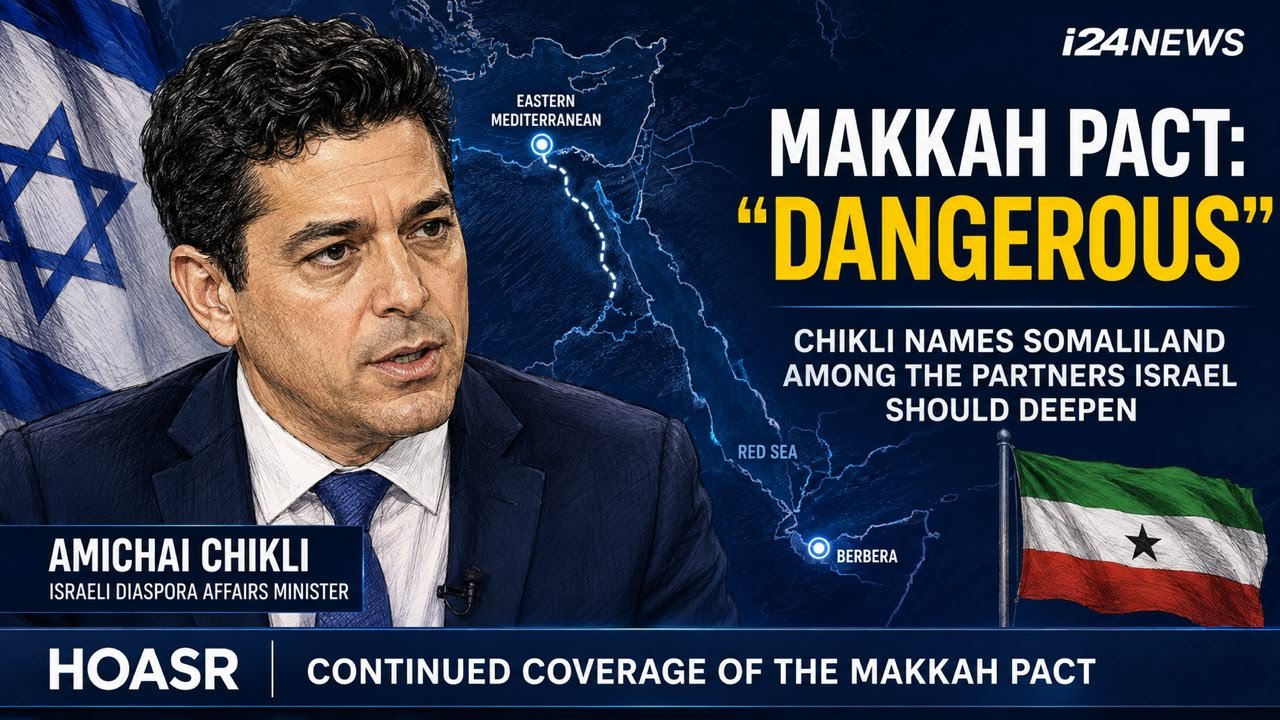
Israeli Minister Amichai Chikli’s response to the Makkah Joint Defence Agreement explicitly named Somaliland among the partnerships Israel should deepen.
Article Two in HOASR’s continuing series on the Makkah Pact, Somaliland recognition and the new Red Sea order
By Prof. Nassir Hussein Kahin
Israel’s Minister of Diaspora Affairs and Combating Antisemitism, Amichai Chikli, has delivered the clearest Israeli political reaction yet to the Makkah Joint Defence Agreement.
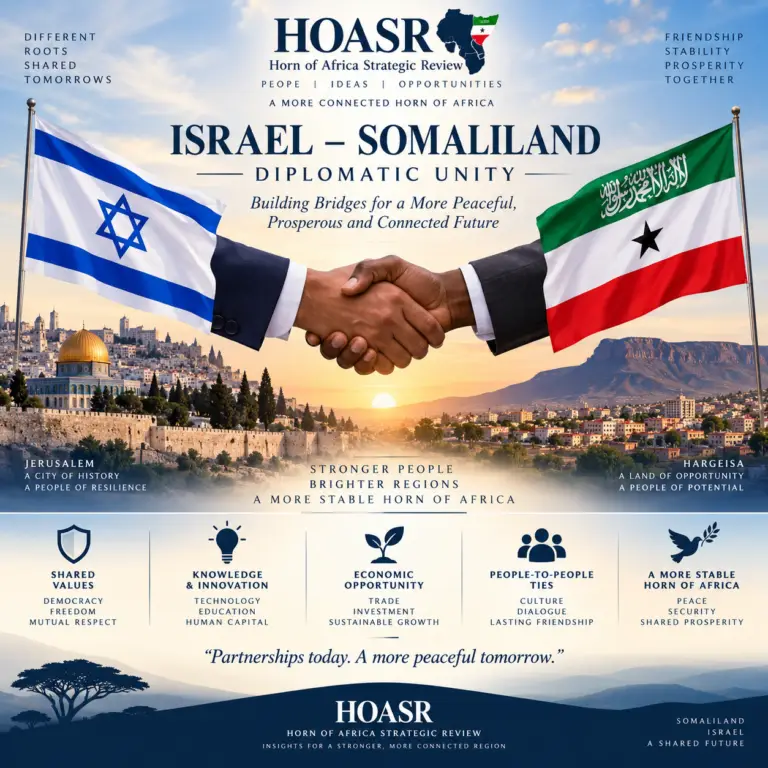
His warning did more than criticize a Saudi–Turkish–Pakistani pact: it publicly placed Somaliland alongside Greece, Cyprus and the United Arab Emirates in the network of partnerships Israel should deepen.
That does not yet constitute a new alliance or settled Israeli doctrine. It does, however, identify Somaliland as a strategic centre of gravity in the widening contest over the Red Sea—and confirms that the next decisive struggle may begin with recognition, not warships.
────────
Editorial status note: what is confirmed, and what remains analysis
This is a fast-moving development. HOASR therefore distinguishes the public record from strategic inference.
1. Saudi Arabia, Türkiye and Pakistan signed the Makkah Joint Defence Agreement on August 7, 2026. The official communiqué says an armed attack against one of the three will be regarded as an attack against all and calls for broader defence cooperation. The full treaty and its operational protocols have not been made public. Pakistan’s Ministry of Foreign Affairs published the official statement.
2. Egypt is not yet a member. Turkish Foreign Minister Hakan Fidan said Cairo could join after technical issues are resolved. Somalia and Eritrea are also not treaty parties.
Reuters reported the pact’s present membership, Saudi-based secretariat and Egypt’s possible accession.
4. Chikli condemned the new alignment and urged deeper partnerships; he did not announce a signed counter-pact.
He called the Mecca alliance a “very dangerous and very troubling development” and said Israel must deepen its alliances with Greece, Cyprus, the UAE and Somaliland. OSINT613 published a transcript of the i24NEWS remarks, and Saxafi Media reported the Somaliland dimension.
5. His words are a cabinet-level signal, but they have not yet been formally adopted as Israeli government doctrine. No publicly available decision by Israel’s cabinet, Prime Minister’s Office, Foreign Ministry or Defence Ministry has created a four-part alliance in response to the Mecca Pact.
It is reasonable to assess that Chikli’s remarks may reflect concerns shared elsewhere in Israel’s security establishment. It would be premature to present them as an official treaty commitment.
That distinction strengthens rather than weakens the analysis. The news is not that a new alliance has already been signed. The news is that a serving Israeli minister has publicly drawn its strategic outline—and has placed Somaliland inside it.
────────
Israel’s first political answer
The Makkah agreement was signed amid a regional search for new security guarantees. Its founders describe it as defensive, and the treaty does not publicly designate Israel, Somaliland or any other state as an enemy. Yet Chikli’s reaction makes clear that at least one Israeli cabinet minister reads its significance through a different lens.
His principal concern is Türkiye.
Saudi Arabia already possessed longstanding military links with Pakistan. Ankara’s entry changes the balance because Türkiye is a formidable NATO member with a large conventional military, an expanding defence industry and growing operational reach across Syria, the Eastern Mediterranean, Libya, the Gulf of Aden and Somalia.
A Turkish–Saudi–Pakistani collective-defence framework can therefore connect theatres that Israel previously managed through separate relationships.
Chikli’s answer was pre-emptive in the strategic sense. He did not wait for the pact to acquire an integrated command, joint basing arrangements or an expanded membership.
He identified the geography Israel would need if the alignment hardened: Greece and Cyprus in the Eastern Mediterranean, the UAE in the Gulf, and Somaliland on the southern shore of the Gulf of Aden.
That is why one part of his statement deserves particular attention.
Greece, Cyprus and the UAE are familiar pillars of Israeli regional diplomacy. Somaliland is the new and consequential addition.
By naming Hargeisa in the same strategic sentence, Chikli elevated Israel’s recognition of Somaliland from a bilateral diplomatic event to a component of wider regional balancing. Somaliland was no longer described merely as a country Israel had recognized.
It was presented as a partner Israel should deepen in response to a defence architecture that Israeli policymakers may increasingly regard as adverse.
This is the first publicly reported Israeli reaction to the Mecca Pact that explicitly places Somaliland within an emerging counter-alignment. It is not yet an alliance announcement. It is something that usually comes before one: a political declaration of strategic geography.
────────
HOASR’s earlier argument has entered the public debate
HOASR has followed this shift across several stages.
The Return of the Periphery? Israel, Somaliland and the Horn of Africa after October 7 examined why Israel’s older search for partnerships beyond its immediate neighbourhood was returning in a new Red Sea form.
Beyond Recognition: Can the Israel–Somaliland Partnership Help Build a New Indo-Abrahamic Maritime Order? argued that recognition would matter only if it developed into functional economic, diplomatic and security cooperation.
A New Red Sea Axis: Israel, India, UAE, Ethiopia Converge in Somaliland described Berbera and the Somaliland corridor as a possible junction between the Abraham Accords, the Horn of Africa and the Indian Ocean.
The Geography Riyadh Ignored: How Saudi Arabia’s Somaliland Blind Spot Deepened Its Red Sea Vulnerability warned that refusing to engage Somaliland left an important section of Red Sea strategy open to competitors.
Most recently, The Makkah Pact and the New Arc of Deterrence assessed the Saudi–Turkish–Pakistani agreement as an institutional beginning rather than a completed “Islamic NATO.” It also warned that Egyptian accession would move the pact’s political weight closer to Suez, the Nile and the Horn.
Chikli’s remarks do not prove every element of those forecasts. They do something more specific and immediately important: they validate the underlying geography.
An Israeli minister responding to the Makkah Pact reached for essentially the same map—an Eastern Mediterranean partnership, a Gulf partner and Somaliland at the entrance to the Red Sea.
This is not merely an HOASR concept any longer. It has entered Israeli political language.
────────
Recognition changed the strategic map
Israel’s recognition of the Republic of Somaliland on December 26, 2025 did not alter geography. It altered the political meaning of geography.
Before recognition, Somaliland’s strategic assets were real but diplomatically discounted. It possessed the Port of Berbera, a long Gulf of Aden coastline, relative internal stability and proximity to Bab al-Mandab. Yet most governments still dealt with those assets through a policy that formally subordinated them to Somalia’s territorial claim.
Recognition broke that convention.
For Somaliland, Israel’s decision created a precedent: a United Nations member state was prepared to treat Hargeisa as the government of a sovereign country rather than as an autonomous administration inside Somalia.
For Israel, recognition created a legitimate state partner on the African side of the Gulf of Aden. It opened routes for direct cooperation in diplomacy, trade, agriculture, technology, training and maritime awareness.
The relationship is already more than symbolic: Somaliland’s defence minister said in June that Israel was training Somaliland police and military personnel.
He also made clear that no Israeli military base was being negotiated and that no Israeli military presence existed—an important correction to speculation that recognition automatically meant basing. Reuters reported both the training relationship and the denial of base talks.
For Somalia and its supporters, however, recognition created an opposing precedent. If one state could recognize Somaliland, others could follow. The diplomatic question was no longer whether recognition was theoretically possible, but whether Israel’s decision would remain isolated.
That is the background against which Chikli’s statement must be read.
The strategic contest is not only over ports, naval access or military alignments. It is over whether Somaliland’s sovereignty becomes internationally achievable.
────────
The same governments appear on both sides of the sequence
Two days after Israel recognized Somaliland, the foreign ministers of 21 states, together with the Organization of Islamic Cooperation, issued a joint statement rejecting the decision and reaffirming Somalia’s unity, sovereignty and territorial integrity.
The overlap with the new Makkah pact is exact and politically significant.
Saudi Arabia, joined the December 28 statement rejecting recognition (Founding treaty member). Türkiye, joined the joint rejection; President Erdoğan later publicly condemned recognition (Founding treaty member and Somalia’s most deeply embedded military partner)
Pakistan, joined the joint rejection and continued to support Somalia’s territorial claim (Founding treaty member )
Egypt, joined the joint rejection and expanded security cooperation with Somalia (Publicly identified as a possible future member )
Somalia, led the diplomatic campaign against recognition (Not a member; closely connected to all three founders through political or defence ties)
Eritrea, not part of the founding pact and not covered by its collective-defence clause (Outside the treaty; relevant to future Red Sea and Ethiopia calculations )
The December 28 joint ministerial statement confirms that Saudi Arabia, Türkiye, Pakistan, Egypt and Somalia all rejected Israel’s recognition.
This does not prove that the Makkah agreement was created to reverse Somaliland’s recognition. Its announced purpose is collective defence, and it emerged from security negotiations wider than the Horn of Africa. Nor does Somalia automatically receive Article 5-style protection from a treaty it has not signed.
But strategic alignments acquire significance from the interests their members already share. All three founders have publicly backed Somalia’s territorial claim against Israel’s recognition.
The most likely fourth member, Egypt, did the same. Türkiye has the most extensive military infrastructure in Somalia, while Saudi Arabia and Egypt have concluded their own security or military-cooperation arrangements with Mogadishu.
For Israel, the concern is therefore not a secret Somaliland clause. It is the consolidation of states that already stood together on the recognition question and that now possess a new mechanism for strategic coordination.
The treaty and the diplomatic campaign are legally separate. Geopolitically, they overlap.
────────
Türkiye’s role: principal driver, not sole treaty commander
It would be inaccurate to describe Türkiye as the formal leader of the Mecca Pact. The agreement has three founders; its secretariat will be located in Saudi Arabia; and its final authority will depend on institutions that are still being built.
Yet Ankara is likely to be its most militarily institutionalized member.
Türkiye contributes NATO experience, a mature defence-industrial base, naval capabilities, drones, missiles, training systems and an established habit of expeditionary engagement. It is also the pact member with the deepest existing position in Somalia.
Türkiye operates its largest overseas military training facility in Mogadishu. Its ten-year maritime-security arrangement with Somalia provides a framework for rebuilding Somali naval capacity and protecting Somalia’s coastline.
Ankara has extended deployments in the Gulf of Aden and entered Somalia’s offshore energy sector. Reuters documented the maritime agreement and Türkiye’s first planned overseas deep-water drilling operation off Somalia.
Türkiye also became one of the strongest international opponents of Israel’s recognition decision. President Recep Tayyip Erdoğan called it unacceptable and illegal, aligning Ankara explicitly with Mogadishu’s sovereignty campaign. Reuters reported Erdoğan’s condemnation.
From Israel’s perspective, these strands are difficult to separate. A NATO member with a substantial military role in Somalia, a confrontational relationship with Israel and a formal collective-defence pact with Saudi Arabia and Pakistan has become a central actor in both the Red Sea security competition and the diplomatic struggle over Somaliland.
Chikli’s reaction is therefore natural, tactical and pre-emptive. Natural, because Israel must account for the convergence of countries opposing its Somaliland policy. Tactical, because stronger bilateral links can be built before any counter-pact exists. Pre-emptive, because early coordination is cheaper and less dangerous than improvising after a crisis.
────────
The outline of an Israeli counter-alignment
Chikli’s list is important because each proposed relationship answers a different part of the emerging challenge.
Chikli’s Strategic counter-alignment geographyTHE MECCA PACT AND THE NEW ARC OF DETERRENCE :
Greece, Eastern Mediterranean defence depth, air and naval cooperation, European access (Longstanding and expanding Israeli security relationship )
Cyprus, Eastern Mediterranean location, intelligence and operational connectivity (Institutionalized trilateral cooperation with Israel and Greece)
United Arab Emirates, Gulf access, capital, logistics and Abraham Accords connectivity (Formal relations and substantial economic and strategic ties with Israel)
Somaliland, Gulf of Aden access, Berbera, Horn intelligence and the southern approach to Bab al-Mandab(Recognized by Israel; bilateral cooperation developing)
India, Wider Indian Ocean weight and a counterbalance to Pakistan (Described separately by Chikli as a highly important strategic partner )
The relationships do not have identical legal status. Greece and Cyprus already possess structured defence cooperation with Israel. The UAE is an Abraham Accords partner but has its own complex interests and has not endorsed an anti-Mecca coalition. Somaliland is a newly recognized partner without a public mutual-defence treaty. India was discussed separately and has not joined Chikli’s four-part formulation.
The correct term at this stage is therefore emerging counter-alignment, not counter-alliance.
There is, however, evidence that Chikli’s wider map is not an isolated personal invention. On June 30, before the Makkah agreement was signed, Israel’s Defence Ministry Director General Amir Baram called for a broader regional architecture stretching from India through the UAE to Greece and Cyprus. Israel’s Ministry of Defence published Baram’s address.
Chikli’s contribution was to connect that established arc to the Mecca Pact—and to add Somaliland. That addition is why the statement may prove historically important.
────────
Why Somaliland is the centre of gravity
Somaliland is not the largest state in this emerging geometry. It is the point where several contests meet.
1. The maritime contest
Somaliland faces the Gulf of Aden near the approaches to Bab al-Mandab, through which trade and energy flows connect the Indian Ocean, Red Sea and Suez Canal. Berbera is therefore relevant to commercial logistics, maritime monitoring and crisis resilience.
2. The recognition contest
Somaliland is the only partner on Chikli’s list whose sovereign status remains internationally contested. Deepening Israel’s relationships with Greece, Cyprus or the UAE reinforces existing state-to-state structures. Deepening the relationship with Somaliland also tests whether other governments will accept the premise of Somaliland statehood.
3. The Türkiye–Somalia contest
Türkiye’s military and economic position is concentrated in Somalia. Israel’s recognized partner is Somaliland. The two relationships sit on opposing sides of the sovereignty dispute, even though neither government has announced a plan for direct confrontation.
4. The Ethiopia access question
Ethiopia remains outside Chikli’s quoted list, and it should not be inserted into his statement. Nevertheless, no serious Horn strategy can ignore Addis Ababa’s search for dependable maritime access or the Berbera corridor linking Somaliland to the Ethiopian market. Egypt’s possible accession to the pact would also bring the Nile dispute closer to the same strategic system.
5. The precedent contest
If Israel remains Somaliland’s only formal recognizer, Mogadishu and its supporters can argue that the decision was exceptional, transactional and internationally isolated. If another United Nations member recognizes Somaliland, the political structure changes. Recognition becomes a process rather than an anomaly.
This final point is decisive. Somaliland is the centre of gravity because control of its international status determines whether geography can be converted into legitimate partnership.
────────
The first front is diplomatic
The first contest between these emerging alignments is unlikely to be a naval clash. It is more likely to be a recognition campaign.
For Somalia and the governments supporting its territorial claim, the immediate objective is containment: prevent Israel’s recognition from producing a second recognition, discourage embassies and formal agreements, and keep international organizations committed to Somalia’s existing borders.
For Somaliland and Israel, the immediate objective is multiplication: turn one recognition into two, then transform bilateral precedent into a wider diplomatic pathway.
That would be the first political and diplomatic victory for the Israel–Somaliland partnership against the strategic environment consolidated by the Mecca Pact.
It would not “defeat” a mutual-defence treaty, because the treaty has no public recognition clause. It would defeat the effort, shared by its founders, to deny Israel’s decision broader diplomatic effect.
One additional recognition would matter for four reasons:
• It would demonstrate that Somaliland’s case is not dependent on Israel alone.
• It would reduce the effectiveness of efforts to frame recognition exclusively through the Arab–Israeli conflict.
• It would give other governments political cover to open their own recognition reviews.
• It would allow Somaliland to build a coalition of recognized bilateral relationships rather than relying on informal offices and unofficial contacts.
A coordinated or joint recognition by more than one state would be more consequential still. It would show that recognition was the product of independent national assessments or a shared strategic decision—not a solitary Israeli initiative.
The diplomatic front therefore precedes the defence front. Before Somaliland can become the secure centre of any wider regional architecture, it must broaden the legal and political acceptance of its sovereignty.
────────
Where the next recognition could come from
No government should be described as an imminent recognizer without an official decision. Strategic proximity is not the same as diplomatic commitment.
Yet Chikli’s list identifies where observers will naturally look.
The UAE has the deepest commercial infrastructure in Somaliland through Berbera and the strongest existing relationship with both Israel and Hargeisa. But Abu Dhabi also maintains important relations with Saudi Arabia, Egypt and Somalia and will calculate the regional costs carefully.
Ethiopia has the clearest material interest in the Berbera corridor and maritime access. Its January 2024 memorandum with Somaliland showed a willingness to negotiate directly with Hargeisa at the highest strategic level. Yet Ethiopia also faces intense regional pressure, internal insecurity and the risk of further confrontation with Somalia, Egypt or Eritrea.
Greece and Cyprus have close defence ties with Israel and their own competitive relationship with Türkiye in the Eastern Mediterranean. Recognition by either would carry European significance, but it would require a shift from established European and African Union positions.
India has growing interests in the western Indian Ocean and a strategic relationship with Israel and the UAE. Pakistan’s place in the Mecca Pact may increase New Delhi’s interest in the emerging geopolitics, but India will judge recognition through its broader African diplomacy.
The United States remains the most consequential potential mover because American recognition would rapidly reshape the international debate. But strategic interest in Berbera, the Red Sea and counterterrorism does not by itself guarantee a change in Washington’s legal position.
The immediate recognition strategy should therefore avoid public predictions and private dependence on a single country. Somaliland needs a portfolio:
1. pursue unilateral recognition where a government is ready;
2. cultivate coordinated recognition among two or more states where interests overlap;
3. convert security and commercial partnerships into explicit state-to-state language;
4. deepen African diplomacy so recognition is not portrayed only as an external geopolitical project; and
5. maintain a lawful, evidence-based case rooted in Somaliland’s 1960 sovereignty, voluntary union, subsequent collapse of that union and three decades of self-government.
The objective is not simply to collect flags. It is to make recognition defensible and increasingly difficult to reverse.
────────
What Israel and Somaliland must now do
Chikli’s statement creates an opportunity, but rhetoric will not convert itself into strategy.
Israel should clarify the level of policy
If Chikli’s assessment is shared by the Prime Minister, Foreign Ministry or Defence Ministry, Israel should define the practical agenda: diplomatic coordination, economic projects, training, maritime awareness, civil aviation, technology and crisis consultation. Ambiguity may be useful briefly, but a partnership cannot mature through hints alone.
Somaliland should remain a partner, not become an outpost
Hargeisa’s value comes from sovereign agency and relative stability. It should not allow its recognition campaign to be reduced to service in another state’s confrontation with Türkiye, Pakistan, Saudi Arabia or Somalia. Somaliland can deepen ties with Israel while retaining relations with Arab, African, European and Asian governments.
Both sides should prioritize a second recognition
The highest-return near-term objective is diplomatic expansion. A second recognizer would do more to secure the political foundation of the partnership than dramatic claims about bases or secret coalitions.
The emerging partners should cooperate functionally before promising collective defence
Greece, Cyprus, the UAE, Israel and Somaliland can expand cooperation in shipping security, port resilience, counter-smuggling, disaster response, cyber defence, food and water technology, and commercial corridors without immediately creating a treaty directed against another bloc.
Public language should remain disciplined
The Mecca Pact is a serious development, but exaggeration would help its founders portray an Israeli–Somaliland partnership as aggressive. The strongest case is narrower: Israel has recognized Somaliland; the pact’s founders all opposed that recognition; and Israel is entitled to deepen lawful relations with partners that support its security and regional access.
────────
A signal, not yet a doctrine
Chikli’s thinking may well be closer to Israel’s developing security assessment than his ministerial portfolio alone would suggest. His list overlaps substantially with the regional architecture publicly advocated by the director general of Israel’s Defence Ministry. The difference is that Chikli explicitly linked the architecture to the Mecca Pact and placed Somaliland within it.
That is strong evidence of an emerging position.
It is not sufficient evidence of settled official doctrine.
The distinction matters because an effective HOASR analysis must tell readers not only what a statement may become, but what it is today. Today, it is a public intervention by a cabinet minister, delivered in response to a newly signed defence pact, identifying the partnerships he believes Israel should deepen. Tomorrow, it could be echoed by the Prime Minister, adopted in a cabinet decision, translated into new agreements or quietly set aside.
HOASR will follow those developments
• Do Israel’s senior security institutions repeat Chikli’s Somaliland formulation?
• Do Greece, Cyprus or the UAE publicly respond?
• Does Egypt formally join to the Makkah agreement?
• Does Somalia gain an associated or protected status?
• Does Israel help Somaliland secure another recognition?
• Do new bilateral arrangements turn the proposed counter-alignment into an operational network?
These are the indicators that could set the stage for the opening declaration of a new strategic order.
────────
Conclusion: the battle for the map
Israel’s recognition of Somaliland altered the political landscape of the Red Sea and the Horn of Africa because it challenged the assumption that Mogadishu and its supporters could permanently veto Somaliland’s external status.
The reaction came first through diplomacy. Saudi Arabia, Türkiye, Pakistan, Egypt, Somalia and other states jointly rejected recognition. It has now been followed by a new defence pact among three of the most consequential members of that diplomatic coalition, with Egypt openly discussed as a possible fourth.
The Makkah agreement is not formally an anti-Somaliland treaty. But its membership consolidates states that have already taken the same side in the recognition struggle. That is why Chikli’s response carries weight.
His warning is the first clear Israeli political statement to answer the Mecca Pact by naming Somaliland as part of the partnerships Israel must deepen. In one sentence, he connected the Eastern Mediterranean, the Gulf and the Horn. More importantly, he identified the point at which that geography becomes politically contested: Somaliland.
The first strategic contest will not necessarily be fought at sea. It will be fought in foreign ministries, presidential offices and international organizations over a direct question: will Israel’s recognition remain alone?
If Somaliland and Israel secure another recognition—especially from a state inside or adjacent to the emerging Greece–Cyprus–UAE–India geometry—they will have achieved the first major diplomatic victory of this new phase. They will have shown that the campaign to isolate recognition has failed and that Somaliland sovereignty is becoming an international process.
That struggle will test more than Somaliland’s lobbying capacity. It will test whether the international system rewards demonstrated statehood or preserves legal fiction indefinitely. Somaliland has governed itself for over three decades, maintained institutions, conducted elections and secured a coastline of growing strategic importance. Recognition would acknowledge, not create, those realities.
If the pact’s founders coordinate their opposition, Mogadishu will seek to raise the cost for governments considering recognition. It can mobilize the OIC, Arab League and African Union around inherited borders. Somaliland must therefore show that recognition would strengthen regional stability rather than fragment it.
Israel also faces a choice. It can treat recognition as a symbolic achievement, or help turn it into durable statecraft through investment, diplomatic channels and cooperation in navigation, trade and counterterrorism. The latter would give substance to Chikli’s words.
The next phase will test implementation. Israel’s decision must generate embassies, commercial agreements, diplomatic advocacy and visible benefits for Somaliland’s citizens. Hargeisa, in turn, must persuade prospective partners that recognition serves their interests and regional stability, not merely Israel’s contest with Türkiye.
Recognition is therefore the political foundation beneath every proposed port, corridor, intelligence partnership and maritime arrangement. Without wider recognition, Somaliland remains strategically valuable but institutionally vulnerable. With it, Hargeisa becomes a lawful regional actor whose partnerships cannot be dismissed as temporary dealings with a disputed territory.
Somaliland and Israel must win the diplomatic argument before their opponents close the opening.
The Mecca Pact was signed as a collective-defence arrangement. Israel’s first publicly reported political answer was a map of partnerships. At the centre of that map stood Somaliland.
That is the recognition front. And it is where the next phase of the Red Sea order may be decided.
────────
HOASR series note
This is Article two in HOASR’s continuing coverage of the Makkah Joint Defence Agreement and the response it is generating across the Red Sea and the Horn of Africa.
_____________________
Principal sources
• Israel recognizes the Republic of Somaliland as an independent and sovereign state — Government of Israel, December 26, 2025
• Makkah Al-Mukarramah Summit for Joint Defence — Pakistan Ministry of Foreign Affairs, August 7, 2026
• Joint rejection of Israel’s Somaliland recognition — Pakistan Ministry of Foreign Affairs, December 28, 2025
• Chikli warns against the Mecca alliance — OSINT613, August 2026
• Israel warns Mecca alliance threatens regional security — Saxafi Media, August 10, 2026
• Türkiye says pact mirrors NATO Article 5 and Egypt may join — Reuters, August 8, 2026
• Somaliland receiving Israeli training but no base talks — Reuters, June 17, 2026
• Israel must prepare for a new regional architecture — Israel Ministry of Defence, June 30, 2026
Prof. Nassir Hussein Kahin is a researcher, educator, journalist, and geopolitical analyst specializing in the Horn of Africa, the Red Sea, international law, diplomacy, and strategic affairs. To read Full Bio click on this link: ABOUT THE AUTHORProf. Nassir Hussein Kahin