The World Can No Longer Pretend Somaliland Does Not Exist
The Editorial Desk
For more than three decades, Somaliland occupied one of the strangest positions in modern international politics: a functioning state treated officially as though it did not exist.
It built institutions without recognition.
Held elections without embassies.
Maintained stability without international guarantees.
Developed a democratic culture in one of the world’s most turbulent regions while remaining locked outside the formal architecture of global diplomacy.
Now that era is ending.
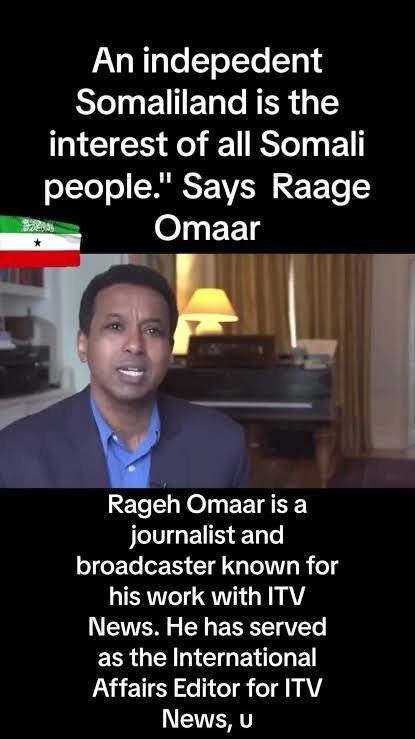
And few individuals have articulated Somaliland’s extraordinary journey more powerfully than Rageh Omaar.
Across two major public interventions — his 2014 address at the UK Somaliland Trade and Investment Forum and his sweeping May 18, 2026 interview on The Brink podcast — Omaar did something far more significant than narrate Somaliland’s story.
He reframed it.
Not as a forgotten African anomaly.
Not as a humanitarian footnote.
Not as a romantic separatist aspiration.
But as a geopolitical reality the world can no longer afford to ignore.
From Ruins to Rebirth
Omaar’s power as a narrator comes from the fact that he speaks simultaneously as:
- witness,
- journalist,
- exile,
- returnee,
- and historian of memory.
Recalling his first return to Hargeisa after the civil war, he described a city flattened almost beyond recognition:
buildings shredded by artillery,
landmines everywhere,
entire neighborhoods reduced to rubble.
He compared it to Dresden and Grozny.
Yet from those ruins emerged one of the most remarkable political reconstruction stories in modern Africa.
“There was a drive and determination and a sense of pride amongst the people to make a real success.”
That sentence captures the essence of Somaliland.
While the world focused almost exclusively on Mogadishu’s collapse, Somaliland quietly rebuilt:
- government institutions,
- police,
- courts,
- telecommunications,
- businesses,
- universities,
- ports,
- and democratic processes.
It did so largely without the massive international state-building machinery poured into Somalia.
And therein lies the uncomfortable truth increasingly confronting Western policymakers:
the functioning political entity in the Horn of Africa was not the one receiving most of the recognition.
“We Exist”
This is the key Western observers often fail to understand.
Recognition for Somaliland is not merely diplomatic symbolism.
It is existential affirmation after:
- dictatorship,
- mass violence,
- aerial bombardment,
- displacement,
- and decades of political invisibility.
The Somaliland question is rooted in historical fact:
the former British Somaliland protectorate became an independent state on June 26, 1960 before voluntarily uniting days later with the former Italian Somalia.
The union failed catastrophically.
The resulting civil war and atrocities permanently altered Somaliland’s political consciousness.
When Somaliland restored its sovereignty on May 18, 1991, it did so not merely as a political maneuver but as a national survival project.
That project succeeded.
The world simply refused to acknowledge it.
Israel Changes Everything
Then came December 2025.
When Israel formally recognized Somaliland, the geopolitical equation changed overnight.
Omaar described the moment perfectly:
“It blew open the doors for international attention.”
And even more importantly:
“It shut Somaliland out of diplomatic deep freeze.”
This was not just another diplomatic gesture.
It was a strategic rupture.
Israel’s recognition instantly transformed Somaliland from:
- an overlooked African territorial dispute
into:
- a Red Sea strategic actor.
Suddenly Somaliland became central to conversations about:
- Maritime Security,
- Gulf geopolitics,
- Iran,
- Israel,
- Turkey,
- China,
- Taiwan,
- and great-power competition.
That transformation matters enormously.
Because states are rarely recognized solely through moral arguments.
They are recognized when morality intersects with strategic interest.
And Somaliland now sits at one of the most strategic crossroads on earth.
The Red Sea Is the New Global Fault Line
The Bab al-Mandab Strait has become one of the defining geopolitical chokepoints of the 21st century.
A significant percentage of global trade passes through nearby waters linking:
- Europe,
- the Middle East,
- Asia,
- and Africa.
Who controls access, logistics, ports, and partnerships in this region increasingly matters to:
- Washington,
- London,
- Beijing,
- Ankara,
- Abu Dhabi,
- and Jerusalem.
This is why Omaar’s observation that “there is a new scramble for Africa” is so important.
The competition is no longer merely colonial.
It is geostrategic.
China has entrenched itself in Djibouti.
Turkey has built major military and economic influence in Somalia.
The Gulf states compete for maritime access.
Taiwan has deepened ties with Somaliland.
Israel has now recognized it.
And Somaliland — once ignored — suddenly finds itself at the center of converging global rivalries.
Not because the world suddenly discovered Somaliland’s democratic virtues.
But because geography eventually forces realism.
Britain’s Strategic Contradiction
No country now faces a greater strategic contradiction than the United Kingdom.
Britain knows Somaliland better than most of the world.
It governed British Somaliland.
It hosts one of the largest Somaliland diaspora communities.
It remains the UN Security Council “penholder” on Somalia.
Yet British policy still officially adheres to the “One Somalia” framework established during the 2012 London Conference on Somalia.
Omaar’s critique was devastatingly precise:
“That 2012 position… doesn’t meet reality.”
And he is correct.
For years, Britain and its allies invested heavily in rebuilding Somalia as a unified state despite:
- chronic fragility,
- corruption,
- insurgency,
- external dependency,
- and limited territorial control.
Meanwhile Somaliland steadily consolidated internal governance and democratic continuity.
Western policy increasingly resembles what Omaar accurately called a “sunken cost fallacy” — the refusal to reassess assumptions because too much political and financial capital has already been invested.
But geopolitics is changing faster than diplomatic orthodoxy.
Somaliland Is Not Somalia
One of the most intellectually serious aspects of Omaar’s analysis is his rejection of simplistic narratives.
He repeatedly emphasized that the Somaliland-Somalia dispute is not fundamentally a conflict between ordinary people.
There is:
- intermarriage,
- trade,
- migration,
- shared culture,
- shared religion,
- and shared language.
This is not Northern Ireland.
Not Sunni versus Shia.
Not Israel versus Palestine.
The issue is political sovereignty and state legitimacy.
That distinction matters profoundly because it separates Somaliland’s case from many destructive ethno-national conflicts elsewhere.
The tragedy is not that Somaliland and Somalia hate each other.
The tragedy is that international diplomacy continues forcing two radically different political realities into a framework that no longer reflects conditions on the ground.
The World Is Finally Catching Up
For decades Somaliland survived in international limbo:
too stable to fit the world’s stereotype of the Horn of Africa,
yet too politically inconvenient to recognize.
That contradiction is collapsing.
The old conversation about Somaliland centered on:
- post-conflict recovery,
- humanitarianism,
- and legal technicalities.
The new conversation centers on:
- Red Sea security,
- maritime trade,
- strategic ports,
- global chokepoints,
- regional alliances,
- and great-power competition.
Somaliland has moved from the margins of geopolitics to the center of it.
And in many ways, Rageh Omaar has become the clearest voice explaining why.
Not as a propagandist.
Not as a politician.
But as a witness to destruction, survival, and emergence.
His words capture the deeper truth Western governments increasingly struggle to avoid:
Somaliland is no longer asking permission to exist.
It already does.
About the Author