By reclaiming its sovereignty in 1991, Somaliland reverted to its original borders (of British Somaliland) adhering to the very principle of territorial integrity the AU claims to uphold.
By Prof. Nassir Hussein Kahin
When the Organization Of African Union (OAU), now African Union (AU) was created in 1963, it charter declared that the organization was committed to keeping all colonial borders sacrosanct, or intact as they were left by the former colonial borders.Since the several politically motivated steps where taken by OAU with the emergence of Eritrea, Senegal and Gambia and later South Sudan that mostly don’t even match at par, Somaliland’s strong grounds for its case with AU playing “political games” and ignoring historical, legal and contemporary realities on the ground!
The African Union (AU) Charter is often cited as a barrier to recognizing Somaliland’s independence, with its emphasis on territorial integrity as a guiding principle. Yet, Somaliland’s historical, political, and legal realities expose contradictions within this principle when applied to its unique case. Compounding this inconsistency is the AU’s failure to act on its own fact-finding mission’s 2005 recommendations, which concluded that Somaliland meets the criteria for international recognition.
Somaliland’s situation cannot be classified as secession because it was a sovereign entity before its voluntary union with Somalia in 1960. Gaining independence from Britain on June 26, 1960, Somaliland was internationally recognized as a separate state with defined borders. Its decision to merge with Somalia on July 1, 1960, was a political arrangement, not the result of colonial boundary adjustments. This union was never formalized through a binding treaty and dissolved in 1991 after decades of marginalization and oppression. By reclaiming its sovereignty, Somaliland reverted to its original borders, adhering to the very principle of territorial integrity the AU claims to uphold.
The AU’s stance becomes even more contradictory when considering its own fact-finding mission to Somaliland in 2005.
The mission concluded that Somaliland satisfied the legal and political requirements for statehood, recommending recognition. However, nearly two decades later, the AU has taken no steps to act on these findings, undermining its credibility as a proponent of African self-determination and stability.
Somalia’s claims over Somaliland’s Red Sea coastline further distort the historical reality. These claims rest on a narrative that Somaliland is a secessionist region of Somalia, an assertion that disregards Somaliland’s separate colonial history and its recognized independence prior to the union. Somalia’s insistence on this point is part of a broader effort to create a false narrative of Somali unity and sovereignty—concepts rendered obsolete by decades of fragmentation and conflict.
Since the collapse of its central government in 1991, Somalia has been under United Nations trusteeship, surviving on international aid and the support of African Union forces. Confined largely to Mogadishu and its immediate vicinity, Somalia’s sovereignty is, at best, symbolic. Its accusations of foreign interference, particularly against Ethiopia, contrast sharply with its reliance on Ethiopian troops and other African forces to maintain order.
At the same time, Somalia has entered into defense agreements with nations like Egypt, Eritrea, and Turkiya, which are more interested in curbing Ethiopia’s regional influence than promoting stability. These actions have destabilized the region, creating tensions that threaten to engulf the Horn of Africa in further conflict.
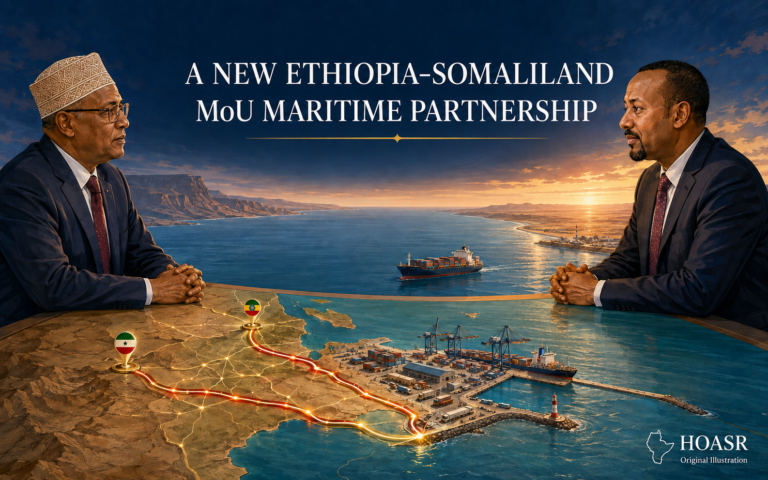
In stark contrast, Somaliland has built a functioning state with all the hallmarks of sovereignty: its own flag, police, army, currency, and passport. It engages diplomatically, hosting offices from countries like Ethiopia and signing international commercial and military agreements, including partnerships with the UAE and a recent Memorandum of Understanding with Ethiopia.
Unlike Somalia, Somaliland has demonstrated its ability to govern, maintain peace, and foster democratic principles. Somaliland’s political maturity is evident in its democratic elections, which have been lauded by international observers for their fairness and transparency. Opposition victories in both presidential and parliamentary elections have led to peaceful transfers of power, a rarity in a region where despots often cling to power. These achievements align Somaliland more closely with established democracies than many recognized states in Africa.
The African Union’s contradictions in handling Somaliland’s case go beyond ignoring its fact-finding mission. Precedents such as Eritrea’s independence from Ethiopia in 1993 and South Sudan’s secession from Sudan in 2011 show that the AU has supported the redefinition of borders when justified by historical and political realities. Somaliland’s case, grounded in legal precedent, historical legitimacy, and its proven capacity for governance, is equally compelling.
As in the case of Senegambia, officially the Senegambia Confederation or Confederation of Senegambia, was a loose confederation in the late 20th century between the West African countries of Senegal and its neighbor The Gambia, which is almost completely surrounded by Senegal. The confederation was founded on 1 February 1982 following an agreement between the two countries signed on 12 December 1981. It was intended to promote cooperation between the two countries, but was dissolved by Senegal on 30 September 1989 after The Gambia refused to move closer toward union.In Somaliland-Somalia the so-called union was never ratified.
Somaliland’s achievements, from maintaining peace and stability to contributing to regional security efforts, make it a model for governance in the Horn of Africa. Its recognition would align with the AU’s principles of promoting peace, human rights, and self-determination. Conversely, Somalia’s fixation on a false narrative of Somali unity serves only to distract from its inability to govern or address its internal challenges.
The time has come for the AU and the international community to rectify these contradictions, honor Somaliland’s accomplishments, and grant it the recognition it rightfully deserves. Doing so would not only reinforce the principles of justice and self-determination but also promote stability and progress in a volatile region. for more insight click on this link:The Cruz Doctrine: Why Recognizing Somaliland Has Become an American Strategic Imperativeeria for recognition.
Prof. Nassir Hussein Kahin is a researcher, educator, journalist, and geopolitical analyst specializing in the Horn of Africa, the Red Sea, international law, diplomacy, and strategic affairs. To read Full Bio click on this link: ABOUT THE AUTHORProf. Nassir Hussein Kahin