
Skip to content
HOASR

Horn of Africa Strategic Review (HOASR)

Geopolitics| Strategy| Analysis| Insights

Primary Menu
  • Home
  • Israel Somaliland Relations
  • Energy & Strategic Minerals
  • Somaliland Recognition
  • Global Power Geopolitics
  • Politics & Government
  • Security and Military Affairs
  • Editorial Analysis
  • Horn of Africa & Red Sea Security
  • Media Hub
  • Opinion & Analysis
Home
  • Home
  • Somaliland Recognition
  • Why the United States Should Recognize Somaliland Now
  • Somaliland Recognition

Why the United States Should Recognize Somaliland Now

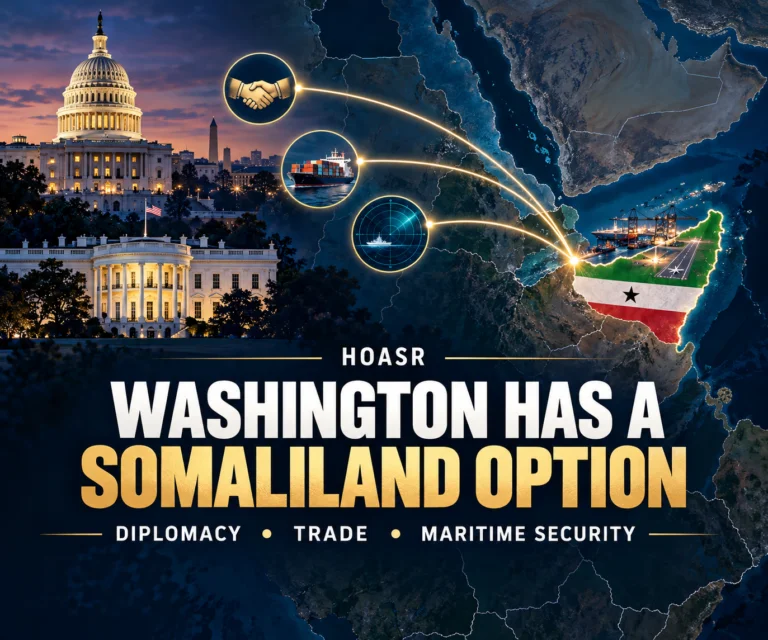
The case for Somaliland is not solely moral or historical—it is strategic. As global power competition intensifies and the Horn of Africa becomes increasingly central to international security and commerce, the United States must reassess long-standing assumptions.
hornofafricastrategicreview.com April 14, 2026
Prof. Nassir Hussein Kahin, Executive Managing Editor.

Prof. Nassir Hussein Kahin, Executive Managing Editor.

Written by hornofafricastrategicreview.com

By Nassir Kahin

For more than three decades, Somaliland has existed in a state of political paradox: a functioning Democracy without international recognition. While the global order often emphasizes stability, governance, and democratic development, Somaliland’s case reveals a persistent gap between principle and practice.

Since reclaiming its independence in 1991 following the collapse of Somalia’s central government, Somaliland has built institutions that, while imperfect, have demonstrated resilience in one of the world’s most challenging regions. It has held elections, maintained relative peace, and developed a coherent administrative system. In contrast, Somalia has struggled with prolonged instability, insurgency, and fragmented governance.

The United States now faces a shifting strategic landscape that makes Somaliland’s status increasingly relevant. The Red Sea corridor—vital for global trade and energy flows—has become a zone of heightened tension. Disruptions to maritime routes, particularly from non-state actors, have underscored the need for reliable regional partners.

Somaliland offers precisely that: a stable, cooperative entity located at a strategic crossroads. Its proximity to the Bab al-Mandeb Strait places it within immediate reach of one of the world’s most critical shipping lanes. In an era where supply chain security is directly tied to national security, geography matters—and Somaliland’s geography is exceptional.

Beyond location, Somaliland aligns with broader U.S. strategic interests. It has demonstrated openness to partnerships, including with democratic actors, and has shown willingness to engage in economic and security cooperation. At a time when global competition is intensifying, particularly with China expanding its influence in Africa, the United States cannot afford to overlook potential partners that offer both stability and alignment.

Recognition would not be without challenges. It would require navigating complex diplomatic dynamics, including relations with Somalia and the African Union. However, the status quo also carries costs. Continued non-recognition limits engagement, constrains investment, and leaves a strategically valuable region underutilized.

Importantly, recognition need not be viewed as a destabilizing act. Rather, it can be framed as an acknowledgment of on-the-ground realities and a step toward a more pragmatic and effective regional policy. The international system has, in the past, adapted to similar situations when political realities demanded it.

The case for Somaliland is not solely moral or historical—it is strategic. As Global Power Competition intensifies and the Horn of Africa becomes increasingly central to international security and commerce, the United States must reassess long-standing assumptions.

Recognizing Somaliland would signal a shift toward a more realistic and forward-looking policy—one that aligns values with interests and acknowledges stability where it exists.

Prof. Nassir Hussein Kahin
hornofafricastrategicreview.com
Publisher & Managing Editor at Horn of Africa Strategic Review | Web

Prof. Nassir Hussein Kahin is a researcher, educator, journalist, and geopolitical analyst specializing in the Horn of Africa, the Red Sea, international law, diplomacy, and strategic affairs. To read Full Bio click on this link: ABOUT THE AUTHORProf. Nassir Hussein Kahin

  • hornofafricastrategicreview.com
    From Cyprus to Berbera: Israel and Türkiye’s Expanding Contest for the Eastern Mediterranean and Red Sea
  • hornofafricastrategicreview.com
    Horn & Red Sea Weekly Review: Uganda’s Exit, Turkey at Sea and Cairo’s Sool Card
  • hornofafricastrategicreview.com
    The Pact, the Panic and the Counter-Pact: Why the Makkah agreement is already changing calculations before it has proved that it can change a battlefield  
  • hornofafricastrategicreview.com
    The Recognition Front: Amichai Chikli’s Makkah Pact Warning Places Somaliland at the Centre of Israel’s Emerging Counter-Alignment
Tweet
Share
Pin
Share

Post navigation

Previous: Bab al-Mandeb, Berbera, and the New Strategic Map of the Horn of Africa
Next: Ethiopia, Access to the Sea, and the Strategic Calculus of Somaliland

Media Hub

Israeli Minister Amichai Chikli’s response to the Makkah Joint Defence Agreement explicitly named Somaliland among the partnerships Israel should deepen.
  • Israel Somaliland Relations
  • Somaliland Recognition

The Recognition Front: Amichai Chikli’s Makkah Pact Warning Places Somaliland at the Centre of Israel’s Emerging Counter-Alignment

hornofafricastrategicreview.com August 11, 2026
Flags of Armenia and Somaliland overlooking the Red Sea, symbolizing shared resilience, diplomacy and strategic partnership.
  • Opinion & Analysis
  • Somaliland Recognition

Armenia Should Recognize Somaliland

Micheal Rubin August 2, 2026 1
Somaliland's Quest for Recognition
  • Opinion & Analysis
  • Somaliland Recognition

Somaliland’s Unrecognized Triumph: A Blueprint for Peace in a Volatile Region

David Nyang July 27, 2026

Israel Somaliland Relations

Israeli Minister Amichai Chikli’s response to the Makkah Joint Defence Agreement explicitly named Somaliland among the partnerships Israel should deepen.
  • Israel Somaliland Relations
  • Somaliland Recognition

The Recognition Front: Amichai Chikli’s Makkah Pact Warning Places Somaliland at the Centre of Israel’s Emerging Counter-Alignment

hornofafricastrategicreview.com August 11, 2026
Geopolitical illustration of Israel strengthening relations with Somaliland to secure the Red Sea and counter Houthi threats
  • Israel Somaliland Relations

Why Israel Chose Somaliland as Its Strategic Partner in the Horn of Africa and the Red Sea

hornofafricastrategicreview.com August 6, 2026 1
Why-Israel-Chose-Somaliland
  • Israel Somaliland Relations

The Return of the Periphery? Israel, Somaliland and the Horn of Africa after October 7

Dr. Asher Lubotzky August 6, 2026 1
Somaliland Leads
  • Editorial Analysis
  • Israel Somaliland Relations

Beyond Recognition: Can the Israel–Somaliland Partnership Help Build a New Indo-Abrahamic Maritime Order?

hornofafricastrategicreview.com August 3, 2026
HOASR Media Hub
  • Israel Somaliland Relations
  • Media Hub

Inside the new Muslim state that proudly supports Israel: The brink in Somaliland with Rageh Omaar

hornofafricastrategicreview.com July 5, 2026
  • Home
  • Horn of Africa Strategic Review
  • About
  • Ownership & Team
  • Editorial Policy
  • Terms of Service
  • Contact Us
  • ABOUT THE AUTHOR
Copyright 2025 Horn of Africa Strategic Review Media Company All Rights Reserved. | MoreNews by AF themes.