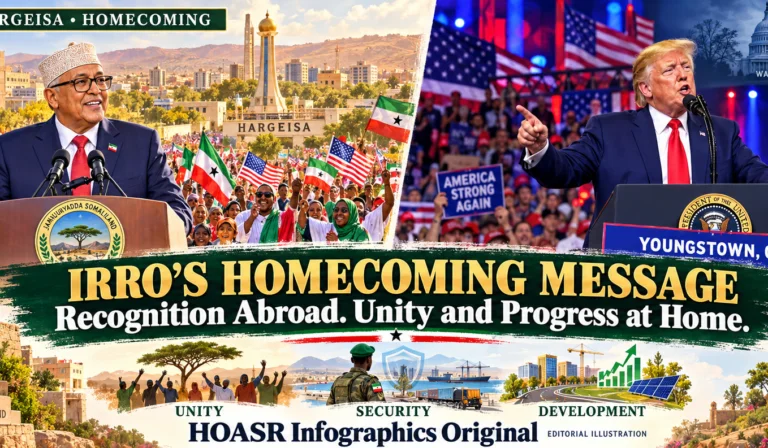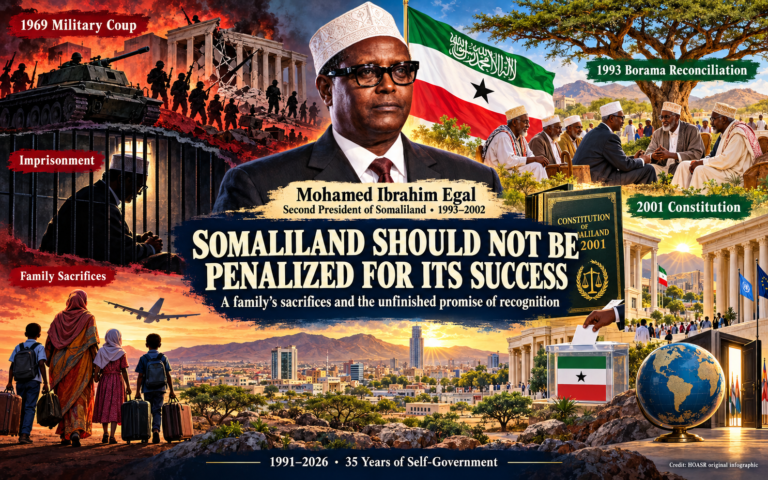

The recent intensification of U.S.-Somaliland relations, highlighted by military agreements, high-level meetings, and the tabling of a bill in the U.S. Congress by Republican Congressman, Perry Scott, advocating for Somaliland’s official recognition, underscores a paradigm shift in global geopolitics. This development is intricately linked to the U.S.’s strategic interests in countering China’s growing influence in the Red Sea and the broader Horn of Africa region, addressing it’s limitations on current military footprint in Djibouti as well as Ethiopia’s relentless search for an alternative access to the Red Sea.
Djibouti, long considered the linchpin of U.S. military strategy in the Horn of Africa, is increasingly becoming a geopolitical liability. With over dozen foreign military bases in the tiny nation, including China’s sprawling facility, the overcrowding has raised concerns about security and operational efficiency. China’s influence in Djibouti has further alarmed U.S. Republican Project 2025 policymakers with close ties to Trump, particularly given the Belt and Road Initiative’s infrastructure projects that tether Djibouti and other vulnerable African nations to Beijing’s greed and ambitions.
In this context, Somaliland emerges as an attractive alternative. Historically, the U.S. maintained a naval base in Berbera during the Cold War, underscoring its strategic significance at the Bab Al-Mandab chokepoint—a vital artery for global trade connecting the Red Sea to the Gulf of Aden. Reviving this presence in Somaliland would offer the U.S. a fresh and less contested base of operations, ensuring secure maritime routes while countering China’s expanding footprint in the region.
Congressman Scott Perry’s recent bill, supported by a Republican majority, seeks to fast-track Somaliland’s recognition, likely positioning it as a cornerstone of U.S. strategy in the region. The potential establishment of a U.S. naval and military base in Somaliland would not only bolster American presence at a critical chokepoint but also reaffirm its commitment to containing rival powers in the Red Sea and the Horn of Africa.
Meanwhile, The recent Ankara Agreement, signed between Ethiopia and Somalia under the facilitation of Türkiye, was designed to sideline Somaliland by granting Ethiopia access to Somali ports on the Indian Ocean (Ethiopia was never interested in accessing the Indian Ocean) while ignoring the MoU between Somaliland and Ethiopia signed on January 1st of last year. This agreement highlights an effort by Somalia to reassert its “claim over Somaliland’s territory”, despite 34 years from 1991 of Somaliland operating as a independent state, following full reclamation of it’s 1960 dejure status.
However, Somaliland’s newly elected president, Dr. Abdirahman Mohamed Abdullahi “Ciro,” has reiterated his commitment to revisiting technical details of the MoU signed by former president Muse Bihi with Ethiopia’s Prime Minister Abby Ahmed. There is a fresh renewed interest on both countries to revive the MoU Agreement with major readjustments for a final approval with a scheduled meeting between the two leaders in Addis Ababa next week. President Ciro has emphasized that the Ankara Agreement is not binding on Somaliland- it was not consulted, did not participate in the discussions, and remains steadfast in its assertion of sovereignty. Somaliland’s determination to maintain the MoU reflects its refusal to be sidelined by Somalia, Eritrea, Egypt, Djibouti, China and Turkiya, and its growing confidence in asserting its position as an independent, self-reliant sovereign country.
Somaliland’s case for recognition which is above and beyond debate, is also strengthened by the failures and contradictions of the African Union (AU). While the AU Charter emphasizes respect for the territorial integrity of member states, this principle does not apply to Somaliland. Unlike other secessionist movements, Somaliland’s claim to independence is rooted in its history as a separate British protectorate and recognized by many countries following its independence for just four days before voluntarily uniting, (a “Bogus Union” that was never legally ratified in parliament) with Italian Somaliland to form the Somali Republic in 1960. Following decades of marginalization and the collapse of Somalia in 1991, Somaliland reasserted its independence, reclaiming its sovereignty.
The AU’s 2005 fact-finding mission to Somaliland concluded that its case for recognition was unique and deserved special consideration. However, the AU has since failed to act on these findings, instead perpetuating a contradictory stance that undermines Somaliland’s legitimate aspirations while upholding Somalia’s claims, which lack practical or legal grounds.
Despite ongoing efforts to sideline Somaliland, the intensifying interest from global and regional powers proves Somaliland’s rising strategic significance in geopolitics. This attention offers Somaliland unprecedented leverage: It must negotiates from a position of strength to secure maximum long term tangible future economic development, prosperity and sociopolitical stability for its people and nation including the following critical pre-conditions and terms for official recognition:
1. Guaranteed Sovereignty: Recognition should come with unambiguous guarantees of sovereignty and territorial integrity. Somaliland’s position as a stable, independent and democratic state should be the foundation of any agreement.
2. Economic Development: Foreign investments in infrastructure, particularly in Berbera Port and other strategic assets, must prioritize local benefits and long-term sustainability over short-term gains.
3. Security Commitments: Any military base agreements must include comprehensive security guarantees for Somaliland, ensuring protection against regional hostilities or retaliation and finally
4. Strategic Autonomy: Somaliland must ensure that its partnerships do not compromise its ability to engage independently with other nations or regional bodies.
The heightened interest in Somaliland is a testament to its growing strategic significance in global geopolitics. However, this attention comes with risks. As the U.S. and other powers vie for control of Somaliland’s strategic assets, the government in Hargeisa must remain vigilant and cautious ensuring that dejure recognition is not achieved at the expense of sovereignty, territorial integrity or long-term national interests.
Somaliland’s leadership should recognize this moment as an opportunity to rewrite its narrative, not just as a self-declared republic seeking recognition in exchange for its sovereignty and territorial integrity, but as a strategic player capable of shaping regional and global dynamics. By negotiating from a position of strength and securing agreements that prioritize the well-being of its people, Somaliland can ensure that its ascent to Nationhood once again is both historic and transformative for posterity.

Prof. Nassir Hussein Kahin is a researcher, educator, journalist, and geopolitical analyst specializing in the Horn of Africa, the Red Sea, international law, diplomacy, and strategic affairs. To read Full Bio click on this link: ABOUT THE AUTHORProf. Nassir Hussein Kahin