Somaliland Coast Guard: Redefining Security in the Bab al-Mandab
By Prof. Nassir Hussein Kahin
For more than three decades, Somaliland’s international campaign has been anchored in a simple but compelling argument: it satisfies the legal, political, and democratic qualifications of statehood and therefore deserves international recognition. While that case remains central, a profound shift is now underway. Somaliland is increasingly demonstrating that recognition is no longer merely about historical justice or legal legitimacy—it is about strategic responsibility.
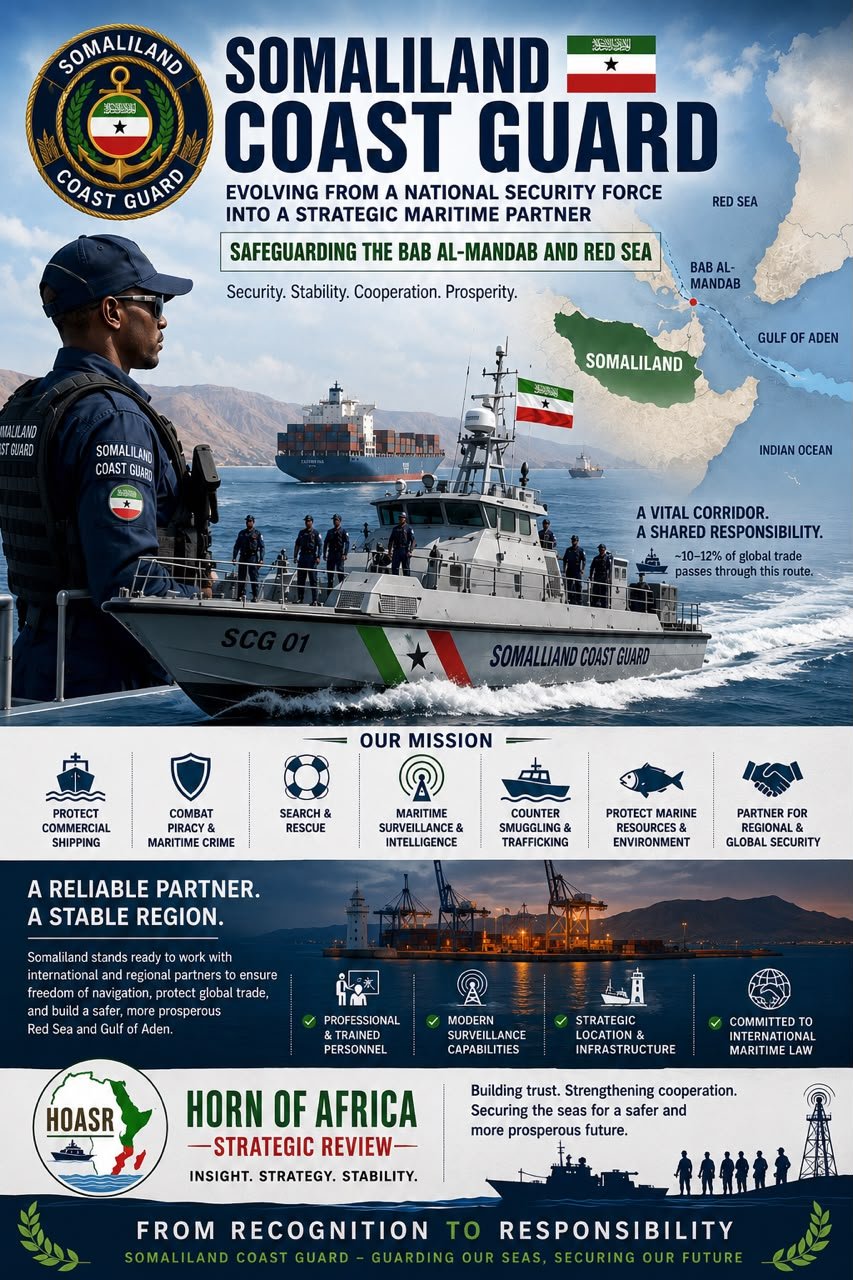
Nowhere is this transformation more evident than in the growing role of the Somaliland Coast Guard. As instability continues to threaten one of the world’s most important maritime corridors, Somaliland is positioning itself not simply as a claimant to sovereignty, but as a provider of regional and global security. In doing so, it is redefining its place in the geopolitical architecture of the Red Sea and the Bab al-Mandab Strait.
The question facing the international community is therefore changing. It is no longer simply whether Somaliland deserves recognition. Increasingly, it is whether the world can afford to overlook a stable and reliable security partner located at one of the most strategically significant maritime crossroads on earth.
The Strategic Importance of the Bab al-Mandab
The Bab al-Mandab Strait is among the world’s most critical maritime chokepoints. Connecting the Gulf of Aden with the Red Sea and ultimately the Suez Canal, it serves as the gateway between Europe, Asia, and East Africa. Approximately one-tenth of global maritime commerce—including energy supplies, manufactured goods, food shipments, and military logistics—passes through these narrow waters each year.
Recent attacks on commercial shipping by Yemen’s Houthi movement have demonstrated how vulnerable global trade remains. Shipping companies have been forced to reroute vessels around the Cape of Good Hope, increasing costs, extending delivery times, disrupting supply chains, and contributing to higher global inflation. The security of the Bab al-Mandab is therefore no longer solely a regional concern; it has become an issue of international economic stability.
For Somaliland, geography has become one of its greatest strategic assets. With more than 740 kilometers of coastline along the Gulf of Aden and the deep-water Port of Berbera located only a short distance from the Bab al-Mandab, Somaliland occupies a position that few countries can match.
Geography Is Not Enough
Geography alone does not create strategic influence. History is filled with nations blessed by geography but weakened by poor governance, instability, or conflict.
Somaliland has sought a different path.
Despite lacking international recognition, it has maintained relative political stability, conducted multiple democratic elections, built functioning state institutions, secured its territory, and developed cooperative relationships with international partners. These achievements distinguish Somaliland from much of the surrounding region and enhance its credibility as a security Partner.
The emergence of the Somaliland Coast Guard reflects this evolution. Its mission increasingly extends beyond traditional coastal policing to encompass broader responsibilities that directly support international maritime security.
These responsibilities include:
* Combating piracy and maritime crime.
* Protecting commercial shipping lanes.
* Conducting search and rescue operations.
* Countering smuggling and trafficking networks.
* Monitoring illegal fishing and protecting marine resources.
* Sharing maritime intelligence with international partners.
* Supporting disaster response and humanitarian operations.
Each of these functions contributes to the collective security of the Red Sea and the Gulf of Aden.
Security as Diplomacy
International politics increasingly rewards states that solve problems rather than merely identify them.
Somaliland appears to recognize this reality.
Instead of relying exclusively on legal arguments based upon the failed 1960 union with Somalia or the restoration of its sovereignty in 1991, Somaliland is beginning to demonstrate tangible contributions to regional stability.
This represents an evolution from recognition through history toward recognition through responsibility.
States that contribute to maritime security, intelligence cooperation, counterterrorism, and regional stability naturally become more valuable diplomatic partners.
The international community has historically recognized strategic necessity as a catalyst for diplomatic change. Countries that become indispensable to regional security often find themselves enjoying deeper political engagement, expanded defense cooperation, and increased economic partnerships.
Berbera: More Than a Commercial Port
The Port of Berbera is often discussed in terms of trade and logistics, yet its strategic significance extends well beyond commerce.
Its modern infrastructure, expanding container facilities, international airport, and proximity to major shipping routes make Berbera a potential hub for maritime coordination, humanitarian logistics, naval support, and disaster response.
As commercial investment grows, protecting the port and surrounding sea lanes becomes increasingly important. A capable and professional Coast Guard therefore represents not merely a security institution but an economic necessity.
Investor confidence depends heavily upon predictable security conditions.
Ports flourish when shipping companies trust that cargo, crews, and maritime infrastructure will remain secure.
A New Security Architecture in the Red Sea
The strategic landscape surrounding the Red Sea is undergoing rapid transformation.
Major international and regional powers—including the United States, the United Kingdom, France, Turkey, the United Arab Emirates, Saudi Arabia, Egypt, China, and Israel—have expanded their military, diplomatic, or economic presence throughout the region. The Horn of Africa has become one of the principal theaters of twenty-first-century geopolitical competition.
In this increasingly complex environment, Somaliland occupies an important geographic position between East Africa and the Arabian Peninsula.
Rather than becoming an arena for proxy competition, Somaliland has an opportunity to establish itself as a dependable partner committed to preserving freedom of navigation, protecting international trade, and supporting regional stability through cooperation with multiple responsible stakeholders.
Its Coast Guard can become one of the principal institutions through which that strategy is implemented.
Recognition Through Contribution
Recognition has traditionally been viewed as a diplomatic objective.
Perhaps it should also be understood as the logical consequence of sustained international contribution.
Governments are more likely to deepen engagement with jurisdictions that consistently demonstrate competence, reliability, and shared strategic interests.
By safeguarding international shipping lanes, participating in maritime security initiatives, combating transnational crime, and contributing to regional stability, Somaliland strengthens not only its security credentials but also its diplomatic case.
This is not recognition based upon sympathy.
It is recognition grounded in strategic relevance.
Responsibilities Accompany Opportunity
Greater strategic importance also carries greater responsibility.
As Somaliland expands its maritime role, it must continue investing in professionalism, transparency, civilian oversight, adherence to international maritime law, environmental protection, and respect for human rights.
A modern Coast Guard is measured not only by operational capability but also by institutional integrity.
Somaliland must likewise ensure that maritime partnerships remain balanced, defensive, and consistent with its broader objective of contributing to regional peace rather than becoming entangled in great-power rivalry.
Conclusion
The evolution of Somaliland’s international image reflects a broader truth about contemporary geopolitics. In today’s world, legitimacy is strengthened not only by history or legal arguments but also by practical contributions to international security.
The Somaliland Coast Guard symbolizes this transformation. It represents a shift from seeking recognition based solely on past injustice to earning international respect through present-day responsibility.
The Bab al-Mandab has become one of the defining strategic frontiers of the twenty-first century. Nations that help secure it will increasingly shape the future security architecture of the Red Sea.
For Somaliland, this is an opportunity to demonstrate that it is not merely requesting a seat at the international table—it is already helping to protect the table itself.
For more insight click on this link: Somaliland, Israel, and the New Red Sea Alliance: Recognition, Risk, and Geopolitical Reality

Prof. Nassir Hussein Kahin is a researcher, educator, journalist, and geopolitical analyst specializing in the Horn of Africa, the Red Sea, international law, diplomacy, and strategic affairs. To read Full Bio click on this link: ABOUT THE AUTHORProf. Nassir Hussein Kahin