By Prof. Nassir Hussein Kahin.
For more than three decades, the international community has lived with a quiet paradox in the Horn of Africa. A territory that operates with the essential attributes of a sovereign state—democratic institutions, a stable political system, defined borders, and a functioning government—remains outside the formal system of international recognition.
That territory is Somaliland.
Since reclaiming its independence from Somalia in 1991, Somaliland has achieved something remarkable under extraordinarily difficult circumstances. While Somalia endured decades of civil war, extremist violence, and repeated attempts at fragile state reconstruction, Somaliland quietly built its own political order. Through locally driven reconciliation conferences and a constitution shaped by public consultation, it created institutions that have delivered stability in a region often associated with instability.
Yet despite these achievements, Somaliland continues to exist in diplomatic limbo. The refusal to recognize it is no longer merely an oversight of international diplomacy; it has become an increasingly untenable contradiction.
Somaliland stands today as one of the rare success stories in a fragile region. In a part of the world where political transitions frequently occur through violence, Somaliland has demonstrated a different path. Multiple competitive elections, peaceful transfers of power, and a functioning parliamentary system have become the norm rather than the exception. These accomplishments were not the product of foreign military intervention or externally imposed political models. Instead, they emerged from traditional reconciliation processes, local leadership, and a political culture that values negotiation and consensus over confrontation.
For policymakers searching for examples of effective governance in fragile regions, Somaliland offers an obvious lesson: stability can grow from local legitimacy and inclusive political dialogue.
From the standpoint of international law, Somaliland’s case is equally compelling. The principles outlined in the Montevideo Convention that defines a sovereign state through four key criteria: a permanent population, a defined territory, an effective government, and the capacity to conduct foreign relations. Somaliland satisfies each of these conditions.
Its borders correspond to those of the former British Somaliland Protectorate which gained independence in June 1960 before entering a voluntary union with Somalia. It has a permanent population governed by established political institutions, and it maintains diplomatic and economic engagement with numerous international partners. For more than thirty years, it has maintained internal peace and administrative control over its territory.
Recognition, however, is not only a legal matter—it is also a strategic one.
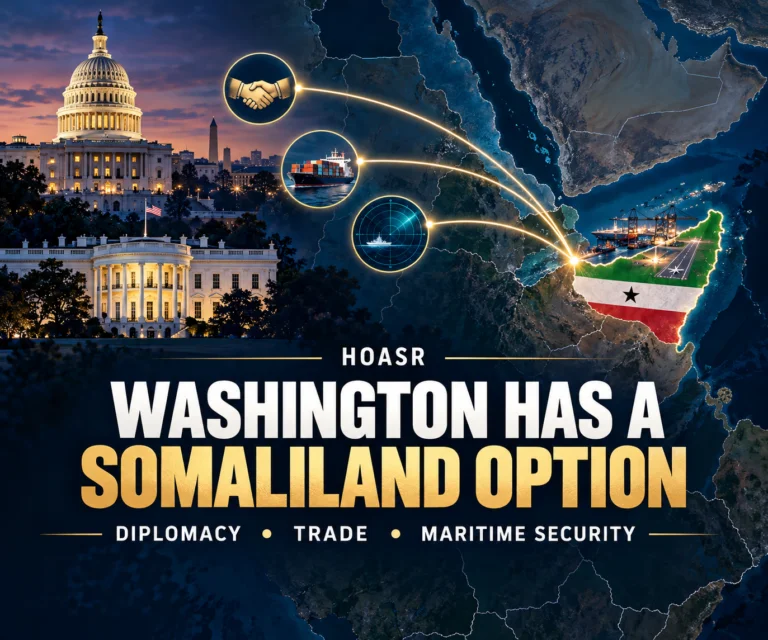
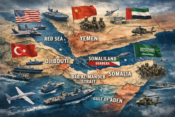
Somaliland occupies a crucial location along the Gulf of Aden near the Bab El Mandeb Straits, one of the most important Suez Canal to maritime corridors on the planet. This narrow passage connects the the Indian Ocean and carries a substantial portion of global trade and energy shipments between Europe, Asia, and the Middle East.
Stability along this coastline is therefore not only a regional concern but a global one.
The expansion of Berbera Port developed with investment from DP World has already begun transforming Somaliland into a strategic logistics hub connecting Africa to international shipping networks. As maritime insecurity and geopolitical competition intensify in the Red Sea region, Somaliland’s reliability and stability make it an increasingly valuable partner.
Indeed, in an era when attacks on shipping lanes and regional conflicts threaten global supply chains, Somaliland offers something rare: predictability. Unlike many fragile states, it has demonstrated an ability to maintain security within its territory and cooperate with international partners in safeguarding maritime trade routes.
The continued refusal to recognize Somaliland carries real costs. Without formal recognition, Somaliland remains largely excluded from international financial institutions, development programs, and diplomatic forums. Aid and investment intended for the region are often routed through Somalia, despite the fact that Somaliland governs itself independently.
This arrangement undermines Somaliland’s economic development and sends an unfortunate signal to the world: that democratic governance and long-term stability do not necessarily translate into international legitimacy.
That message is deeply counterproductive. At a time when the international community seeks reliable partners in regions facing instability, Somaliland should be encouraged rather than ignored.
The geopolitical landscape is changing rapidly. As competition for resources, strategic ports, and secure trade routes intensifies, Somaliland’s importance is becoming increasingly difficult for the world to overlook. The decision by Israel to recognize Somaliland signaled that some states are beginning to reassess long-standing assumptions about the territory’s status.
Recognition does not need to happen all at once. In international practice, many countries have achieved recognition gradually as individual states established diplomatic relations. Somaliland’s path may follow a similar trajectory.
For more than three decades, Somaliland has demonstrated resilience, political maturity, and a commitment to peaceful governance. Few territories seeking recognition can point to such a sustained record of stability.
The international system can no longer afford to ignore this reality. Recognizing Somaliland would not only correct a long-standing diplomatic inconsistency; it would reward democratic success and strengthen stability in one of the world’s most strategically important regions.

Prof. Nassir Hussein Kahin is a researcher, educator, journalist, and geopolitical analyst specializing in the Horn of Africa, the Red Sea, international law, diplomacy, and strategic affairs. To read Full Bio click on this link: ABOUT THE AUTHORProf. Nassir Hussein Kahin